MaMeeFarm™ Insight Signal
Publication Date: 25 September 2026
Region: Asia
Primary Topic: Business
Related Topics: Economy · Supply Chain · Infrastructure
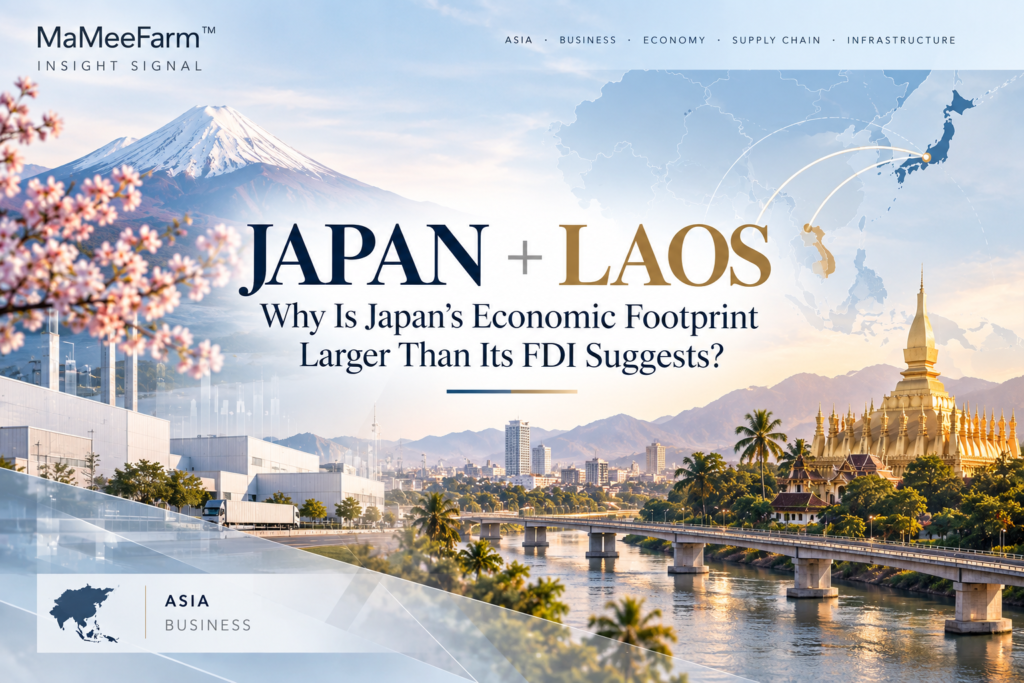
JAPAN + LAOS
Why Is Japan’s Economic Footprint Larger Than Its FDI Suggests?
Sometimes the most visible economic presence does not belong to the largest investor.
Japan in Laos offers an interesting signal.
At first glance, the investment numbers appear modest. According to Laos’ Investment Promotion and Management Committee, Japanese enterprises have invested in 91 projects totaling more than US$134 million since Laos opened to foreign investment. By this measure, Japan ranks 14th among foreign investors in the country.
Yet Japan’s economic presence in Laos is difficult to describe through that ranking alone.
What if FDI tells us how much investment entered, but not the full extent of an economy’s presence?
Investment is only one layer
FDI is useful. It tells us about investment commitments, ownership and capital entering productive activity.
But economies interact through more than direct investment.
Companies operate across borders. Technology moves. Workers are trained. Supply chains develop. Equipment enters markets. Business relationships accumulate. Development cooperation can also build infrastructure and capabilities.
Japan’s Ministry of Foreign Affairs reported in April 2026 that 145 Japanese companies were operating in Laos as of April 2025. The same official data also records decades of Japanese loans, grants and technical cooperation.
More recently, Japan and Laos have expanded cooperation under their Comprehensive Strategic Partnership. In May and June 2026, their governments discussed human resource development, energy and resources, and strengthening supply chain resilience.
These activities are not all FDI.
That distinction is precisely the signal.
From selling into a market to producing inside it
The commercial relationship is also showing signs of change.
In June 2026, Toyota Tsusho announced the establishment of Toyota Tsusho Manufacturing Laos. JETRO reported that the company plans an assembly plant in Vientiane’s VITA Park, with operations scheduled to begin in April 2028 and planned annual capacity of more than 5,000 vehicles.
JETRO also noted that this would be the first production of Toyota branded vehicles inside Laos, where imported completely built vehicles have traditionally dominated the market.
That represents a shift in economic activity:
Import → Local Production
Once production moves inside a country, the relevant questions become broader than the investment announcement itself.
What will be sourced locally? What skills will be developed? Which suppliers may participate? How much value will remain within the domestic economy?
The announcement does not yet answer those questions. But it makes them increasingly relevant.
Laos is also positioning itself differently
The relationship is not being shaped by Japan alone.
At the Lao Japan Business Forum in Tokyo on 11 June 2026, Lao officials presented investment opportunities to Japanese businesses and emphasized trade, regional integration and international connectivity, including the role of the Lao China Railway.
This matters because Laos’ economic proposition is not limited to the size of its domestic market.
Its geographic position and connections with neighboring economies can also become part of the business case.
FDI Flow ≠ Economic Footprint
A country can rank relatively low in an investment statistic while maintaining a broader presence through companies, technology, production, development cooperation, institutional relationships and supply chains.
Conversely, a large investment figure alone does not tell us how deeply an investment connects with the domestic economy.
So perhaps the larger question is not simply:
Who invested the most?
But:
What kind of economic presence did that investment help create?
Capital may be one part of the story.
The wider footprint is what gets built around it.
Sources
- Investment Promotion and Management Committee, Lao PDR: Lao Japan Business Forum, 11 June 2026.
- Ministry of Foreign Affairs of Japan: Japan Laos Relations, Basic Data, 17 April 2026.
- Ministry of Foreign Affairs of Japan: Japan Laos Foreign Ministers’ Meeting, 22 May 2026.
- Ministry of Foreign Affairs of Japan: Japan Laos Summit Meeting, 10 June 2026.
- JETRO: Toyota Tsusho to begin local Toyota brand vehicle production in Laos, 12 June 2026.
MaMeeFarm™ Insight Signal
Asia · Business · Economy · Supply Chain · Infrastructure
Author: P’Toh
Role: System Architect DGCP™
Public under the MaMeeFarm™ Ecosystem
Under the DGCP™ Framework