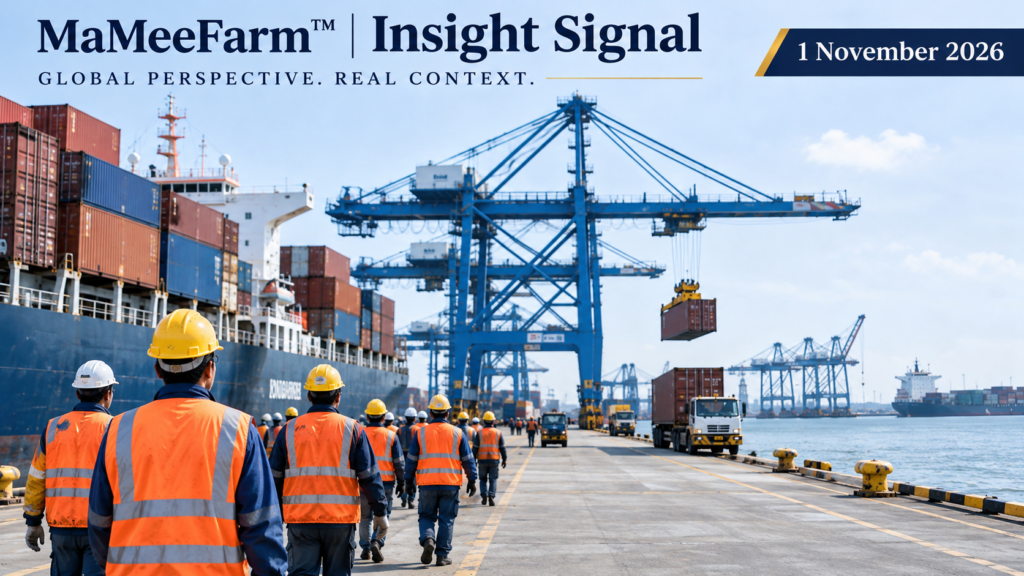
MaMeeFarm™ Insight Signal
Publication Date: 1 November 2026
Domain: Global Trade / Maritime Logistics / Labour Relations / Supply Chain Resilience
Observable Development
Global trade depends on ships, terminals, transport corridors, and cargo-handling infrastructure.
But infrastructure alone does not keep a port operating.
Cargo must still be handled.
Vessels must be serviced.
Terminal operations must be coordinated.
And those activities depend on people.
The coordinated labour actions across ports on 30 October 2026 show why this distinction matters.
A port can remain physically intact and technically capable of handling cargo while its practical availability becomes temporarily constrained by labour action.
More Than 100 Ports Joined the Mobilisation
Reuters reported coordinated action across 113 ports in 22 countries.
More than 25 unions supported the mobilisation.
Workers and unions raised several concerns, including arms shipments, military use of ports, deaths and injuries among seafarers in conflict zones, wages, and working conditions.
The scale of participation was internationally significant.
But the operational consequences differed from port to port.
Some locations experienced full-day strikes.
Others saw shorter stoppages, demonstrations, or rallies.
The number of participating ports should therefore not be interpreted as the number of ports that completely stopped cargo operations.
Participation Did Not Mean Uniform Shutdown
The distinction is important.
A demonstration outside a terminal does not necessarily stop cargo handling.
A short work stoppage may delay selected operations.
A full-day strike can create much larger disruption.
The available evidence supports the conclusion that there was coordinated international labour mobilisation.
It does not support the conclusion that all 113 ports experienced the same level of interruption.
France Saw Significant Industrial Action
French port workers participated in a 24-hour strike across major ports.
Reportedly affected locations included Le Havre, Marseille-Fos, Dunkirk, Rouen, and several other ports.
French labour representatives expected substantial disruption to cargo activity.
The actual operational impact varied by location.
This provides one example of how labour availability can temporarily reduce effective port capacity even when the physical infrastructure itself remains fully functional.
Greece Experienced Both Port and Ferry Disruption
At Piraeus, dockworkers joined the international mobilisation.
Reuters reported that cargo operations were halted during the action.
Ferry services were also disrupted.
However, part of the ferry disruption was linked to a separate seafarers’ strike involving pay, safety, and working conditions.
The two actions should therefore not be treated as identical.
This distinction matters when attributing operational effects.
Labour Availability Is Part of Port Capacity
Ports are usually described in terms of infrastructure.
Berths matter.
Cranes matter.
Storage areas matter.
Road and rail connections matter.
But those systems still require workers and operational coordination.
A port can therefore possess substantial physical capacity while temporarily being unable to use all of it.
That is not an infrastructure failure.
It is an operational constraint.
The Mobilisation Combined Labour and Political Concerns
Industrial action in ports is not new.
Dockworkers have long used strikes and collective bargaining to address wages and working conditions.
The October mobilisation also included objections to arms shipments and the use of commercial ports for military purposes.
Those positions were expressed by participating unions and protesters.
They should not be treated as representing every worker, port operator, government, or shipping company.
The importance for trade infrastructure is narrower:
Disputes over labour conditions and the handling of sensitive cargo can both influence port operations.
Disruption Does Not Require a Global Shipping Collapse
The actions attracted attention partly because major ports are connected through international shipping networks.
But the evidence does not indicate a collapse of global shipping.
The Associated Press reported that supply-chain experts expected limited effects on world trade overall.
Localized delays and congestion were more plausible consequences.
That distinction is essential.
A global shipping collapse would involve sustained disruption across major transport networks.
A localized port interruption may affect individual vessels, terminals, or cargo flows without materially reducing global trade.
Different Ports Can Absorb Disruption Differently
The effect of a strike depends on local circumstances.
Duration matters.
Participation matters.
Existing congestion matters.
Available alternative ports and shipping schedules matter.
A temporary interruption at one terminal may be absorbed quickly.
A longer interruption at a heavily used port may create larger delays.
This means the geographic scale of a labour mobilisation is not by itself a measure of its economic impact.
Actual operational data are needed.
Trade Infrastructure Depends on Institutions as Well as Assets
Ports are not only physical facilities.
They also operate through contracts, labour relations, public authorities, safety requirements, and commercial coordination.
When those relationships are disrupted, operational availability can change even though the physical assets remain untouched.
This is particularly visible when a dispute affects cargo handling directly.
The cranes may still work.
The berths may still be open.
The ships may still arrive.
But cargo cannot necessarily move at normal speed.
The Wider Trade Impact Is Still Uncertain
Current reporting documents real operational interruptions at some ports.
But the wider economic effects remain uncertain.
The reported 113-port participation does not establish that global trade volumes fell materially.
It does not establish that international supply chains experienced systemic breakdown.
And estimates of cargo or economic losses promoted by organisers require independent verification before being treated as measured outcomes.
The next useful evidence will come from vessel-delay records, terminal throughput, congestion levels, and post-event cargo data.
What to Watch
- Watch whether vessel delays increased materially at the ports experiencing full-day stoppages.
- Watch whether cargo congestion persisted after workers returned.
- Watch whether shipping lines rerouted cargo or adjusted schedules.
- Watch whether similar coordinated labour actions recur across multiple countries.
- Watch whether labour disputes increasingly interact with geopolitical questions surrounding specific categories of cargo.
Evidence Boundary
Current evidence supports the conclusion that dockworkers and maritime unions coordinated actions across more than 100 ports on 30 October 2026.
The intensity of participation varied substantially.
The evidence does not establish that 113 ports completely shut down.
It does not establish that world shipping experienced a systemic failure.
It does not establish that every reported delay or ferry disruption resulted from the same labour action.
And it does not yet establish the overall impact on global cargo volumes.
The narrower signal is that labour availability can temporarily constrain the practical use of port infrastructure even when the infrastructure itself remains operational.
Insight Signal
Global trade infrastructure can remain physically functional while its practical availability becomes temporarily constrained by coordinated labour action.
The October mobilisation did not demonstrate a collapse of international shipping.
It demonstrated something narrower.
Ports depend not only on cranes, berths, and transport connections, but also on the people and institutions required to operate them.
The structural signal is that port reliability depends on operational participation as well as physical capacity.
Sources
- Reuters. Dockworkers strike in Europe and beyond against arms shipments, war deaths. 30 October 2026.
- Associated Press. Dockworkers worldwide strike against arms shipments and to demand better working conditions. 30 October 2026.
- Reuters. Reporting on coordinated dockworker actions across more than 100 ports. 29-30 October 2026.
MaMeeFarm™
Insight Signal
Global Trade / Maritime Logistics / Labour Relations / Supply Chain Resilience
Public under the MaMeeFarm™ Ecosystem
Under the DGCP™ Framework