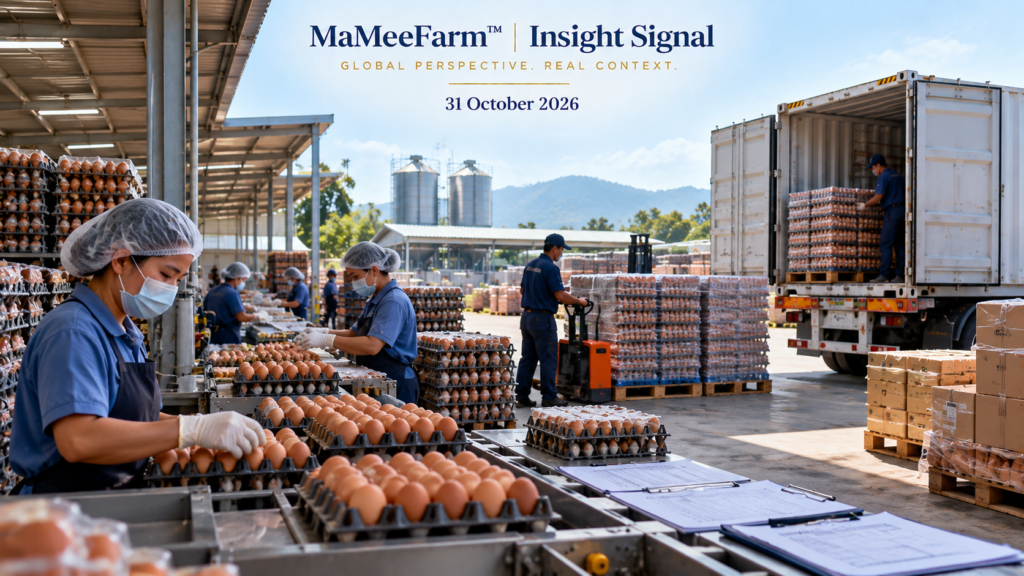
MaMeeFarm™ Insight Signal
Publication Date: 31 October 2026
Domain: Food Security / Agriculture / Climate Disruption / International Trade
Observable Development
Food security is often discussed as a question of agricultural production.
Countries need enough crops, livestock, and food-processing capacity to meet domestic demand.
But food security also depends on distribution.
It depends on whether food can still move through disrupted transport networks.
And it depends on how governments respond when domestic availability becomes uncertain.
Thailand’s response to severe flooding in October 2026 illustrates another dimension of that problem.
The government asked egg exporters to reduce or postpone some overseas shipments while authorities worked to protect domestic supply.
The request was not presented as a blanket legal export ban.
But it shows how quickly international trade decisions can become part of domestic food-supply management.
Flooding Reached the Egg Supply Chain
Severe flooding affected several parts of Thailand during September and October.
Agricultural production and transportation were disrupted.
Thailand’s Department of Internal Trade reported that egg-producing farms were affected and that authorities were working with producers, wholesalers, retailers, and exporters to maintain domestic availability.
The disruption was therefore not limited to production.
Food that remained available also had to move through affected transport and distribution networks.
That made logistics part of the food-security response.
Exporters Were Asked to Reduce or Delay Shipments
On 1 October, the Department of Internal Trade met egg producers, trade associations, exporters, wholesalers, and retailers to assess domestic supply.
Exporters were asked to reduce overseas shipments by approximately 30% to 50% or postpone some planned exports.
The department also requested export plans for October and November so it could monitor domestic availability.
This distinction is important:
A Requested Reduction is not the same as A Verified Reduction in Actual Exports.
The announced percentage describes the government’s requested cooperation.
It does not prove that customs shipments ultimately fell by the same amount.
The Duration Was Not Described Identically Across Sources
The implementation period also requires caution.
The Department of Internal Trade described a reduction or postponement of approximately two to three weeks while export plans for October and November were monitored.
Reuters reported that companies had been asked to reduce exports by 30% to 50% through December.
These descriptions may refer to different phases or interpretations of the response.
The available evidence does not establish one single, consistently defined period for the full requested reduction.
That difference matters because a short delay in exports is not economically identical to a multi-month reduction.
Domestic Supply Protection Extended Beyond Exports
The government’s response involved several measures.
The Department of Internal Trade estimated domestic egg demand at approximately 12 million eggs per day.
Authorities also asked producers to extend the productive period of laying hens by several weeks in an effort to maintain supply.
Distribution through normal retail and wholesale channels was also emphasized.
The response was therefore broader than export policy alone.
It combined production support, distribution management, price monitoring, and export coordination.
Distribution Can Matter as Much as Production
Flooding can create a food-supply problem even when national production has not completely collapsed.
Road disruption and logistical bottlenecks can prevent available products from reaching certain areas.
That means local shortages can emerge even while food remains available elsewhere.
The Thai response reflects this distinction.
Authorities were attempting not only to maintain egg production but also to keep products moving through the domestic market.
Export Decisions Can Become Part of Domestic Resilience
The export request shows how food-security policy can extend into trade allocation.
When domestic supply becomes uncertain, governments may ask producers and exporters to prioritize the home market.
That can influence commercial decisions even without a formal export prohibition.
Shipment schedules may change.
Export volumes may be delayed.
Overseas buyers may need to reassess procurement plans.
The actual scale of those effects depends on what exporters ultimately do.
Importing Countries Experience the Same Event Differently
Thailand is an important egg supplier to Singapore.
But Thailand’s importance as an exporter should not be confused with Singapore’s dependence on Thai eggs.
Singapore’s Food Agency said Thailand accounts for less than 15% of the country’s total egg supply.
Singapore also imports eggs from more than ten countries and has domestic production.
That gives it alternative supply options.
This creates another important distinction:
Export Concentration is not the same as Import Dependence.
A country can account for a large share of an exporter’s overseas sales while representing only a smaller share of the importing country’s total supply.
Diversification Changes the Impact of Export Restraint
Singapore’s response illustrates the value of supply diversification.
The Singapore Food Agency said it was monitoring developments and communicating with Thai authorities and local importers.
Alternative suppliers reduce the risk that disruption from one country automatically becomes a national shortage.
But diversification does not mean adjustment is always immediate or costless.
Individual businesses may still face different supplier relationships, specifications, and delivery arrangements.
The broader point is that the effect of export restraint depends partly on how diversified the importing market already is.
This Was Not a General Food-Export Ban
The Thai government’s action should not be described as a comprehensive legal prohibition on egg exports.
The reviewed sources describe cooperation with exporters and requests to reduce or postpone shipments.
That distinction matters.
Governments can influence trade flows through coordination and industry cooperation before introducing binding legal restrictions.
This makes export allocation relevant to food security even when no formal ban exists.
Climate Disruption Can Reach International Trade
The October events demonstrate a broader connection.
Climate-related disruption affected farms and transportation.
Authorities became concerned about domestic food availability.
Export planning became part of the response.
Importing countries then monitored their own exposure and alternative sources.
A local agricultural disruption can therefore create international commercial effects without producing a complete national shortage.
What to Watch
- Watch actual Thai egg-export volumes for October and November.
- Watch whether the requested reduction translated into measurable changes in shipments.
- Watch how quickly affected poultry production recovered.
- Watch domestic egg prices and availability.
- Watch whether importing markets had to materially alter their sourcing patterns.
Evidence Boundary
Current evidence supports the conclusion that Thailand asked egg exporters to reduce or postpone some shipments following flood-related disruption.
The request was part of a broader effort to maintain domestic supply and distribution.
The evidence does not establish that Thailand imposed a comprehensive legal export ban.
It does not establish that actual export volumes fell by exactly 30% to 50%.
It does not establish that Thailand experienced a nationwide egg shortage.
And it does not establish that Singapore experienced an egg shortage as a result.
The precise duration of the export restraint also differs across available reporting and should not be treated as fully resolved.
The narrower signal is that domestic food-supply concerns can reach export decisions before a formal trade prohibition becomes necessary.
Insight Signal
Climate-related food disruptions can turn export allocation into part of domestic supply management even when a country does not impose a formal export ban.
Thailand’s October response combined production support, domestic distribution management, price monitoring, and cooperation with exporters.
For importing countries, the impact depends partly on how diversified their supply networks already are.
The structural signal is that food security, logistics, and international trade can become tightly connected when climate disruption reduces confidence in domestic availability.
Sources
- Thailand Department of Internal Trade, Ministry of Commerce. Press releases dated 1-2 October 2026.
- Thailand Government Public Relations Department. Department of Internal Trade Addresses Flood-Related Vegetable and Egg Prices. 6 October 2026.
- Reuters. Thailand asks firms to cut egg exports after flood losses. 6 October 2026.
- Channel NewsAsia. Singapore contacts Thai authorities, importers over planned egg export cuts: SFA. 7 October 2026.
MaMeeFarm™
Insight Signal
Food Security / Agriculture / Climate Disruption / International Trade
Public under the MaMeeFarm™ Ecosystem
Under the DGCP™ Framework