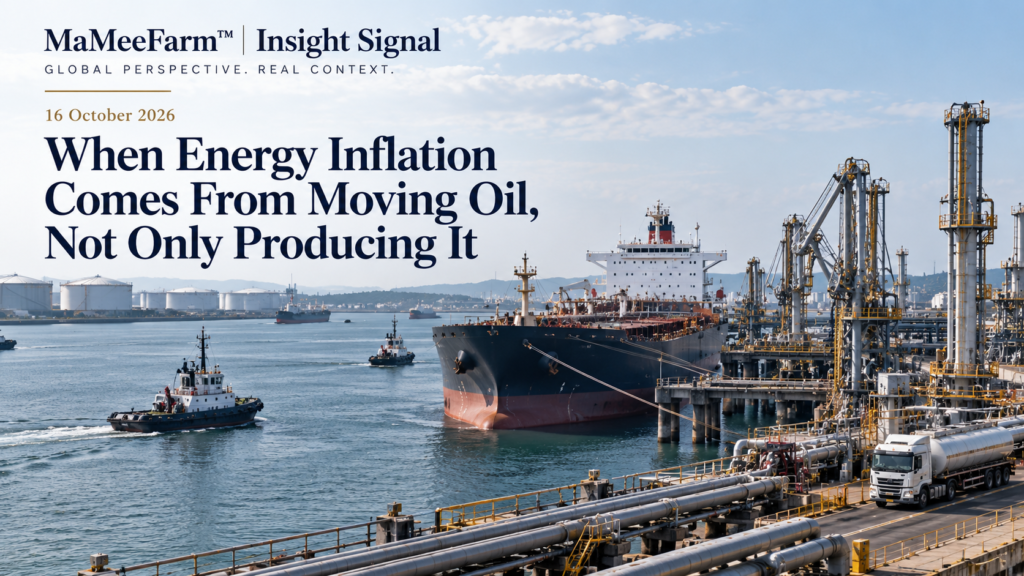
MaMeeFarm™ Insight Signal
Publication Date: 16 October 2026
Domain: Energy / Shipping / Inflation / Logistics
Observable Development
Oil can remain physically available while becoming more expensive to deliver.
For importing economies, the economic cost of energy depends not only on the crude benchmark but also on the cost and risk of transportation.
When shipping routes become longer, more expensive, or more difficult to insure, the delivered price of oil can rise even without a major decline in production.
Physical Availability Is Not the Same as Deliverable Availability
A producer can continue pumping oil while importers face higher costs or slower delivery.
This means physical supply can remain available even as the logistics required to move that supply become more constrained.
For an importing economy, the relevant question is not only whether the barrel exists, but whether it can arrive at a tolerable cost.
Shipping Costs Can Become Part of Energy Inflation
Freight, insurance, and route-related costs can raise the landed cost of oil.
Consumer fuel prices can therefore remain elevated even when crude prices soften if transport costs stay high.
The benchmark price alone may not capture the full pressure reaching importing economies.
Why This Matters
Energy inflation does not always require a collapse in physical production.
Transport constraints can create a different form of scarcity by making available supply more expensive to move.
This adds logistics to the set of factors that can influence energy prices and inflation.
Evidence Boundary
Higher shipping costs do not always pass through immediately to consumers.
Refiners and other intermediaries may absorb part of the increase temporarily, and route risk varies across corridors and market conditions.
Not every rise in fuel prices is caused by shipping, and higher freight costs do not necessarily imply lower physical oil production.
The available evidence supports a narrower observation:
logistics costs can become an additional inflation channel when moving oil becomes materially more expensive even though the oil itself remains available.
Insight Signal
Energy inflation can rise even when the barrel still exists, if the cost of moving that barrel becomes the new scarcity.
For importing economies, the delivered cost matters more than the production price alone.
When transport becomes the bottleneck, the economic scarcity is no longer the barrel itself, but the ability to deliver it at tolerable cost.
Sources
- Reuters. Reporting on sharply higher crude-oil shipping costs and consumer-price transmission. 15 October 2026.
- S&P Global. 2026 tanker-rate and maritime-route analysis covering vessel availability, rerouting, and insurance costs.
- Reuters. 2026 reporting on marine-fuel costs, bunker shifts, and shipping-market disruptions.
MaMeeFarm™
Insight Signal
Energy / Shipping / Inflation / Logistics
Public under the MaMeeFarm™ Ecosystem
Under the DGCP™ Framework