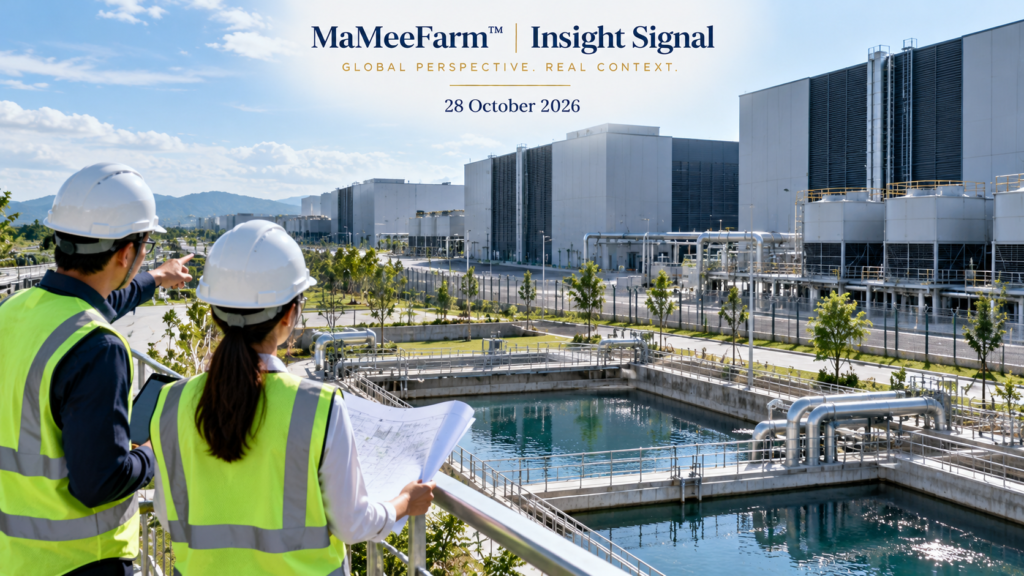
MaMeeFarm™ Insight Signal
Publication Date: 28 October 2026
Domain: Data Centers / Regulation / Water / Land Use / Environmental Standards
Observable Development
Digital infrastructure is becoming physical infrastructure.
That is the deeper signal emerging from Thailand’s latest effort to build a dedicated regulatory framework for data centers.
For years, governments across Asia have competed to attract data-center investment through tax incentives, industrial zones, connectivity, electricity access, and investment promotion.
But as the sector grows, the policy question changes.
It is no longer only:
How do we attract more investment?
It increasingly becomes:
How do we govern an industry that is becoming a major user of land, electricity, water, and physical infrastructure?
Growth Changes the Regulatory Problem
A small number of data centers can often be managed through existing building, utility, and industrial rules.
A rapidly expanding sector creates a different challenge.
At scale, data centers can affect electricity demand, grid planning, water systems, land use, fuel storage, environmental management, and surrounding communities.
That means their physical footprint becomes increasingly important to regulators.
Digital Infrastructure is not the same as Resource-Light Infrastructure.
The services may be digital.
The infrastructure underneath them is not.
Thailand Is Moving Toward a Sector-Specific Framework
Thailand is now developing a more dedicated regulatory structure for data centers.
The draft framework approved for further consideration includes minimum requirements covering location, connections to electricity and water systems, environmental reporting, and economic and social contribution.
The proposal would also divide data centers into seven categories based on electricity demand.
The smallest category begins at 0-0.5 MW, while the largest covers facilities using 200 MW or more.
That classification is significant because it signals that physical scale is becoming part of how the sector is governed.
Draft Policy Is Not Final Regulation
This distinction is important.
Thailand’s framework remains part of an ongoing policy process.
The government has approved a draft policy for submission to the Cabinet, and additional legal and administrative measures are still being developed.
Therefore:
Policy Direction is not the same as Final Regulation.
The signal is not that every proposed rule is already binding.
The signal is that data centers are increasingly being treated as a distinct infrastructure category requiring dedicated governance.
Power Demand Becomes Part of the Regulatory Picture
The decision to classify facilities by electricity demand is particularly important.
A larger data center can place different demands on power systems, backup infrastructure, cooling, and emergency systems than a small facility.
Power consumption therefore becomes more than an operating cost.
It becomes part of the regulatory identity of the facility.
That reflects a broader shift in how governments are beginning to understand digital infrastructure.
Land Use Becomes Part of Digital Policy
Data centers also occupy physical space.
Their location can affect utility access, zoning, communities, safety systems, and supporting infrastructure.
Thailand has already been examining data-center requirements involving building standards, land use, and urban planning, particularly in high-investment areas such as the Eastern Economic Corridor.
Technology policy therefore begins to overlap with spatial planning.
That is another sign that the sector is moving beyond conventional digital-policy boundaries.
Water Is Becoming a Policy Issue
Electricity receives most of the attention surrounding data centers.
Water is becoming harder to ignore.
Cooling systems can create meaningful water demand, particularly when multiple facilities cluster in the same region.
Thailand’s developing framework explicitly includes water infrastructure among the areas requiring regulatory attention.
This moves water from a facility-level engineering question toward a wider infrastructure-policy question.
Environmental Standards Are Becoming More Formal
Thailand is also moving toward common environmental requirements for the sector.
The proposed framework includes environmental reporting and a Code of Practice approach.
Earlier government policy statements have also emphasized clean energy, environmental impact, community protection, and more systematic standards for data-center development.
This matters because rapid growth can make project-by-project treatment less sufficient.
A larger sector creates demand for clearer common expectations.
More Regulation Does Not Automatically Mean Less Investment
A more formal regulatory framework can increase compliance requirements.
But regulation can also reduce uncertainty.
For long-lived infrastructure projects, knowing the rules before capital is committed can be economically valuable.
That means investment promotion and regulation do not necessarily sit on opposite sides.
A government can continue attracting data-center investment while also defining how that investment interacts with land, power, water, communities, and the environment.
Thailand’s current policy direction reflects that balance.
Data Centers Are Hybrid Infrastructure
A modern data center does not fit neatly into one traditional category.
It is simultaneously a computing facility, an industrial electricity load, a telecommunications node, a cooling system, and a building with backup-power requirements.
That hybrid nature helps explain why generic rules become more difficult as the sector grows.
The larger the industry becomes, the harder it is to treat it only as a technology sector.
Sector Growth Creates Governance Demand
This is a recurring infrastructure pattern.
A sector begins relatively small.
Existing rules are sufficient.
Investment increases.
Physical impacts grow.
Eventually, dedicated governance begins to appear.
Thailand’s latest policy move suggests that data centers are entering that phase.
The regulatory system is beginning to catch up with the physical scale of the digital economy.
What to Watch
- Whether the proposed seven-tier electricity classification is retained in the final framework.
- How Thailand defines the minimum requirements for land, electricity, water, and environmental management.
- How the proposed Data Center One Stop Service changes the approval process.
- Whether other rapidly expanding data-center markets in Asia move toward similarly dedicated regulatory regimes.
Evidence Boundary
Current evidence supports the conclusion that Thailand is developing a more dedicated governance framework for data centers as investment and physical infrastructure demands expand.
The proposed framework includes minimum requirements and a seven-level classification based on electricity consumption.
It does not establish that every proposed requirement is final, that all thresholds will remain unchanged, or that every element has already entered into force.
The narrower signal is that data centers are increasingly being regulated according to their physical footprint and infrastructure impact rather than only their technological function.
Insight Signal
As data centers become large users of land, electricity, water, and supporting infrastructure, their regulatory treatment begins shifting from ordinary commercial development toward a dedicated infrastructure regime.
This does not mean every proposed rule is already binding.
It means the policy architecture is changing.
Governments are beginning to govern data centers according to the physical systems they depend on and affect.
When a digital sector becomes large enough to reshape electricity, water, and land systems, regulation begins following the physical footprint rather than the technological label.
Sources
- Reuters. Reporting on Thailand’s planned minimum requirements and seven-tier classification for data centers. 27 October 2026.
- Royal Thai Government. Draft Data Center regulatory policy and minimum requirements. 27 October 2026.
- Royal Thai Government. Policy statements on Data Center regulation, strategic infrastructure, energy, water, and environmental management. September-October 2026.
MaMeeFarm™
Insight Signal
Data Centers / Regulation / Water / Land Use / Environmental Standards
Public under the MaMeeFarm™ Ecosystem
Under the DGCP™ Framework