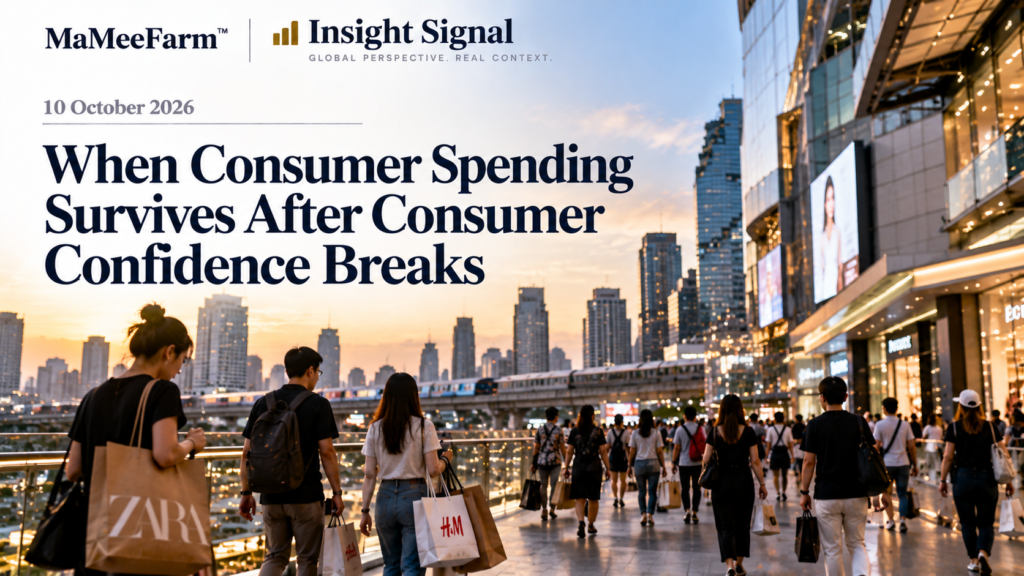
MaMeeFarm™ Insight Signal
Publication Date: 10 October 2026
Domain: Households / Consumption / Wealth / Inequality
Observable Development
Consumer confidence can weaken sharply without producing an immediate collapse in consumer spending.
The United States currently provides a useful example.
Household sentiment has deteriorated, cost-of-living concerns remain elevated, and financial pressure is uneven across the household sector.
Yet aggregate consumption has remained relatively resilient.
This apparent contradiction becomes easier to understand when spending is not treated as the behavior of a single average household.
Spending Capacity Is Not Distributed Evenly
Households do not contribute equally to total consumption.
Higher-income and higher-wealth households generally have greater financial buffers and can continue spending even when confidence weakens.
Other households may face greater pressure from essential costs, debt payments, or limited savings.
This means strong aggregate spending can coexist with significantly different household experiences.
Resilient consumption does not necessarily mean resilient consumers.
Confidence and Spending Measure Different Things
Consumer confidence reflects how households perceive current and future economic conditions.
Spending data measure what households actually purchase.
Those two measures do not have to move together at the same time.
A household may feel less confident about the economy while still having enough income, savings, assets, or access to credit to maintain spending.
Likewise, weaker sentiment can appear before a visible change in aggregate consumption.
The divergence therefore does not necessarily mean either measure is wrong.
They are describing different parts of household economic behavior.
Aggregate Strength Can Hide Uneven Pressure
Strong headline consumption does not mean financial conditions are equally strong across households.
Higher-spending households can continue supporting aggregate demand while lower-income or lower-wealth households experience tighter financial conditions.
That makes distribution increasingly important when interpreting consumer resilience.
The question is not only whether total spending remains strong.
It is also who is still able to spend.
Evidence Boundary
Weak consumer sentiment does not automatically predict an immediate decline in spending.
Likewise, resilient aggregate consumption does not establish that most households are financially comfortable.
Household responses can vary by income, wealth, debt, employment, savings, and exposure to essential costs.
Aggregate spending data also do not reveal precisely how much consumption is being supported by current income, accumulated wealth, or credit.
The available evidence supports a narrower observation:
consumer spending can remain resilient even while confidence and financial conditions weaken unevenly across households.
Insight Signal
Consumer confidence and consumer spending can move in different directions because they measure different things.
A weak confidence reading does not automatically mean demand has already collapsed.
And strong aggregate spending does not automatically mean households are broadly financially resilient.
When spending power is concentrated among households with stronger financial buffers, aggregate consumption can remain durable even while pressure increases elsewhere.
That creates a two-speed consumer environment without requiring the entire household sector to move in the same direction at once.
A strong consumer economy can hide a weak consumer experience when spending power is concentrated.
Sources
- Reuters. U.S. consumer sentiment deteriorates further in October. 9 October 2026.
- University of Michigan Surveys of Consumers. Preliminary October 2026 data.
- Reuters. Federal Reserve household income, wealth, and debt stress reporting. 9 October 2026.
- Reuters. U.S. luxury spending and household demand reporting. October 2026.
- Federal Reserve. Survey of Consumer Finances and household balance-sheet data.
MaMeeFarm™
Insight Signal
Households / Consumption / Wealth / Inequality
Public under the MaMeeFarm™ Ecosystem
Under the DGCP™ Framework