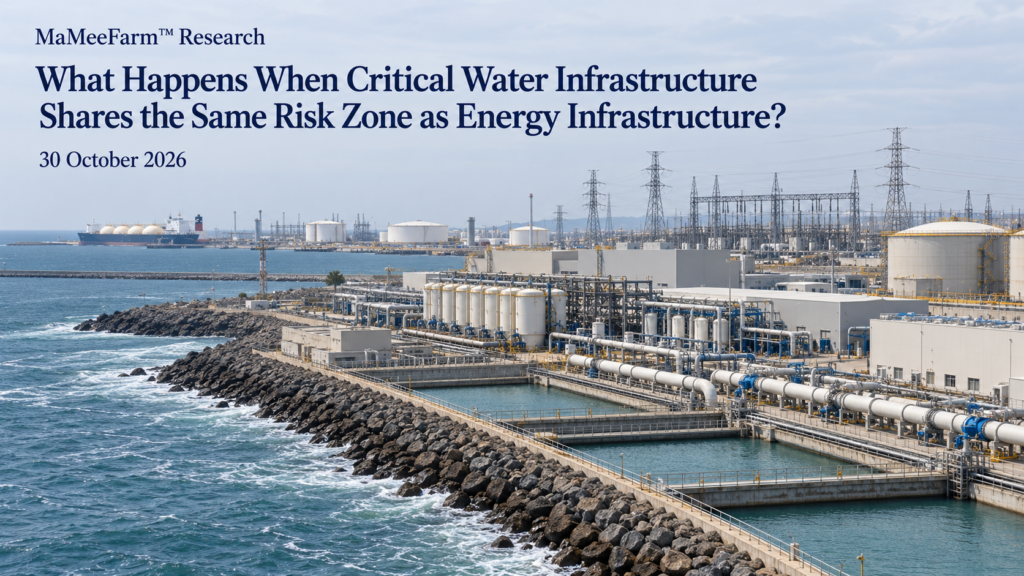
Publication Date: 30 October 2026 Category: Research Region: United Arab Emirates / Global Focus: Water Security · Energy Infrastructure · Desalination · Coastal Risk · Infrastructure Resilience
Abstract
Critical infrastructure is often assessed through the reliability of individual assets.
A desalination plant may have multiple treatment units. A power station may maintain backup equipment. A water utility may operate emergency storage facilities.
These arrangements can protect against certain failures.
However, separate assets may still depend on the same physical environment, energy supply, transport network, or operational infrastructure.
When several essential services share a common hazard, individual backup systems may provide less protection than expected.
An oil spill off the coast of the United Arab Emirates in October 2026 illustrates this concern.
Reuters reported that oil had approached the coastline near the Naqa’a desalination plant, a major seawater reverse-osmosis facility.
At the time of reporting, no shutdown of the plant or interruption to potable-water service had been announced.
The incident therefore provides evidence of potential exposure, not a confirmed infrastructure failure.
Nevertheless, it raises an important question about how critical systems are designed and evaluated.
A desalination facility depends on seawater quality, electricity, transport, treatment equipment, and distribution networks.
If several of these supporting systems are exposed to the same disruption, the consequences can extend beyond an individual facility.
This research examines how shared hazards and operational dependencies affect water and energy infrastructure, and why maintaining essential services requires more than simply increasing the number of backup assets.
1. Infrastructure Can Lose Operational Capacity Without Physical Damage
Infrastructure disruption does not always begin with structural destruction.
A desalination plant may remain physically intact while its seawater intake becomes unsuitable for normal operation.
An electricity facility may retain undamaged generating equipment but lose access to fuel or transmission capacity.
A water-distribution network may remain structurally functional while pumping operations are interrupted.
These situations demonstrate the difference between the physical condition of an asset and its ability to provide a service.
For seawater desalination, the quality of the source water is particularly important.
Seawater reverse osmosis involves intake, screening, pretreatment, membrane filtration, post-treatment, and distribution.
Contamination can interfere with several of these stages.
Oil entering an intake environment may create operational problems for filtration and treatment equipment.
Depending on the nature and severity of contamination, operators may need to adjust treatment, restrict intake, or temporarily suspend production to protect equipment and water quality.
A controlled shutdown can therefore be a protective response rather than evidence that the facility has suffered structural damage.
The wider consequence depends on whether other parts of the water system can maintain supply.
An individual plant may become temporarily unavailable without causing an interruption to consumers if sufficient storage, alternative production, and distribution capacity exist.
This distinction makes service continuity a more comprehensive resilience objective than the operating status of any single asset.
2. The UAE Oil Spill Illustrates Exposure, Not Confirmed System Failure
In late October 2026, Reuters reported an oil spill affecting coastal waters of the United Arab Emirates.
Its 29 October reporting described oil approaching the coast near the Naqa’a desalination plant.
Reuters-verified footage placed the visible slick approximately two kilometres from the facility.
The location matters because Naqa’a is a significant water-production asset.
Etihad Water and Electricity describes the facility as a seawater reverse-osmosis plant with a design capacity of approximately 150 million imperial gallons per day.
Large desalination facilities support the reliable production of potable water at substantial scale.
Their concentration of production capacity can offer operating and economic advantages.
However, disruption at a major production facility can also have significant consequences if alternative supply is insufficient.
The October incident should be interpreted carefully.
The available reporting did not establish that oil entered the Naqa’a intake, that potable water became contaminated, or that the plant shut down.
It also did not demonstrate that nearby energy infrastructure failed or that the UAE experienced a cascading water-energy emergency.
Those outcomes must not be inferred from the proximity of an oil spill.
The case instead illustrates a plausible exposure pathway.
A coastal industrial and maritime environment supports shipping, energy-related activity, and water production.
An environmental incident within that shared space can create operational concerns for more than one infrastructure function.
The broader lesson concerns how common exposure should be assessed before a disruption produces confirmed service failure.
3. Shared Coastal Environments Can Create Common-Cause Risk
Coastal areas often contain concentrations of economically important infrastructure.
Ports provide access to international trade.
Fuel terminals and pipelines support energy logistics.
Industrial facilities depend on transport and electricity.
Desalination plants require access to seawater.
Locating these systems near one another can reduce transport distances, improve connectivity, and support efficient operations.
However, the same geographic concentration can create shared exposure.
A severe coastal storm may affect multiple facilities within one area.
A maritime accident may disrupt navigation while creating pollution risks for nearby water intakes.
A regional electricity interruption may affect several water-production facilities simultaneously.
These are examples of common-cause risk.
Assets that appear operationally separate during normal conditions may become vulnerable to the same disruptive event.
This is particularly important when backup equipment shares the exposure of the primary equipment.
Two treatment units at one desalination plant may provide protection against an individual mechanical failure.
They do not necessarily provide independent protection against contamination affecting their common seawater source.
Similarly, two facilities may be geographically separated but remain dependent on the same electricity corridor or transport route.
Geographic distance alone does not establish operational independence.
Co-location is not inherently poor infrastructure planning.
Its economic advantages can be substantial.
The resilience challenge is to understand which shared hazards could affect several essential functions at the same time and whether alternative service arrangements would remain available.
4. Water and Energy Infrastructure Depend on One Another
Seawater reverse-osmosis desalination requires electricity.
Power is needed for seawater intake, pretreatment, high-pressure pumping, control systems, and water distribution.
An interruption to electricity can therefore affect water production even when seawater quality and treatment equipment remain normal.
Energy and industrial infrastructure can also depend on water.
Water may be required for cooling, processing, cleaning, and other operational functions.
These relationships create the possibility of cascading disruption.
For example, a prolonged electricity interruption may reduce desalination output.
If reduced water availability then affects facilities that support energy production or distribution, the consequences can become more complicated.
However, the existence of interdependence does not mean that every power failure will cause a water crisis or that every water disruption will affect energy supply.
Actual outcomes depend on system design, operating reserves, alternative supplies, and the duration of the event.
Recovery planning must account for these dependencies.
A water utility may need electricity before it can restore normal production.
An energy facility may need access to water, transport, or other services before returning to full operation.
Separate emergency plans can overlook these relationships if each organization assumes that supporting systems will remain available.
Coordinated planning can help identify where restoration priorities overlap.
It can also reveal whether a backup arrangement depends on the same infrastructure that the original disruption has affected.
5. Source Protection and Early Monitoring Can Reduce Disruption
Desalination resilience begins before seawater enters the treatment plant.
The surrounding marine environment directly affects the quality of the source water.
Monitoring can help operators identify changing conditions, including oil contamination, harmful algal blooms, unusual sediment levels, or other threats to intake operations.
For oil spills, trajectory forecasting can provide information about potential movement.
Currents, wind, waves, and oil characteristics influence how contamination spreads.
Forecasts can help estimate whether a facility may be exposed and how much preparation time is available.
However, predictions remain uncertain and require continuing observation.
Early detection can support decisions about intake operation, treatment adjustments, or temporary isolation.
Pretreatment provides another form of protection.
Depending on facility design, screening, coagulation, flotation, filtration, and other processes can reduce certain contaminants before water reaches sensitive membrane systems.
These processes have operational limits.
Severe contamination may exceed what normal treatment arrangements can manage safely.
For that reason, resilience cannot depend exclusively on treatment capability.
Operators may need the ability to isolate an affected intake or suspend production until conditions improve.
Such measures can protect the long-term condition of the plant.
Their effectiveness at the service level depends on whether the wider water system can compensate for temporary production loss.
6. Emergency Storage and Alternative Supply Provide Response Time
Water storage can help maintain essential services when production is interrupted.
Stored potable water separates immediate consumption from continuous production.
If a desalination plant temporarily reduces output, storage facilities may allow customers to continue receiving water while operators assess the situation.
However, storage is finite.
Its value depends on the amount of usable water available, the level of demand, distribution losses, and the expected duration of disruption.
A large storage volume does not automatically establish how long essential services can continue.
Emergency demand management may extend available supply by reducing non-essential consumption.
Alternative production can also support continuity.
Other desalination facilities or water sources may be able to provide additional supply when one plant becomes unavailable.
Yet spare production capacity is useful only when water can be transported to the affected area.
Pipelines, pumping stations, network connections, and operational controls determine whether alternative water can reach consumers.
This distinction is important for large regional systems.
A distant facility may have sufficient production capacity but lack the network capacity to replace lost supply in another service area.
The UAE Water Security Strategy 2036 recognizes the importance of emergency water production and distribution, strategic storage, and interconnection among water and electricity entities.
These priorities reflect a system-wide approach to water security.
Nevertheless, the existence of a national strategy does not independently establish the operational performance of every connection or backup arrangement during a particular emergency.
The practical resilience of a water network depends on how its facilities perform together under actual disruption.
7. Interconnection Improves Flexibility but Requires Isolation
Interconnected infrastructure can improve resilience by allowing supply to move between different parts of a network.
Water utilities may transfer water from alternative production facilities.
Electricity networks may reroute power through available transmission paths.
Transport operators may use alternative corridors when normal routes are disrupted.
These capabilities can reduce dependence on individual assets.
However, interconnection also creates additional relationships between systems.
A disturbance in one location may affect other locations if networks cannot contain the problem.
For water systems, operational controls and isolation arrangements can help prevent affected sections from compromising the wider network.
For electricity systems, protective equipment and switching arrangements serve related purposes.
The objective is not simply to maximize connectivity.
Networks must also be capable of separating disrupted components when necessary.
Backup power illustrates a similar challenge.
A desalination plant may have emergency generation equipment, but its effectiveness depends on available fuel, maintenance, and sufficient generating capacity.
If fuel deliveries rely on a port affected by the same coastal emergency, the backup arrangement may have a shared vulnerability.
Battery storage or dedicated power systems can provide additional options, but their usefulness depends on operating duration and the electrical loads they can support.
Some backup arrangements may maintain monitoring, controls, or limited pumping without sustaining full desalination production.
This can still be valuable.
Resilience planning should identify which essential functions must continue and what supporting resources are needed to maintain them.
8. Critical Infrastructure Resilience Requires Coordinated Recovery
The resilience of a critical service depends partly on how quickly it can recover after disruption.
For a desalination plant exposed to contamination, recovery may require inspection, cleaning, replacement components, and verification that normal treatment can resume safely.
The necessary work may depend on specialist personnel, chemicals, filters, equipment, and transport access.
A disruption affecting ports or roads can therefore delay the recovery of water infrastructure even when the plant itself remains accessible.
Electricity restoration may also be required before normal water production can restart.
These dependencies make coordinated recovery planning important.
Water utilities, electricity providers, port operators, transport authorities, and emergency-management organizations may each have separate responsibilities.
Their recovery plans need to account for the resources and services they require from one another.
Combined emergency exercises can help identify assumptions that might otherwise remain hidden.
A plan designed for an isolated power outage may not be sufficient during a storm that also damages transport infrastructure.
A desalination contingency plan may need revision if the same coastal event affects both seawater quality and electricity supply.
The goal is not necessarily to prevent every individual facility from shutting down.
Temporary isolation can protect equipment and water quality.
The more important objective is to preserve essential service wherever possible and restore normal capacity safely.
This requires attention to alternative supply, available capacity, recovery time, and the independence of supporting systems.
Research Conclusion
Modern infrastructure systems depend on more than the physical condition of their individual assets.
A desalination plant requires suitable source water, electricity, treatment equipment, operational supplies, and distribution networks.
Energy infrastructure may depend on water, fuel logistics, transport, and communications.
When these systems share the same coastal or industrial environment, they can also share exposure to disruptive events.
The October 2026 oil spill near the Naqa’a desalination plant illustrates this concern.
The available reporting did not confirm a plant shutdown, drinking-water contamination, or interruption to water service.
The incident should therefore be understood as a case of potential exposure rather than demonstrated infrastructure failure.
Its wider significance lies in the relationship between location, dependency, and service continuity.
Multiple treatment units may protect against individual equipment failures while remaining exposed to a common intake problem.
Separate facilities may share an electricity supply or transport corridor.
Alternative water production may exist without sufficient network capacity to deliver that water where it is needed.
Emergency storage may preserve supply temporarily but cannot replace production indefinitely.
These distinctions show why the number of backup assets is not a complete measure of resilience.
Critical infrastructure resilience depends on whether essential services can continue through sufficiently independent supply and recovery arrangements when shared hazards affect multiple systems.
This does not require eliminating large centralized facilities or avoiding all infrastructure co-location.
Centralized production can offer substantial economic and operational benefits.
The challenge is to ensure that the surrounding system can manage disruption.
Monitoring can provide warning.
Intake protection can reduce contamination risk.
Storage can preserve supply during temporary production loss.
Alternative sources and network connections can support service continuity.
Isolation arrangements can contain disturbances.
Coordinated recovery plans can help restore dependent systems in an appropriate sequence.
Each contributes to resilience, but none provides a universal guarantee.
The broader implication extends beyond desalination.
Electricity networks, ports, transport systems, communications infrastructure, and other essential services can also share hazards and dependencies.
Their resilience should therefore be considered both individually and as parts of connected systems.
The most important question is not simply how many backup facilities exist.
It is whether those facilities and their supporting networks can remain available when the same event affects several critical services at once.
Evidence and Limitations
This research is based on Reuters reporting concerning the October 2026 UAE oil spill, information attributed to Etihad Water and Electricity, the UAE Water Security Strategy 2036, and supporting literature on desalination protection and critical-infrastructure interdependence.
The incident is treated as an exposure case.
The research does not establish that oil entered the Naqa’a seawater intake, that the facility suspended operations, or that potable-water quality was compromised.
It also does not establish simultaneous failure of water and energy infrastructure during the reported event.
The plant’s approximately 150 million imperial gallons per day design capacity is not equivalent to a verified production figure for the date of the incident.
The discussion of alternative supply, storage, network interconnection, and recovery describes infrastructure resilience mechanisms. It does not independently verify their actual operating capacity or emergency performance across the UAE water system.
Potential cascading failures are presented as plausible system risks, not observed outcomes of the October incident.
The interpretation of service continuity and independent backup arrangements reflects the research’s analytical synthesis rather than a claim that every infrastructure system requires the same design.
References
- Reuters. (29 October 2026). How Could the Oil Spill Off the UAE Coast Affect Desalination Plants?
- Reuters. (26 October 2026). Oil Spill Off UAE Widens, Satellite Images Show, Prompting More Beach Closures.
- Etihad Water and Electricity. Naqa’a Desalination Plant Operational Information.
- Etihad Water and Electricity. Annual Statistical Report 2023.
- Etihad Water and Electricity. Naqa’a RO Plant Provides Safe Drinking Water to 2 Million Residents.
- United Arab Emirates Government. The UAE Water Security Strategy 2036.
- Etihad Water and Electricity. Al Khuraijah Water Distribution Center and Naqa’a Strategic Storage.
- Desalination. (2023). Oil Spill Management to Prevent Desalination Plant Shutdown from the Perspectives of Offshore Cleanup, Seawater Intake and Onshore Pretreatment.
- OECD. (2025). Ensuring the Resilience of Critical Infrastructure.
- OECD. Good Governance for Critical Infrastructure Resilience.
- World Bank. Advancing Knowledge of the Water-Energy Nexus in the GCC Countries.
MaMeeFarm™
People • Business • Opportunities