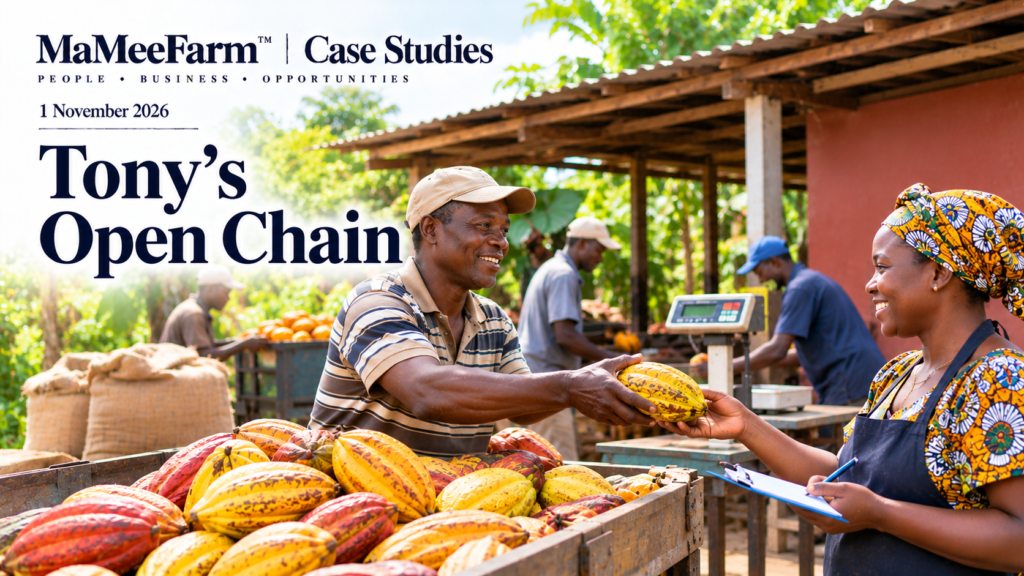
MaMeeFarm™ Case Studies | Cocoa Supply Chains • Retail Sourcing • Farmer Livelihoods
1 November 2026
A chocolate bar reaches the customer as a finished product. The cocoa behind it passes through a longer commercial chain, connecting farmers, cooperatives, traders, processors and brands.
Decisions made along that chain affect more than the movement of beans. Purchasing prices, volumes and the duration of relationships influence what farmers can earn and how confidently cooperatives can plan.
Tony’s Open Chain brings those purchasing conditions into a shared sourcing initiative that other brands and retailers can join.
A shared approach to purchasing cocoa
The initiative describes five sourcing principles: traceable cocoa, higher prices, long-term relationships, stronger farmer organisations, and improvements in quality and productivity.
Its pricing principle uses a Living Income Reference Price, including applicable certification premiums. These commitments are presented as a combined approach to addressing structural problems in cocoa sourcing.
The model does not eliminate the physical supply chain.
Tony’s Open Chain’s network description includes farmer cooperatives, local buying and processing businesses, exporters and partner processors supplying participating brands, known as Mission Allies.
The distinction matters. Connecting a brand with identifiable producers does not necessarily mean that beans travel directly from a farm to that brand without other commercial participants.
A retailer puts the model into a product range
ALDI SOUTH provides a concrete participant example.
The retailer states that it joined Tony’s Open Chain in 2021 and sources all cocoa for its Choceur CHOCO CHANGER range from the initiative’s partner cooperatives.
Its description includes traceability from farms to the processor’s door and a commitment to additional premiums above certification premiums, alongside support for cooperatives and farming skills.
That traceability claim has a defined boundary. It should not be interpreted as evidence that the cocoa remains physically segregated from all other cocoa throughout every subsequent processing stage.
This is also a defined product-range commitment. It should not be read as evidence that every cocoa product sold by ALDI follows the same arrangement.
The example nevertheless illustrates how a retailer can use a shared sourcing approach while maintaining its own products and customer-facing brand.
Long-term cooperation without exclusivity
Cooperatives occupy an important position between individual farmers and the wider supply network.
Tony’s Open Chain describes its partner cooperatives as farmer-owned organisations that represent members and help organise programmes around local needs.
Its published explanation states that memoranda of understanding provide for at least five years of collaboration. Cooperatives remain free to sell cocoa to other buyers. The approach also includes joint strategic planning and annual implementation reviews.
The combination is commercially relevant: continuity can support planning while non-exclusive relationships preserve other selling opportunities.
A commitment to collaborate, however, should not automatically be interpreted as a guarantee to purchase every farmer’s entire harvest. Specific purchasing obligations require the applicable agreement.
A reference price is not a household income
Fairtrade defines a Living Income Reference Price around the price needed under specified conditions, including viable farm size and sustainable yields.
It explicitly states that paying that reference price does not guarantee that a household earns a living income. Productivity, farm size and the proportion of production purchased under the arrangement remain important. Cooperative costs and the distribution of price differentials can also affect what individual farmers receive.
This separates two questions.
The first concerns purchasing conditions: what price and premiums buyers commit to pay. The second concerns outcomes: what households actually earn after production costs and other circumstances are considered.
Evidence of the first cannot substitute for measurement of the second.
Reading the reported results within their scope
Tony’s Open Chain’s 2024/25 impact report estimates that 40.6% of farmers at its three longest-term partner cooperatives earned at or above the living income benchmark. The report places the remaining 59.4% below that benchmark.
These are estimates reported by Tony’s Open Chain for the cooperatives included in its assessment. They should not be treated as independently verified results for the entire sourcing network.
The report also states that its living income analysis methodology changed, making the figures not directly comparable with the previous season. A simple year-to-year increase therefore cannot establish the size of an improvement attributable to the initiative.
The findings indicate that some farmers in the assessed group were estimated to have reached the benchmark, while a majority remained below it.
The business significance
Tony’s Open Chain illustrates how brands can connect cocoa purchasing with longer-term cooperative relationships and explicit pricing commitments.
Its relevance extends beyond identifying where beans originate. The commercial relationship also concerns how buyers purchase, what they commit to support and how outcomes are assessed.
The available evidence documents participating businesses and the initiative’s stated operating approach. It does not establish that traceability eliminates exploitation or that every participating household achieves a living income.
The case demonstrates why responsible sourcing commitments and household livelihood results must be understood together, while remaining distinct.
Sources
- Tony’s Open Chain – Sourcing Principles
- Tony’s Open Chain – Network and Partners
- ALDI SOUTH – CHOCO CHANGER
- Tony’s Open Chain – Cooperative Partnership Publication
- Fairtrade – Living Income Reference Price FAQ
- Tony’s Open Chain – Impact Report 2024/25, Page 48
- Tony’s Open Chain – Impact Report 2024/25, Page 47
MaMeeFarm™
People • Business • Opportunities