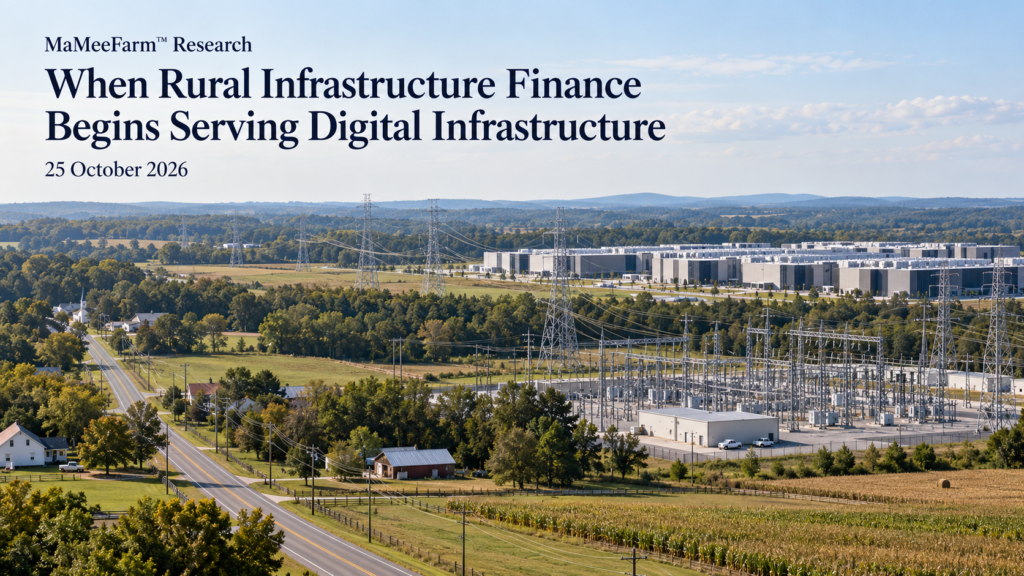
Publication Date: 25 October 2026 Category: Research Region: United States / Global Focus: Rural Development · Electricity Infrastructure · Data Centers · Public Finance
Abstract
Rural infrastructure finance has traditionally supported the provision of essential services in communities where conventional commercial investment may be difficult to attract.
Electricity networks are a central part of that mission.
Reliable power supports households, agriculture, food processing, public services, and rural businesses.
However, the expansion of large digital facilities is changing electricity demand.
Data centers can require substantial power capacity, sometimes prompting utilities to consider major investments in generation, transmission, and distribution infrastructure.
This creates new questions when those investments involve financing programmes originally established to improve rural services.
In October 2026, Reuters reported that the U.S. Department of Agriculture had approved a record US$3.3 billion rural utility loan connected to a power project in Georgia.
A USDA official indicated that the resulting electricity capacity could indirectly support the state’s expanding data-center industry.
The available evidence does not establish that the loan is a direct subsidy to data centers or that the financed infrastructure will serve them exclusively.
Nevertheless, the case illustrates a broader development issue.
When publicly supported rural infrastructure also serves large industrial electricity users, the distribution of costs, risks, and benefits becomes increasingly important.
This research examines how digital infrastructure demand is intersecting with rural electricity finance and what that means for the long-term public value of utility investment.
1. Rural Electricity Finance Has a Development Purpose
Rural electricity infrastructure often faces economic conditions that differ from those of densely populated urban areas.
Networks may need to cover long distances while serving relatively few customers.
This can increase the cost of infrastructure relative to the revenue available from electricity sales.
Public-backed financing programmes can help overcome some of these barriers.
In the United States, the Department of Agriculture’s Rural Utilities Service supports investment in infrastructure that improves electric service in eligible rural areas.
The Electric Infrastructure Loan & Loan Guarantee Program can finance generation, transmission, distribution, and related system improvements.
These investments can support a broad range of economic activity.
Farms rely on electricity for equipment, irrigation, storage, and processing.
Rural businesses need reliable power to operate machinery and communications systems.
Households, schools, healthcare facilities, and public services depend on the same infrastructure.
The development purpose of rural electricity finance therefore extends beyond constructing physical assets.
It involves improving the reliability, accessibility, and economic usefulness of electricity service.
This distinction becomes important when new industrial customers begin using infrastructure supported by rural development programmes.
2. Georgia Illustrates the Intersection of Rural and Digital Infrastructure
On 16 October 2026, Reuters reported that the USDA had approved a US$3.3 billion rural utility loan associated with a new electricity project in Monroe County, Georgia.
The financing was described as a record loan under the relevant rural utility programme.
A USDA official stated that the additional electricity capacity could indirectly benefit the state’s expanding data-center sector.
This connection is significant because data centers have become major sources of anticipated electricity-demand growth in several U.S. regions.
However, the reported relationship requires careful interpretation.
The loan finances electricity infrastructure.
It is not equivalent to a US$3.3 billion grant to a technology company.
Nor does the reporting establish that the project is dedicated exclusively to data centers.
Electricity infrastructure can serve multiple categories of users over its operating life.
A generation facility may supply existing households and businesses while also supporting new industrial demand.
The Georgia case therefore raises a question about how the resulting infrastructure will serve different users.
It does not, by itself, establish that the rural development purpose of the financing has been displaced.
3. Large Digital Customers Can Change Electricity Investment
Data centers differ from many traditional commercial electricity customers because of the scale and concentration of their power requirements.
A large facility may require substantial capacity at a single location.
Several facilities developing within the same region can place additional demands on generation and transmission planning.
Utilities may respond by considering new power plants, substations, network upgrades, and other investments.
These projects can create opportunities.
Additional infrastructure may strengthen regional electricity systems, improve service reliability, and support future industrial activity.
A large customer may also generate substantial electricity revenue, potentially improving the financial utilization of existing or new assets.
However, infrastructure investment typically occurs before the full economic benefits are realized.
Utilities may incur construction costs and financing obligations while customer facilities are still being developed.
If a planned data center is delayed, reduced in scale, or cancelled, expected electricity revenues may not materialize as originally anticipated.
The infrastructure may remain useful, but the financial assumptions supporting its construction can change.
This is especially important for long-lived utility assets, where repayment obligations may continue for decades.
Large-load growth can therefore create both development opportunities and financial exposure.
4. The Allocation of Costs Determines Who Carries the Risk
Electricity infrastructure requires financing, and those costs must ultimately be recovered.
When a large new customer triggers additional investment, an important question is how much of the resulting expense should be assigned to that customer.
Some investments may primarily support a particular connection or facility.
Others may strengthen the wider electricity network.
The allocation of costs depends on the nature of the investment, applicable regulatory arrangements, and commercial agreements.
If infrastructure is built in anticipation of a large customer that later withdraws, the utility may face a gap between expected revenue and continuing financial obligations.
Without adequate protections, some costs could potentially be passed to other electricity customers.
This is one reason U.S. federal energy authorities have increasingly focused on large-load integration.
The Department of Energy has examined electricity rate designs for large loads, including approaches intended to address cost recovery and consumer protection.
The Federal Energy Regulatory Commission has also considered reforms affecting the connection of major electricity users and the treatment of associated infrastructure costs.
Commercial arrangements can help manage these risks.
Depending on the circumstances, utilities may use minimum-payment commitments, upfront contributions, long-term service agreements, or provisions addressing early customer departure.
These mechanisms do not eliminate uncertainty.
They can, however, influence how financial exposure is shared.
For rural communities, the important issue is whether existing customers remain adequately protected when infrastructure investment is driven partly by large new industrial demand.
5. Public Financing Does Not Automatically Mean Private Subsidy
The use of public-backed finance introduces a separate question about economic benefit.
A government loan programme may provide eligible borrowers with access to capital under terms that differ from conventional commercial financing.
Such arrangements can help infrastructure projects proceed when financing would otherwise be difficult or expensive.
However, a loan is not the same as a grant.
Borrowers remain responsible for repayment under the applicable terms.
The value of public-backed financing may arise through access to credit, financing costs, repayment periods, or other features of the programme.
When the resulting infrastructure serves several types of customers, benefits may also be shared.
Rural households and businesses may gain from improved electricity reliability or expanded network capacity.
Large industrial customers may benefit from access to electricity infrastructure that supports their operations.
Shared use is not inherently inconsistent with a rural development mission.
Roads, water systems, and electricity networks frequently support households and commercial activity simultaneously.
The relevant question is whether public-backed financing continues to produce meaningful benefits for the communities it was designed to serve.
The Georgia case cannot be classified as an improper subsidy or an example of policy failure solely because data centers may benefit indirectly.
Such a conclusion would require detailed evidence about financing terms, electricity allocation, customer charges, and the resulting benefits to rural users.
6. Rural Communities May Gain Benefits Beyond Electricity Sales
Large digital facilities can create economic activity in the regions where they operate.
Potential benefits include construction expenditure, utility revenue, local procurement, and tax receipts.
Additional electricity infrastructure may also support other businesses.
Food processors, manufacturers, agricultural facilities, and logistics operations may benefit if new capacity becomes available to them.
However, these outcomes should not be assumed.
A large infrastructure project does not automatically generate substantial permanent employment.
Data centers can involve considerable construction activity while requiring comparatively limited operating staff relative to their capital investment.
Local tax benefits may also depend on exemptions, incentives, and the structure of applicable tax arrangements.
Similarly, additional generation capacity does not necessarily mean that unused capacity will be available for other rural customers.
Some or most of the new capacity may already be committed.
The wider economic value of an electricity investment therefore depends on how it changes actual conditions for the surrounding region.
Relevant outcomes include service reliability, electricity affordability, business access to capacity, and durable local economic activity.
A project can be financially large without producing equally large benefits for every community affected by it.
7. Long-Term Infrastructure Creates Long-Term Responsibilities
Electricity infrastructure can remain in service for several decades.
USDA rural electricity financing may involve repayment periods extending up to 35 years, subject to programme requirements and the useful life of financed facilities.
This creates a difference between infrastructure planning and commercial technology investment.
A utility may need to recover costs over many years.
A technology company may revise its investment plans much more quickly.
Changes in computing efficiency, equipment design, corporate strategy, or market demand can affect the amount of electricity a digital facility ultimately requires.
These uncertainties do not mean that investment should stop.
They mean that utilities and financing institutions must consider how projects remain financially sustainable under different demand outcomes.
Long-term commitments from major customers can improve revenue certainty.
Appropriate contract provisions can also reduce the risk that existing customers will carry costs caused by cancelled or substantially reduced projects.
At the same time, delaying all infrastructure investment until demand becomes certain can create other problems.
Insufficient capacity may restrict economic development or delay important connections.
The challenge is to support investment while maintaining financial discipline and protecting the users whose service the infrastructure was intended to improve.
8. Digital Growth Can Strengthen Rural Development Under the Right Conditions
The expansion of digital infrastructure does not necessarily conflict with rural development.
Large electricity customers may improve utility revenue, support investment, and create opportunities for additional economic activity.
They may also create pressure on generation capacity, transmission systems, land, and other local resources.
Some data-center operations may be capable of adjusting electricity demand under specific conditions, potentially supporting grid management.
However, operational flexibility should not be assumed merely because a facility uses digital technology.
Its usefulness depends on technical capabilities, service requirements, and actual commercial arrangements.
The wider development impact also extends beyond electricity.
Data centers may require land and cooling infrastructure, and some designs can create substantial water demand.
Local benefits should therefore be considered alongside potential resource pressures.
The important distinction is between digital growth that expands useful infrastructure for the wider region and growth that leaves existing communities carrying disproportionate costs or risks.
Rural infrastructure can serve both traditional communities and emerging industries.
Whether that shared use strengthens development depends on the terms under which investment occurs and the benefits that remain over time.
Research Conclusion
The growth of digital infrastructure is beginning to intersect with financing systems established to address longstanding rural development needs.
Electricity networks remain essential to households, farms, public services, and local businesses.
At the same time, data centers and other large industrial users are creating new demands for generation and grid capacity.
The US$3.3 billion USDA rural utility loan reported in Georgia illustrates this intersection.
The financing supports electricity infrastructure, while the resulting capacity may indirectly benefit expanding digital industries.
That relationship does not establish that public funds are being transferred directly to data-center operators.
Nor does it demonstrate that rural communities will necessarily lose out.
The implications depend on how the infrastructure is financed, used, and paid for.
Large customers can support utility revenue and encourage investment.
They can also create financial risks if demand forecasts change or projects fail to proceed as expected.
For long-lived electricity assets, those risks may persist well beyond the commercial planning horizons of individual technology companies.
This makes cost allocation and customer protection important elements of infrastructure governance.
The public value of rural electricity finance should not be judged only by the amount of capital invested or the capacity constructed.
It should also be judged by the quality of service and economic opportunities that remain available to the intended communities.
Digital infrastructure can contribute to rural development when its electricity requirements are financed responsibly and the resulting infrastructure delivers durable benefits beyond the initial large customer.
The central question is therefore not whether rural electricity systems should serve data centers.
Modern infrastructure frequently serves several economic purposes.
The more important question is whether new industrial demand strengthens the original public purpose of the infrastructure or places that purpose under additional financial pressure.
As digital electricity demand expands, that distinction will become increasingly relevant to public finance, utility regulation, and regional economic development.
Evidence and Limitations
This research draws on Reuters reporting dated 16 October 2026, USDA Rural Development programme information, and policy material attributed to the U.S. Department of Energy and Federal Energy Regulatory Commission.
The US$3.3 billion figure refers to a reported rural utility loan, not a grant or direct subsidy to data centers.
The potential benefit to Georgia’s data-center sector is attributed to a USDA official and should not be interpreted as proof that all financed capacity will serve digital facilities.
The available evidence does not establish the final distribution of electricity capacity, the detailed financing advantage, the project’s customer-specific cost allocations, or the eventual impact on rural electricity rates.
It also does not establish that the project will create stranded assets or produce a particular level of local economic benefit.
The broader discussion of cost allocation, customer protection, and long-term development reflects analytical implications of large-load electricity investment rather than verified outcomes for the Georgia project.
References
- Reuters. (16 October 2026). Data Centers May Benefit from Massive Rural Utility Loan, US Official Says.
- U.S. Department of Agriculture Rural Development. Electric Infrastructure Loan & Loan Guarantee Program.
- U.S. Department of Agriculture Rural Development. Rural Utilities Service.
- U.S. Department of Energy. (2025). Electricity Rate Designs for Large Loads: Evolving Practices and Opportunities.
- Federal Energy Regulatory Commission. (2026). FERC Launches Targeted Action to Speed Large Load Integration.
- Federal Energy Regulatory Commission. (2026). Cost Transparency and Customer Protection Initiatives in Large Load Interconnections.
MaMeeFarm™
People • Business • Opportunities