MaMeeFarm™ Case Studies | Retail Operations • Reverse Logistics • Circular Economy
24 October 2026
Returning an empty beverage container may take only a few moments for a consumer. Behind that simple action, however, is a system involving retailers, beverage producers, collection facilities, transport operators, and recycling businesses.
Romania’s RetuRO deposit return system provides an example of how these activities can be connected through a nationwide operating network.
The programme demonstrates that encouraging consumers to return packaging is only one part of developing a functioning circular economy service. Businesses must also organize the collection, movement, accounting, and processing of the materials that come back.
Building a National Deposit Return System
Romania launched its national deposit return system on 30 November 2023.
The system covers eligible single-use beverage containers made from plastic, metal, and glass, with capacities ranging from 0.1 to 3 litres.
Consumers pay a deposit of RON 0.50 when purchasing an eligible beverage. The deposit can be recovered when the empty container is returned through a participating collection point.
Eligible packaging carries identifying information, including a barcode and the deposit-system marking.
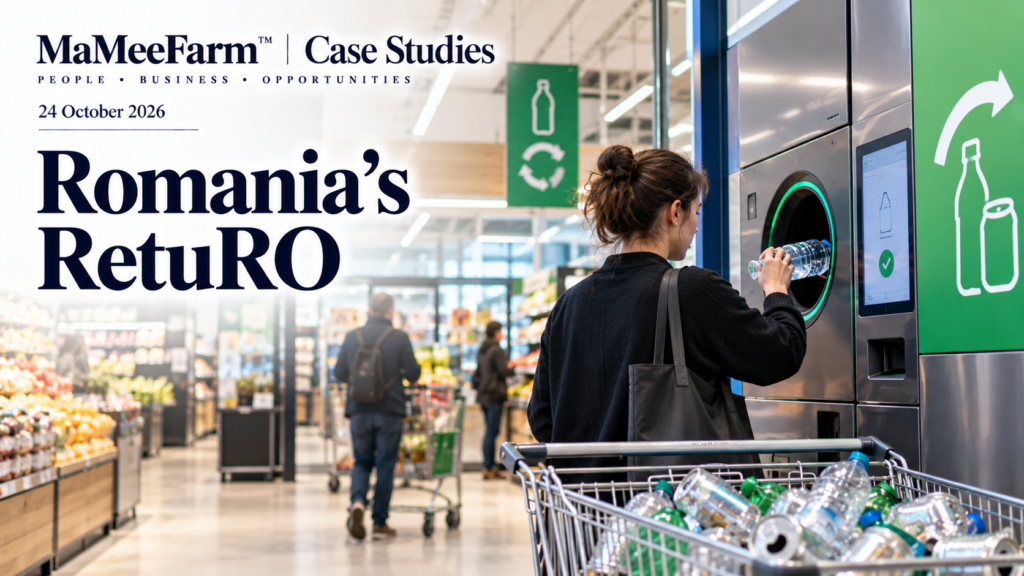
Containers can be returned through automated reverse vending machines or accepted manually at designated collection points.
RetuRO, the organization responsible for administering the system, brings together beverage producers, retailers, and the Romanian state within its ownership structure.
This arrangement connects organizations that participate at different stages of the beverage packaging lifecycle.
Producers place packaged products on the market. Retailers sell those products and provide collection access. Consumers return eligible containers, while the system operator coordinates the movement of recovered materials toward recycling.
The Retailer Becomes a Collection Point
For retailers, a deposit return system introduces activities beyond conventional product sales.
A shop normally receives goods from suppliers and sells them to customers.
Under the RetuRO system, participating retailers also receive empty packaging moving in the opposite direction.
This creates a reverse flow of materials through the retail network.
Collection points must accept eligible containers, process deposit refunds, and arrange for accumulated packaging to enter the wider collection system.
Larger locations may use reverse vending machines to automate parts of the process.
Other collection points may handle returns manually.
Both arrangements require operating space, staff or equipment, and procedures for managing the containers after customers leave them behind.
The retailer therefore performs a service that connects consumer participation with the national recovery network.
Why Deposit Refunds and Handling Fees Are Different
The system distinguishes between the deposit returned to consumers and the handling fee paid to retailers.
The deposit refund gives customers back the amount they paid when purchasing an eligible beverage.
The handling fee compensates retailers for their role in operating collection points.
These payments serve different purposes.
One supports consumer participation. The other recognizes that receiving and managing returned packaging creates work for the retail business.
Retailers may need to allocate space for returned containers, maintain collection equipment, manage staff responsibilities, and prepare packaging for collection.
The handling-fee arrangement provides a commercial mechanism associated with these activities.
However, receiving a handling fee does not automatically establish that every retailer operates its collection point profitably.
Operating costs can differ according to store size, return volumes, equipment, staffing, and collection arrangements.
Connecting Containers with Transaction Records
A deposit return system must manage both physical packaging and the transactions associated with it.
When a customer returns an eligible container, the system needs to recognize the item and process the appropriate refund.
Automated collection points use reverse vending machines to identify and record accepted packaging.
Manual collection follows a different process, with eligible containers subsequently identified and counted through RetuRO’s operating arrangements.
The system must also account for the materials collected from participating locations.
This creates a connection between the number of containers accepted, the deposits refunded, and the quantities entering the collection network.
The records support financial reconciliation between participating businesses and the system operator.
They also provide information needed to manage the movement of recovered packaging.
For retailers, the service therefore involves more than storing empty bottles and cans.
It becomes part of an organized transaction and materials-handling system.
The Logistics Network Behind the Return Point
A container returned to a shop has not yet completed its journey.
It still needs to move from the collection point into a network capable of handling large volumes of packaging.
RetuRO’s operating model connects collection points with transport services, regional facilities, and recycling partners.
The recovered materials require collection, counting, sorting, and onward movement.
Different packaging materials also have different handling and processing requirements.
Glass, metal, and plastic cannot simply be treated as identical materials once they enter the recovery network.
Their physical characteristics affect storage, transportation, sorting, and recycling operations.
The development of this infrastructure requires investment.
ING has reported providing RON 426 million in green financing to support implementation of Romania’s deposit return system.
That financing represents a disclosed contribution to the programme rather than its total implementation cost.
The investment illustrates the scale of infrastructure needed to support a nationwide service involving large numbers of retail collection points.
Collection and Recycling Are Different Stages
The RetuRO system has developed into a major channel for recovering beverage packaging in Romania.
Its public reporting tracks containers placed on the market, packaging returned through the system, and materials transferred into recycling activities.
These measures describe different stages of the process.
A container placed on the market represents eligible packaging entering commercial circulation.
A returned container represents packaging recovered through the deposit return network.
Material delivered to recycling facilities has moved further through the system.
Processing that material into usable recycled output is another stage.
The distinction matters because collecting packaging does not automatically mean that all of it has become new recycled material.
Actual recycling results depend on the quantities accepted for processing, material losses, technical conditions, and the output of recycling facilities.
The system’s development demonstrates the ability to organize collection across a national retail network, while final recycling outcomes require their own measurements.
The Commercial Challenge of Reverse Logistics
RetuRO illustrates how a retail network can support the movement of materials in two directions.
Products travel from producers and distributors toward consumers.
After consumption, eligible packaging moves back through collection points toward sorting and recycling facilities.
These flows involve different operating requirements.
New products arrive as commercial inventory intended for sale.
Returned packaging arrives as used material that must be identified, accepted, stored, and transported.
The deposit creates an incentive for consumers to participate.
Retail collection points provide accessible locations for returns.
Handling fees recognize the operational role performed by retailers.
The system operator coordinates the wider collection and recovery network.
Each participant contributes a different function to the service.
The arrangement also creates costs that must be managed across the system, including collection equipment, transport, facility operations, and administration.
Its financial sustainability depends on how those responsibilities and costs are supported over time.
What the RetuRO Case Reveals
Romania’s deposit return system demonstrates how circular economy services can be organized through existing commercial networks.
The programme connects consumer behaviour with retail operations and specialized material-recovery infrastructure.
Its significance extends beyond the deposit itself.
A financial incentive may encourage consumers to bring packaging back, but the system must also provide accessible collection points and reliable arrangements for moving the recovered material onward.
Retailers become part of that infrastructure by receiving containers and processing refunds.
Transport and recovery facilities provide the next connection, allowing collected packaging to move toward recycling.
The case illustrates how an everyday consumer action can depend on substantial coordination between businesses, infrastructure operators, and public institutions.
It also highlights the distinction between collecting a material and completing its recovery.
A successful return is an important first step, but further handling and processing determine what happens next.
RetuRO’s experience shows that circular services require more than a willingness to return used products.
They require an operating network capable of receiving those products, managing the associated transactions, and moving materials toward their next productive use.
Sources
- RetuRO – Consumer FAQ and Deposit Return System
- RetuRO – Retailer Guidance
- European Circular Economy Stakeholder Platform – RetuRO
- ING Bank Romania – RON 426 Million Green Financing Announcement, July 2023
MaMeeFarm™
People • Business • Opportunities