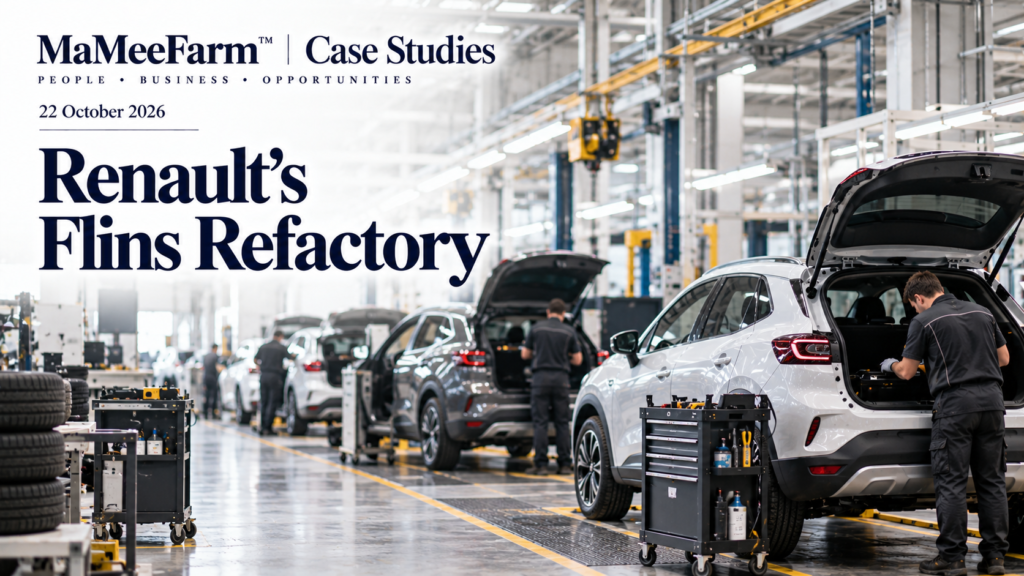
MaMeeFarm™ Case Studies | Automotive Operations • Industrial Transformation • Circular Economy
22 October 2026
Every used car arrives with a different history.
One may need mechanical repairs. Another may require bodywork, replacement components, or cosmetic preparation before it can return to the market.
Unlike manufacturing new vehicles from standardized components, refurbishing used cars means working with products that have already experienced years of individual use.
For Renault Group, transforming its historic Flins factory in France into a centre for circular automotive activities created an opportunity to apply industrial manufacturing capabilities to this different kind of work.
At the heart of that transformation is the Renew Factory, an operation designed to refurbish used vehicles through organized production processes rather than relying entirely on conventional workshop arrangements.
The project illustrates how an established manufacturer can develop new industrial activities around vehicles that have already completed their first period of ownership.
From Vehicle Manufacturing to a New Industrial Role
Renault announced its plans to transform the Flins site in November 2020.
The factory, which had produced vehicles for decades, was to become a centre for activities associated with extending vehicle life, repairing components, recovering materials, and developing circular mobility services.
The used-car refurbishment operation began in September 2021 and was formally inaugurated that November.
By the time of the inauguration, Renault reported that more than 1,500 vehicles had already been refurbished.
The transformation took place gradually rather than through an immediate replacement of all existing operations.
Production of the Renault Zoe and vehicle body assembly continued at Flins until March 2024, when those manufacturing activities ended.
The wider Refactory subsequently brought together several distinct industrial functions, including used-car refurbishment, repair of heavily damaged vehicles, battery-related activities, and remanufacturing of components.
Within this larger site, the Renew Factory focuses on preparing used vehicles for further commercial use.
Bringing Factory Organization to Used-Car Refurbishment
A conventional automotive production line begins with defined components and a planned manufacturing sequence.
Used-car refurbishment starts with uncertainty.
Vehicles arrive with different mileage, mechanical conditions, maintenance histories, and repair requirements.
Renault’s approach applies structured industrial processes to this variation.
Vehicles undergo initial checks to identify their condition and the work required. Mechanical repairs, bodywork, paint preparation, and cosmetic improvements can then be organized according to the needs of each vehicle.
The operation also uses digital systems to track progress through refurbishment.
This gives participating businesses greater visibility into where a vehicle stands in the process and which activities remain outstanding.
The approach does not eliminate differences between vehicles. Instead, it creates a more organized way to manage those differences across a larger volume of work.
Why Parts and Scheduling Matter
Identifying a vehicle’s problems is only one part of preparing it for resale.
The necessary components must also be available, and the work must be scheduled so that repairs can proceed without unnecessary interruption.
A vehicle awaiting a replacement part occupies time and potentially space without moving closer to completion.
At industrial scale, those interruptions can affect the movement of other vehicles through the facility.
Renault’s refurbishment model brings together diagnosis, repair planning, parts supply, and production coordination.
The Flins operation also benefits from the group’s wider automotive capabilities, including technical expertise and access to component-related activities.
These connections are particularly relevant when refurbishing vehicles from different manufacturers.
A multi-brand operation must accommodate varying technical specifications and repair requirements while maintaining consistent service standards.
The commercial challenge is not simply completing individual repairs. It is organizing the work so that a continuous flow of vehicles can move through the facility.
Preparing a Vehicle for Its Next Customer
Refurbishment is not complete merely because the mechanical work has finished.
A vehicle returning to the market must also pass the necessary checks and be presented to potential buyers.
Renault incorporated technical inspection and vehicle photography into the Flins operation.
Its production system includes facilities for creating images that can be used in online vehicle listings.
This connects workshop activity with the commercial process of bringing a refurbished vehicle back to market.
Rather than treating photography and sales preparation as entirely separate activities after the vehicle leaves the factory, they can form part of the broader refurbishment sequence.
The arrangement illustrates how industrial and retail requirements meet in the second-hand automotive business.
The factory prepares the vehicle to the required condition, while commercial channels connect it with its next customer.
Industrial Capacity and Commercial Partnerships
Renault’s published site information identifies annual refurbishment capacity of up to 45,000 vehicles within an 11,000-square-metre facility.
That capacity indicates the scale for which the operation is designed, rather than the number of vehicles actually refurbished each year.
Actual production depends on the number and condition of incoming vehicles, available parts, staffing, repair requirements, and demand from commercial customers.
The development of external partnerships demonstrates another dimension of the operation.
In March 2026, Renault announced a partnership with vehicle leasing company Ayvens in France.
The cooperation supported Ayvens’ Re-Lease offering, which provides refurbished used vehicles through its leasing business.
The companies stated that their collaboration had begun in 2025 and had already involved nearly 5,000 vehicles.
The arrangement also highlighted the Renew Factory’s ability to handle vehicles from multiple brands.
For Renault, the partnership provided a commercial application for its industrial refurbishment capabilities.
For Ayvens, it offered access to an established automotive manufacturer’s technical facilities and refurbishment processes.
The reported vehicle volume demonstrates activity within the partnership, although it does not represent total factory production or establish the financial performance of either company.
A New Business Activity for an Established Factory
The Flins transformation represents more than a change in the type of vehicles moving through a production facility.
Traditional automotive manufacturing creates new products for sale.
Refurbishment works with vehicles that already exist, seeking to restore their condition and prepare them for further use.
That creates a different relationship between industrial capacity and commercial demand.
The availability of incoming vehicles depends on sources such as dealerships, fleet operators, and leasing companies.
The work required depends on each vehicle’s condition.
Revenue opportunities are connected to refurbishment services and the wider second-hand vehicle market rather than exclusively to the production of new cars.
The transition also involves workforce development.
Renault introduced training activities to help employees move into new roles associated with refurbishment and other circular automotive operations.
Existing manufacturing experience provides a foundation, but inspecting, repairing, and preparing used vehicles requires a different combination of tasks from assembling new cars.
The transformation therefore extends across facilities, employee capabilities, suppliers, and commercial relationships.
The Challenges of Industrial Transformation
Developing a functioning refurbishment operation does not remove the broader challenges facing a transformed industrial site.
The future of Flins remains connected to investment decisions, the development of new activities, workforce requirements, and demand for the services the site provides.
On 16 September 2026, French newspaper *Le Parisien* reported that CGT and CFDT representatives had mobilized following a management investment decision affecting the site.
Union representatives expressed concern about the implications for industrial activity and employment at Flins.
The reported dispute highlights continuing uncertainty surrounding particular investments at the site. It does not establish that Renault has formally decided to close the Refactory or end its used-car refurbishment business.
The existence of an operating refurbishment business and uncertainty surrounding other industrial investments can coexist.
For Renault, the long-term significance of Flins will depend not only on establishing new activities but also on sustaining the industrial and commercial conditions that support them.
What the Renault Case Reveals
Renault’s Renew Factory demonstrates how industrial capabilities can be applied to products that have already entered the market.
The operation brings together vehicle diagnosis, repair work, parts supply, technical inspection, and commercial preparation within an organized production environment.
Its development also shows how refurbishment can support relationships between automotive manufacturers and businesses operating in the used-vehicle market.
The Ayvens partnership provides an example of that connection, linking industrial refurbishment capacity with a leasing company’s commercial offering.
Yet capacity and commercial activity do not automatically establish profitability or environmental savings.
Those outcomes depend on actual operating performance, the condition and volume of vehicles processed, resources consumed, and the economic value created through refurbishment.
The broader significance of Flins lies in the changing role of an automotive factory.
Instead of creating value only by manufacturing new vehicles, industrial facilities can also support the continued use of vehicles already in circulation.
That requires more than repair expertise.
It requires the ability to manage different vehicle conditions, coordinate production resources, maintain quality, and connect completed work with commercial demand.
Renault’s Flins Refactory illustrates how those responsibilities can be brought together at industrial scale, while the continuing transformation of the site shows that building a new industrial activity and securing its long-term future remain separate challenges.
Sources
- Renault Group, November 2020 – Flins Refactory Transformation Announcement
- Renault Group, November 2021 – Used-Car Factory Inauguration
- Renault Group – Flins Refactory Site Profile
- Renault Group, March 2026 – Ayvens France Partnership
- Le Parisien, September 2026 – Flins Industrial Investment Dispute
MaMeeFarm™
People • Business • Opportunities