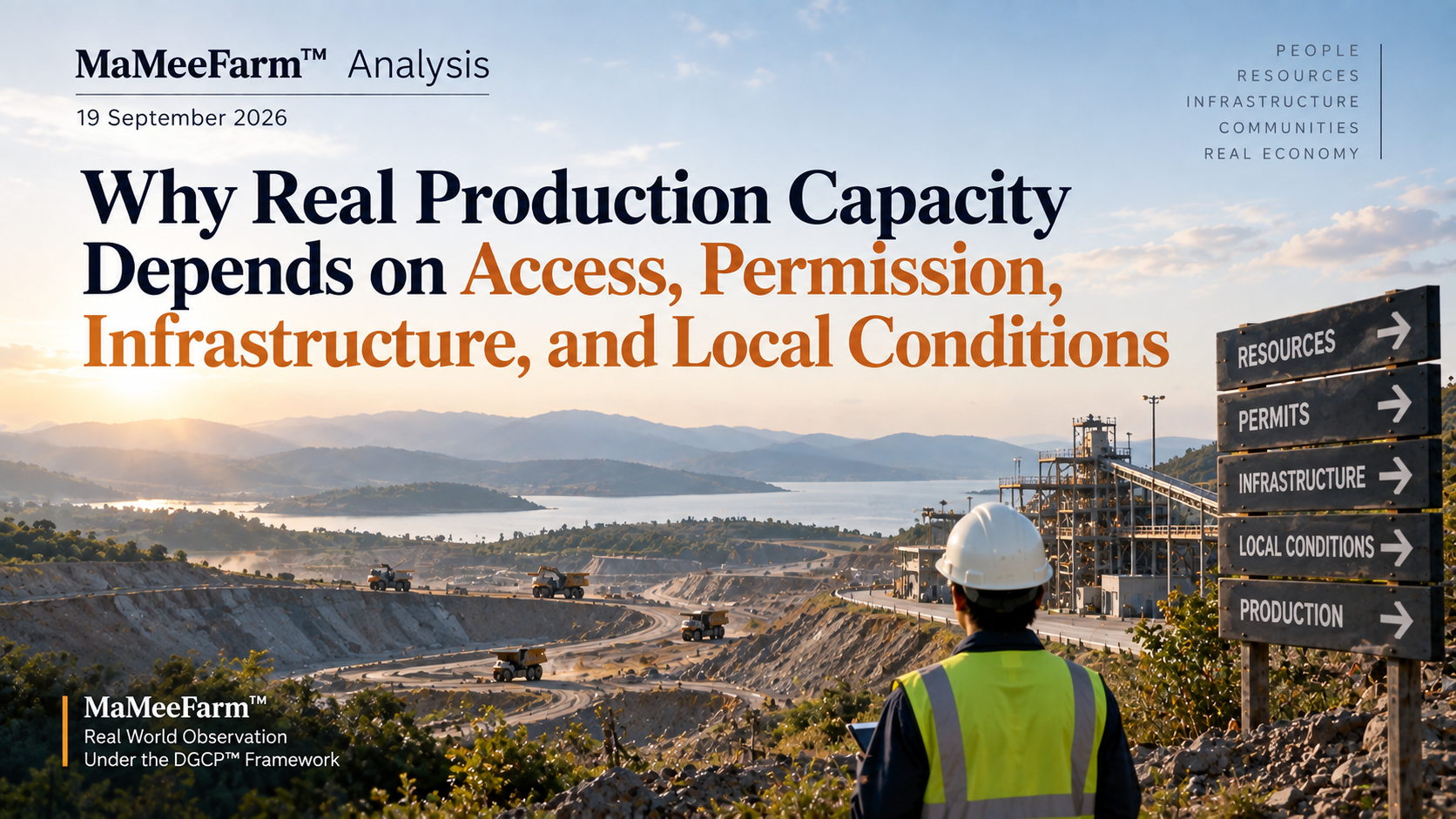
Production capacity is often described through resources,
machines, land, labor, or installed equipment.
But the presence of productive assets does not automatically mean
that their full productive potential can be used.
Producers also depend on whether essential inputs can be obtained,
infrastructure is usable, operating requirements can be met,
and local conditions allow activity to continue.
Real production capacity is therefore different from capacity that exists only in theory.
It reflects what can actually be used under real operating conditions.
Core Observation
Productive assets create potential.
Real production depends on whether that potential can actually be used.
Resources Alone Do Not Create Output
A region may contain water, minerals, energy resources, agricultural land, or access to industrial inputs.
Yet the presence of those resources does not automatically generate production.
Inputs may still need to be obtained and delivered. Equipment may require electricity. Materials may require transport. Finished products may need storage and a route to market.
The difference between potential and actual output often appears in the conditions surrounding production.
Access Determines What Can Actually Be Used
A producer may know that electricity exists in the wider system, water exists in the region, or materials exist in the market.
That does not necessarily mean those resources are available at the point where production takes place.
Distance, cost, quantity, timing, quality, supply interruptions, and local distribution conditions can all affect whether an available resource becomes a usable input.
For production, availability becomes meaningful only when the required resource can actually be obtained.
From Potential to Production
A resource or productive asset has economic value when
the producer can actually obtain, support, and use it
under workable operating conditions.
Permission Can Affect Whether Production Proceeds
Technical capability is not always enough for production to begin or expand.
Depending on the activity and location, a producer may need land access, operating authorization, connection approval, resource use rights, or other forms of permission.
When a required approval is unavailable or delayed, productive assets may remain in place while actual operation remains limited.
Practical production capacity therefore depends partly on whether the activity can lawfully and operationally proceed.
Infrastructure Connects Productive Potential to Use
Infrastructure allows resources, inputs, energy, information, and finished products to move.
Roads, power connections, water systems, storage facilities, processing capacity, transport networks, and communications infrastructure can all affect production conditions.
A producer may be located close to a valuable resource but still face practical limitations if the supporting infrastructure is weak, congested, unreliable, or insufficient.
Infrastructure therefore influences how much of the available productive potential can actually be used.
Local Conditions Change What Is Practically Possible
Conditions at the production site can also affect practical capacity.
Weather, terrain, workforce availability, service reliability, maintenance conditions, local market access, and other site-specific factors may influence how easily production can continue.
This means that two producers with similar equipment or access to similar resources may still experience different operating conditions.
Headline capacity figures do not always capture those local differences.
Installed Capacity and Usable Capacity Can Differ
A producer may still own the same machinery, land, buildings, and equipment during a disruption.
But the amount of production those assets can support may fall if electricity becomes unreliable, water becomes insufficient, inputs are delayed, transport access weakens, or another essential operating condition changes.
The physical assets have not disappeared.
What has changed is how much of their productive potential can actually be used.
The Point of Production Reveals the Practical Difference
Broad statistics can describe the amount of resources, infrastructure, or installed capacity within a larger system.
Producers operate at the point where those wider conditions become real operating conditions.
A system may appear well supplied in aggregate while a particular producer still faces a connection limit, delivery problem, local shortage, delayed approval, or another practical constraint.
This is why local production conditions can differ from what wider capacity numbers appear to suggest.
MaMeeFarm™ Note
Real production capacity is not defined only by what exists.
It is reflected in what a producer can actually use
under the conditions present where production takes place.
Resources, equipment, and infrastructure establish productive potential.
Actual production depends on whether that potential remains accessible and usable under real operating conditions.
This is why capacity on paper and capacity in practice can produce very different pictures.
For the producer, the meaningful question is not only what exists, but what can actually support real work.