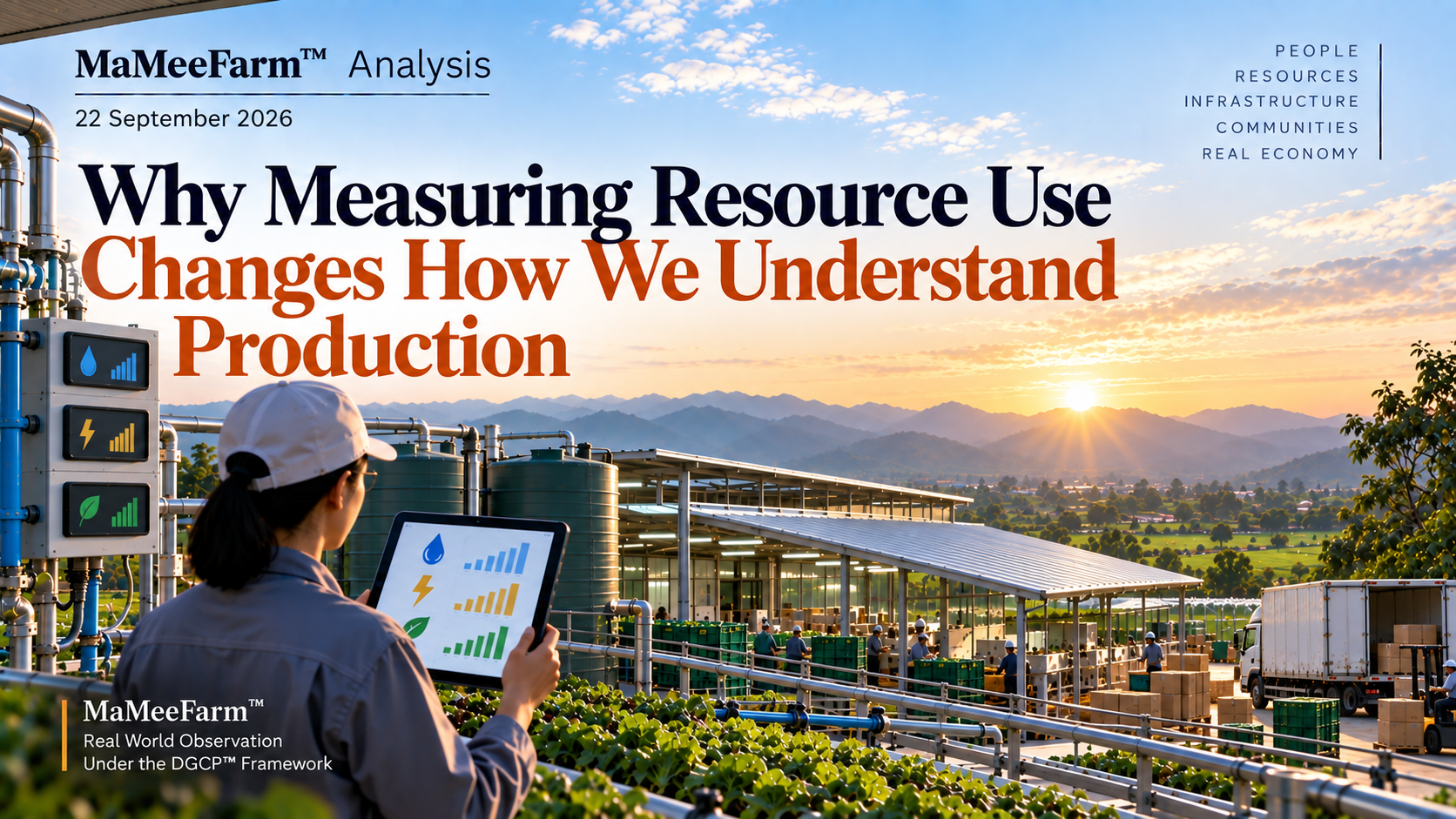
It is one thing to know that a production system uses electricity,
water, fuel, labor, or other inputs.
It is another to know how much it uses,
when that use occurs, and what level of production it supports.
Production is often discussed in broad terms.
A factory consumes electricity.
A farm requires water.
Transport depends on fuel.
These statements describe real dependencies,
but they provide only a general picture.
Measurement adds detail.
It can make resource use more visible,
show how use changes over time,
and provide better context for understanding
how resources relate to actual production activity.
Core Observation
Resource use becomes more informative
when quantity, timing, and production activity
can be observed together rather than discussed only in general terms.
Knowing a Resource Is Used Is Not the Same as Understanding Its Role
Nearly every production system depends on resources.
Machinery may use electricity or fuel.
Crops require water.
Processing uses labor and equipment.
Transport consumes energy and time.
Without measurement, however,
these observations remain broad.
They show that a resource matters,
but not how much is being used,
whether use is stable or changing,
or how that use relates to production activity.
Quantity Reveals the Scale of Resource Use
Measuring quantity provides a clearer view of scale.
It can show whether resource use is relatively small,
concentrated, rising, falling,
or changing alongside production volume.
A system that uses electricity is not necessarily energy intensive.
A farm that uses water is not automatically water intensive.
Those descriptions require context.
The amount used, the type of activity,
the operating conditions, and the resulting output all matter.
Once quantity becomes visible,
discussion can move beyond general assumptions
toward observable operating conditions.
Timing Reveals When Resource Dependence Matters Most
Production does not use every resource evenly across time.
Electricity demand may rise during processing periods.
Water demand may increase during irrigation windows.
Fuel consumption may rise during harvesting,
transport, or other intensive operating periods.
Measuring when resources are used can therefore reveal
operating patterns that total consumption alone may not show.
A system may use a moderate amount of electricity overall
while depending heavily on reliable power during a short production window.
A farm may use a limited annual volume of water
while still depending strongly on supply during a critical seasonal period.
Timing adds operational context to the quantity being measured.
Output Gives Resource Use More Meaningful Context
Resource use becomes more informative
when it can be considered alongside production output.
Electricity consumption alone tells only part of the story.
The same is true for water, fuel, labor,
or other production inputs.
Output provides context for what that resource use is supporting.
A change in resource consumption may reflect higher output,
a different production process,
changes in operating conditions,
greater resource intensity,
or several factors acting together.
For this reason,
a single resource figure should not automatically be treated
as proof that a system has become more or less efficient.
The relationship between inputs and output
needs to be understood in the context of the production activity being observed.
Measurement Can Reveal Constraints That Broad Observation Misses
A production system may appear stable
when viewed only through final output.
Measurement can sometimes reveal changes underneath that apparent stability.
Electricity use may rise faster than production.
Water use may become concentrated in one part of the process.
Fuel consumption may increase while output remains unchanged.
These patterns do not explain themselves.
But they can show where further observation is needed
and where resource pressure may be changing
even when headline production remains stable.
Better Visibility Changes Operational Understanding
Once resource use becomes visible,
production can be understood with greater specificity.
A producer may be able to see
when electricity demand is highest,
which activity requires the most water,
when fuel consumption increases,
or where resource use changes alongside output.
Measurement does not automatically provide a solution.
It improves visibility.
Instead of relying only on general impressions,
observations can be connected more closely
to actual operating patterns.
Production Looks Different Once Resource Use Becomes Visible
The wider importance of measurement is not only technical.
It changes how production itself can be observed.
Two farms may produce similar output
while using water differently.
Two factories may appear similar in scale
while having very different electricity profiles.
A process that looks small in physical size
may still depend heavily on a particular resource
during a narrow operating period.
Measurement makes these differences more visible
without assuming that one operating pattern is automatically better than another.
MaMeeFarm™ Note
A production system becomes easier to understand
when resource use is not only acknowledged,
but observed in terms of quantity,
timing, and the production activity it supports.
Production depends on resources,
but knowing that dependence exists
is different from understanding how it operates.
Measurement makes resource use more visible.
It can reveal scale,
timing,
changing operating patterns,
and the relationship between resource use and output.
It does not remove the need for context,
and measurement alone does not establish cause or efficiency.
What it provides is a stronger observational basis
for understanding how real production systems actually operate.