Publication Date: 24 October 2026 Category: Research Region: Europe / Global Focus: Land Use · Wildfire Resilience · Rural Development · Preventive Infrastructure
Abstract
Infrastructure is commonly associated with roads, bridges, electricity networks, drainage systems, and other constructed assets.
However, some forms of public protection depend on activities that are less visible.
Agricultural land is grazed, vegetation is cut, orchards are maintained, forest edges are managed, and rural access routes remain usable through repeated human activity.
When those activities decline, the physical landscape can change.
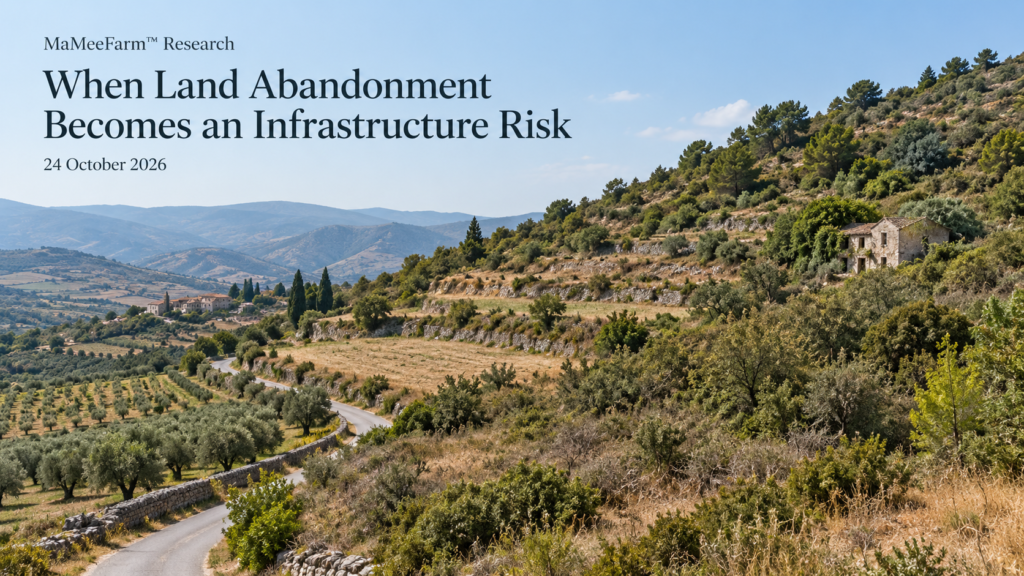
Across parts of Europe, rural depopulation and agricultural land abandonment have reduced traditional land-management practices. In some locations, shrubs and other vegetation have expanded across previously managed areas, increasing the continuity of combustible material.
These changes can influence wildfire behaviour.
They do not mean that abandoned land automatically causes fires. Wildfire risk also depends on weather, drought, wind, ignition, topography, vegetation characteristics, and emergency-response capacity.
Nevertheless, European institutions increasingly recognize that land abandonment and insufficient active management can contribute to more difficult wildfire conditions.
This raises a broader infrastructure question.
If repeated land maintenance helps protect settlements, roads, utilities, and surrounding communities, should that maintenance be considered part of preventive infrastructure?
This research examines how rural demographic change, landscape management, and wildfire resilience intersect, with particular attention to the economic and institutional challenges of maintaining land across fragmented ownership boundaries.
1. How Rural Depopulation Changes the Landscape
Agricultural land abandonment often begins as an economic or demographic process.
Farming may become less profitable, landowners may age, younger residents may migrate, and rural services may decline.
As agricultural activity contracts, fewer people remain available to maintain fields, pastures, orchards, and access routes.
The resulting changes are not always immediately visible.
A former pasture may gradually accumulate shrubs. Agricultural boundaries may become less distinct. Trees may establish on previously cultivated land.
These processes vary according to climate, soil, vegetation, and previous land use.
Some abandoned land develops into woodland. Other areas remain grassland or undergo different ecological transitions.
Abandonment should therefore not be treated as a single environmental outcome.
In some locations, natural regeneration can provide ecological benefits, including habitat development, carbon storage, and soil protection.
In other locations, reduced management may contribute to vegetation conditions that increase wildfire exposure.
The European Commission has identified rural depopulation, abandonment of traditional farming practices, and insufficient active forest management as factors contributing to biomass accumulation in parts of Europe.
The important issue is not simply whether land remains agricultural or becomes forested.
It is how changes in vegetation and management affect the surrounding landscape.
2. Why Land Abandonment Can Increase Wildfire Risk
Wildfire behaviour is influenced by the amount, condition, and arrangement of combustible vegetation.
When previously managed fields and pastures undergo vegetation change, combustible material may become more continuous across a landscape.
This can create conditions in which fire encounters fewer interruptions between different vegetation areas.
However, fuel accumulation is only one component of wildfire risk.
High temperatures, prolonged drought, low fuel moisture, strong winds, and ignition conditions can all influence whether a fire starts and how it spreads.
Topography and suppression capacity also matter.
The relationship between land abandonment and wildfire is therefore conditional rather than automatic.
A managed agricultural landscape can still burn under severe conditions.
An unmanaged landscape does not necessarily experience destructive wildfire.
The European Commission’s integrated wildfire-risk approach recognizes that climate change and land-management changes can interact, particularly in Mediterranean regions.
This interaction is important because the same vegetation conditions may produce different outcomes under different weather conditions.
It also explains why expanding forest cover should not be treated as inherently harmful.
Forests provide important ecological services.
The relevant question is whether their structure, surrounding land uses, and management are appropriate for local wildfire exposure.
3. Land Maintenance Can Provide a Preventive Function
Agriculture contributes more than food production in some rural landscapes.
Grazing, mowing, pruning, and other management practices can influence vegetation growth and the continuity of combustible material.
Where suitable, these activities may help reduce fuel loads or create managed areas that slow fire spread.
European wildfire-prevention guidance identifies several relevant practices, including extensive grazing, sustainable forest management, vegetation thinning, and strategically maintained firebreaks.
The effectiveness of each approach depends on local conditions.
Grazing may reduce grasses and shrubs in appropriate areas, but excessive grazing can damage soils and ecosystems.
Mechanical vegetation management can target specific locations, although repeated treatment may be necessary.
Prescribed burning can reduce fuel under carefully controlled conditions, but it requires professional oversight and appropriate weather and safety conditions.
These approaches are not interchangeable.
Nor can any single intervention guarantee protection against wildfire.
Their importance lies in the potential to reduce exposure and improve the conditions under which emergency services respond.
Land maintenance can therefore perform a preventive function when it is appropriately designed, located, and sustained.
4. Productive Landscapes Can Support Fire Prevention
One challenge in wildfire prevention is maintaining treated land after the initial intervention.
Vegetation regrows.
A firebreak that is cleared once may gradually lose effectiveness if maintenance stops.
This creates recurring financial and operational requirements.
Some regions are exploring ways to connect wildfire prevention with economically productive land use.
Grazing, orchards, agroforestry, and other managed activities may help maintain areas with lower fuel continuity while also generating agricultural income.
The European Commission’s RESIST initiative in Extremadura, Spain, provides an example.
The project promotes landscape approaches that combine productive fuel breaks, agroforestry mosaics, participatory planning, and preventive public forest management.
In October 2026, the EU Mission on Adaptation to Climate Change reported plans to expand this approach in high-risk pine-forest areas of Extremadura.
The proposed initiative aims to convert part of the region’s continuous high-risk pine stands into more varied, actively managed landscapes.
These measures illustrate an important possibility.
Where land use generates sufficient economic value, ongoing agricultural activity may help support maintenance that also contributes to wildfire resilience.
However, productive land management is not feasible everywhere.
Steep terrain, remote locations, weak markets, or poor agricultural conditions may limit its economic viability.
In such areas, public or ecological management may remain necessary.
The appropriate approach depends on the landscape rather than a universal requirement to restore farming.
5. Fragmented Ownership Creates a Coordination Problem
Wildfire risk rarely follows property boundaries.
A fire can move across privately owned parcels, public land, forests, farmland, and settlement areas.
Yet the responsibility for managing these areas is often divided among different owners and institutions.
This creates difficulties when effective prevention requires coordinated activity across an entire landscape.
A landowner may maintain one property while neighbouring areas remain unmanaged.
A strategically important corridor may cross numerous parcels with different owners, financial resources, or management priorities.
Some owners may live elsewhere.
Others may lack the income required for repeated vegetation management.
Unclear ownership or unresolved inheritance arrangements can create additional barriers.
These challenges are not necessarily technical.
Authorities and land managers may understand which treatments are appropriate but still face difficulties implementing them across connected areas.
Collective arrangements can help address this problem.
Landowner associations, cooperatives, municipalities, and regional programmes may coordinate management across multiple properties without requiring all land to have the same owner.
The purpose is to match the scale of management more closely to the scale of wildfire exposure.
European adaptation initiatives increasingly recognize participatory landscape governance as part of this response.
6. Who Should Pay for Preventive Land Management?
Land maintenance creates costs.
Vegetation must be cut or managed, access routes maintained, equipment operated, and treatments repeated as conditions change.
For individual landowners, these expenses may be difficult to justify when the land generates limited income.
However, the benefits of maintenance may extend beyond the property itself.
Reduced fuel continuity or improved access can potentially protect neighbouring land, settlements, transport corridors, and utility infrastructure.
This creates a public-policy question.
When the benefits of prevention are shared across a community, should the costs remain entirely with individual owners?
European agricultural and rural-development policies already provide mechanisms that can support wildfire prevention and sustainable land management.
The European Commission identifies the Common Agricultural Policy as one source of support for preventive investment, extensive grazing, agroforestry, and forest management.
Such programmes demonstrate that land management can have public value beyond agricultural production.
However, public financing is not automatically the most efficient solution in every location.
Different arrangements may involve landowner contributions, agricultural support, municipal programmes, regional funding, or other incentives.
The appropriate balance depends on local risks, ownership arrangements, public benefits, and the cost of intervention.
The central financial challenge is continuity.
A one-time investment may create a managed area, but maintaining its protective function can require expenditure over many years.
7. Preventive Infrastructure Must Be Maintained Over Time
Roads, drainage networks, and electricity infrastructure require ongoing maintenance to remain functional.
Landscape-based wildfire prevention has a similar characteristic.
Vegetation changes over time.
Access routes can become overgrown or damaged.
Previously treated areas may require additional work as fuel accumulates again.
This means that the effectiveness of preventive land management cannot be judged solely by whether an intervention was completed.
Its continuing condition matters.
The analogy with infrastructure is particularly relevant where managed land supports access, reduces exposure, or helps emergency services operate.
Rural tracks and water points, for example, can serve agricultural purposes during normal conditions while also supporting wildfire response.
The loss of routine land management may therefore affect both vegetation conditions and access to the landscape.
However, describing stewardship as preventive infrastructure does not mean that every field, pasture, or woodland must receive the same treatment.
Management should reflect ecological conditions and the exposure of nearby communities and assets.
The aim is to maintain useful protective functions where they are justified, rather than to remove vegetation indiscriminately.
8. Landscape Resilience Requires Selective and Coordinated Action
Wildfire prevention involves difficult choices about land use.
Some abandoned areas may be suitable for natural regeneration.
Others may require active management because of their proximity to settlements, roads, electricity infrastructure, or evacuation routes.
A diverse landscape containing forests, farmland, pastures, orchards, and naturally regenerating areas may provide ecological and operational benefits.
However, diversity alone does not guarantee wildfire protection.
The arrangement of vegetation, local weather conditions, management practices, and the location of vulnerable assets remain important.
European institutions increasingly support approaches that combine landscape planning with sustainable management and community participation.
The objective is not universal agricultural restoration.
Nor is it universal vegetation clearing.
It is to maintain appropriate land conditions where they can reduce wildfire exposure while preserving ecological and economic value.
This requires cooperation among landowners, farmers, forest managers, local authorities, and regional institutions.
It also requires recognizing that wildfire prevention is not solely an emergency-service responsibility.
Rural development, agricultural policy, environmental management, and infrastructure planning can all influence the conditions in which fires occur.
Research Conclusion
Land abandonment is often described as a demographic, agricultural, or environmental transition.
Farms close, rural populations decline, and previously managed land begins to change.
In some locations, those changes include the accumulation of combustible vegetation and the loss of maintained boundaries, tracks, or access areas.
These developments can influence wildfire exposure.
They do not establish that abandonment is the primary cause of wildfires or that every unmanaged landscape is dangerous.
Climate, weather, ignition, vegetation, and emergency-response capacity remain fundamental determinants of fire behaviour.
Nevertheless, European evidence supports the importance of active land management in certain fire-prone landscapes.
The wider significance lies in the recurring nature of that management.
Grazing, mowing, vegetation treatment, and access maintenance may need to continue over many years.
Where these activities reduce risks beyond individual property boundaries, they can provide benefits similar to those associated with preventive infrastructure.
This creates economic and institutional questions.
Private owners may face costs that are difficult to recover through ordinary land use.
The benefits may extend to neighbouring properties, public infrastructure, and surrounding communities.
Fragmented ownership can make coordinated prevention more difficult.
Public authorities and land managers must therefore consider how responsibilities and costs should be shared.
Land maintenance can function as preventive infrastructure when sustained stewardship helps reduce risks that extend beyond individual properties.
This does not require every abandoned field to return to agriculture.
Some landscapes can regenerate naturally.
Others may benefit from grazing, agroforestry, sustainable forestry, or targeted vegetation management.
The appropriate response depends on local conditions and the risks that society seeks to reduce.
The broader lesson is that rural depopulation can remove more than agricultural production.
In some places, it can also weaken the human and institutional capacity that previously maintained the landscape.
When those functions disappear, wildfire resilience may require new arrangements for long-term stewardship.
Land abandonment becomes an infrastructure issue when the loss of maintenance affects the safety and reliability of the wider landscape.
Evidence and Limitations
This research draws on Reuters reporting from October 2026 and European Commission publications concerning wildfire prevention, rural depopulation, and landscape management.
The European Commission identifies land abandonment and insufficient active management as factors that can contribute to biomass accumulation and wildfire risk.
The RESIST initiative in Extremadura provides a documented example of productive fuel breaks and coordinated landscape governance.
The evidence does not establish that land abandonment causes every wildfire, that expanding forest cover necessarily increases fire risk, or that all abandoned land requires intervention.
It does not establish a universal economic return from preventive management or identify a single financing model suitable for every region.
The description of landscape maintenance as preventive infrastructure is an analytical interpretation of its potential public protective function, not a claim that every land-management activity is legally classified as infrastructure.
References
- Reuters. (22 October 2026). How Europe’s Emptying Countryside Is Fuelling a New Wildfire Crisis.
- European Commission. Wildfire Prevention and Restoration in Agriculture and Forests.
- European Commission. Wildfires.
- European Commission. (2026). Integrated Wildfire Risk Management.
- European Commission, EU Mission on Adaptation to Climate Change. (7 May 2026). RESIST Region Success Story: Extremadura.
- European Commission, EU Mission on Adaptation to Climate Change. (6 October 2026). From Pilot to Regional Action: Extremadura to Scale Up Wildfire Prevention Solutions Developed Through RESIST.
- European Commission, EU CAP Network. Recovery of Abandoned Agricultural Lands.
- European Commission, Joint Research Centre. Why Are Forests at Risk?
MaMeeFarm™
People • Business • Opportunities