Publication Date: 1 November 2026 Category: Research Region: Russia / Global Focus: Food Trade · Industrial Infrastructure · Port Logistics · Grain Safety · Supply-Chain Resilience
Abstract
Food-system resilience is often associated with constructing additional infrastructure.
Governments and businesses may invest in new grain terminals, storage facilities, railway connections, or export corridors to reduce dependence on established routes.
However, new infrastructure requires planning, financing, construction, and operational preparation.
When trade routes are disrupted suddenly, these requirements can delay the availability of replacement capacity.
Existing industrial infrastructure may offer another option.
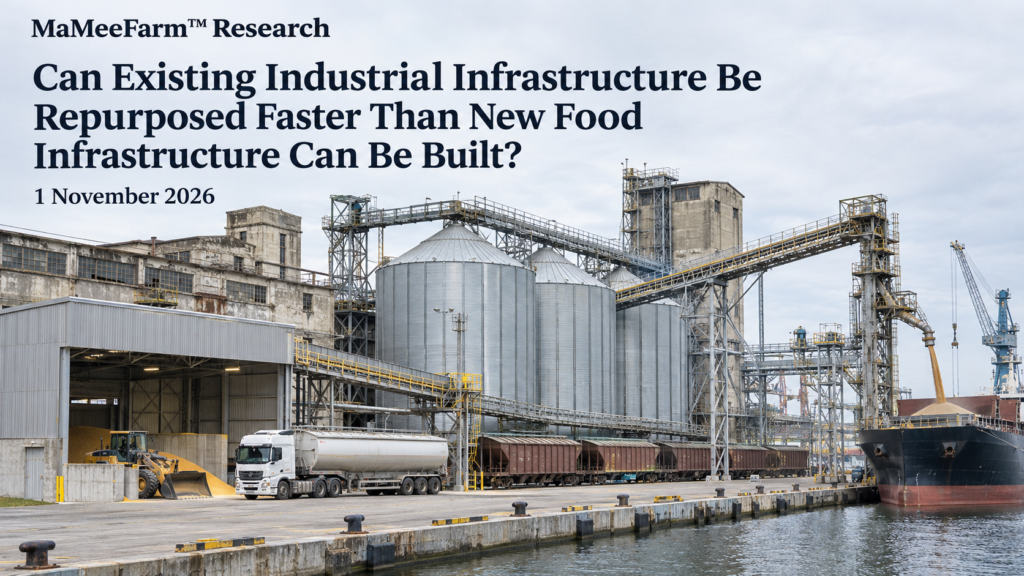
Ports originally designed to handle fertilisers, coal, and other bulk commodities can contain assets that are potentially useful for grain exports.
Berths, rail connections, conveyors, and ship-loading equipment may already be available.
In September and October 2026, Reuters reported that Russian companies were adapting industrial terminals at Baltic and Arctic ports to support grain exports following disruption to established Black Sea routes.
At Murmansk, operators introduced grain-loading arrangements using equipment associated with fertiliser handling and direct transfers from railcars to vessels.
These developments illustrate the potential value of infrastructure adaptation.
However, a terminal capable of moving bulk commodities is not automatically suitable for food or feed.
Grain handling requires attention to contamination, sanitation, quality inspection, moisture, pests, and operational segregation.
The central question is therefore not simply whether existing industrial equipment can move grain.
It is whether that equipment can be adapted into a safe, connected, and operationally useful food-export system quickly enough to respond to disruption.
This research examines the opportunities, limitations, and infrastructure requirements associated with adaptive reuse.
1. Infrastructure Resilience Depends on Adaptability as Well as Capacity
Infrastructure is commonly evaluated according to its designed capacity.
Ports may be assessed by annual cargo throughput, berth availability, storage volume, and loading rates.
These measures help describe how much activity a facility can support under specified conditions.
However, they do not fully explain how an infrastructure system responds when trade patterns change.
A port may have substantial capacity for one commodity but limited ability to handle another.
Conversely, a facility with unused equipment may be capable of supporting a different cargo after suitable modifications.
This introduces adaptability as an important dimension of resilience.
Existing industrial facilities may contain some of the most expensive and time-consuming components of a logistics system.
These include marine access, heavy civil structures, rail connections, utilities, and bulk-handling machinery.
Where such assets can be reused, operators may avoid parts of the construction process associated with a completely new terminal.
However, the existence of these assets does not establish that conversion will be quick or economical.
Equipment compatibility, regulatory requirements, operating conditions, and available transport capacity all influence the outcome.
The relevant measure is not simply the amount of installed infrastructure.
It is how quickly that infrastructure can provide usable throughput for the required commodity.
A smaller facility that becomes operational during an emergency may have greater immediate value than a larger project that cannot be completed until the disruption has passed.
2. Russian Grain Exports Illustrate the Use of Existing Industrial Assets
Russia’s grain-export system has historically depended heavily on southern maritime routes, particularly ports serving the Black Sea.
During 2026, disruption associated with the war in Ukraine affected established export operations.
Russian exporters consequently sought additional routes through Baltic and Arctic ports.
Reuters reported on 21 September that companies were adapting terminals previously used for fertilisers, coal, and other bulk cargoes to accommodate grain exports.
The reported locations included Ust-Luga and Murmansk.
At Murmansk, operators planned to use existing handling equipment and a direct-transfer arrangement to move grain from railway wagons into ship holds.
Reuters reported on 28 October that Murmansk Commercial Seaport and Demetra Holding had begun loading an initial shipment of approximately 3,400 metric tons of grain.
This is evidence that an alternative loading operation was being established using existing port infrastructure.
It does not independently establish the full annual grain-handling capacity of the converted facility.
Nor does it demonstrate that the adapted terminal could match the operating efficiency, storage capacity, or quality-management systems of a purpose-built grain terminal.
The case illustrates the potential usefulness of industrial assets when established trade routes become constrained.
It also shows that infrastructure adaptation can create an additional logistics option without necessarily reproducing every function of a dedicated facility.
3. Bulk-Handling Capability Does Not Establish Food-Grade Readiness
Coal, fertiliser, mineral products, and grain can share certain bulk-handling requirements.
They may be transported through conveyors, hoppers, rail-unloading equipment, and ship loaders.
This mechanical similarity creates opportunities for equipment reuse.
However, grain introduces additional concerns because it may enter food or animal-feed supply chains.
Equipment previously used for industrial commodities may contain residues or materials unsuitable for grain contact.
Potential concerns include chemical contamination, foreign material, lubricants, moisture, pests, and residues from previous cargoes.
The suitability of equipment therefore depends partly on its operating history and the condition of surfaces that may contact grain.
Cleaning, inspection, equipment modification, and separation of cargo-handling systems may be necessary.
Some components may be suitable for conversion.
Others may require replacement or dedicated use.
Grain also requires quality-management procedures that are not necessarily part of an industrial bulk terminal’s original operations.
These may include sampling, grading, monitoring, and controls over the movement and segregation of different grain lots.
USDA Federal Grain Inspection Service guidance illustrates the importance of documented handling practices and monitoring within regulated grain operations.
However, U.S. regulatory procedures should not be presented as automatically governing Russian port operations.
They provide a relevant example of grain-handling controls rather than proof that any particular converted Russian terminal met those requirements.
The broader distinction remains essential.
A terminal can be mechanically capable of moving grain without having demonstrated complete food-grade readiness.
4. Conversion May Shift the Main Constraint From Construction to Operations
Purpose-built grain terminals are designed to integrate multiple functions.
These may include receiving grain, weighing, sampling, inspection, storage, segregation, and vessel loading.
Industrial bulk terminals may already possess some of the necessary equipment.
However, their original configuration may not support the same operating procedures.
Converting such facilities can therefore shift the main challenge from building physical structures to preparing the operating system.
For example, an existing conveyor may be suitable for moving grain after modification.
Yet the wider handling process may still require contamination controls, cleaning procedures, and quality monitoring.
A facility may also need to separate grain from incompatible cargoes or establish dedicated handling arrangements.
The required work depends on the previous cargo, equipment design, intended grain use, and applicable requirements.
These considerations can affect the time needed to begin operations.
A terminal with compatible equipment and limited contamination concerns may be relatively straightforward to adapt.
Another facility may require substantial reconstruction or replacement of handling components.
Consequently, the apparent availability of existing infrastructure does not guarantee rapid conversion.
The actual advantage depends on whether the remaining modifications are less demanding than constructing a new facility.
5. Direct Rail-to-Ship Loading Can Reduce Storage Requirements
One approach to rapid infrastructure adaptation is to transfer grain directly from railway wagons into vessels.
This reduces the immediate need for a complete grain-storage and elevator system.
Reuters reported that Murmansk operators intended to use a direct-transfer method previously associated with potash cargoes.
Such an arrangement can make use of existing rail access and ship-loading equipment.
However, storage facilities normally provide important operational flexibility.
They allow grain to arrive before a vessel is ready.
They can support segregation of different lots, quality assessment, and temporary isolation when problems are identified.
Storage can also help operators manage variations in railway deliveries and vessel schedules.
Direct transfer reduces some of these buffering capabilities.
If a vessel is delayed, arriving railcars may need to wait.
If rail deliveries are interrupted, loading operations may be affected.
The severity of these constraints depends on scheduling arrangements, temporary holding capacity, and the reliability of the transport network.
Direct transfer should therefore be understood as an operational trade-off.
It can help establish loading capability without completing every element of a purpose-built terminal.
However, it may provide less flexibility when transport schedules or cargo quality requirements change.
The value of the arrangement depends on whether its operational limitations remain manageable.
6. A Converted Port Must Be Supported by a Functional Transport Corridor
A port terminal is only one component of a grain-export system.
Grain must travel from agricultural production regions to inland collection points, transport networks, port facilities, and finally vessels.
Each stage must have sufficient capacity for the intended trade flow.
Alternative ports may be located farther from producing regions than established export terminals.
This can increase transport distances, coordination requirements, and costs.
Murmansk illustrates this issue because it is geographically distant from Russia’s principal southern grain-producing areas.
The availability of maritime access does not remove the need to transport grain to the port.
Rail capacity, wagon availability, inland handling facilities, and scheduling can all affect the amount of grain that reaches the terminal.
A converted port may therefore possess unused loading capacity while the railway network becomes the limiting factor.
Similarly, an increase in rail deliveries may create congestion if the port cannot unload or load vessels at a matching rate.
Infrastructure adaptation must consequently be evaluated across the full transport corridor.
The presence of a suitable berth or conveyor is not sufficient evidence that a complete export route can support sustained commercial volumes.
The system must be capable of moving grain through each connected stage.
7. Adaptive Reuse Can Preserve Investment Flexibility
The duration of a trade disruption is often uncertain.
A route may reopen relatively quickly.
Alternatively, restrictions or security risks may persist for an extended period.
This uncertainty creates difficult investment decisions.
Constructing a large new terminal may provide substantial long-term capacity, but it can require significant capital and time.
If the original trade route later becomes available again, demand for the new facility may be lower than expected.
Adaptive reuse can offer an intermediate option.
Existing infrastructure may be modified to provide additional capacity while operators assess the duration and consequences of the disruption.
This can help preserve commercial activity without immediately committing to a completely new logistics system.
Operating an adapted facility may also provide information about actual demand, transport constraints, cargo-handling requirements, and the economics of alternative routes.
Such information can support later investment decisions.
However, adaptive reuse does not always preserve flexibility.
Some conversions may require expensive permanent modifications.
Others may reduce a terminal’s ability to handle its original cargo.
The investment benefit therefore depends on conversion cost, reversibility, operating performance, and the expected duration of demand.
The concept of investment flexibility is an analytical interpretation of the potential value of adaptation.
It should not be treated as a verified financial result for the Russian terminals discussed in this research.
8. Food Infrastructure Resilience Requires Safe and Usable Capacity
The Russian port examples illustrate a broader principle of infrastructure resilience.
Existing industrial assets may provide useful alternatives when established food-trade routes are disrupted.
However, the ability to move grain is only one requirement.
A converted facility must also manage cargo quality, contamination risk, transport connections, and operational coordination.
These requirements determine whether physical capacity becomes usable food-export capacity.
A terminal may have an available berth but insufficient rail access.
It may have compatible conveyors but lack appropriate segregation arrangements.
It may be able to load grain directly into vessels while having limited capacity to manage delays or hold cargo for quality assessment.
These constraints can reduce the practical value of conversion.
The most useful adaptation opportunities are likely to arise where existing infrastructure already provides major civil and logistics assets and where remaining modifications are technically and operationally manageable.
This does not establish that conversion is always preferable to new construction.
A purpose-built terminal may offer better long-term efficiency, storage, quality management, or expansion potential.
The appropriate choice depends on the urgency of the disruption, the expected duration of demand, the condition of existing assets, and the requirements of the intended cargo.
Resilience planning should therefore consider both temporary adaptation and permanent infrastructure investment.
The central objective is to maintain safe and reliable food movement when established routes become unavailable.
Research Conclusion
Food-system resilience depends not only on the quantity of agricultural products available but also on the infrastructure needed to move them.
When established export corridors are disrupted, building entirely new facilities may take longer than the immediate situation allows.
Existing industrial terminals can offer alternative capacity because they may already contain marine access, rail connections, utilities, conveyors, and loading equipment.
The Russian examples reported during September and October 2026 demonstrate that companies were adapting such facilities to support grain exports.
At Murmansk, the reported use of existing equipment and direct rail-to-ship loading illustrates how operators can establish an alternative handling arrangement without first completing a conventional grain terminal.
However, the evidence does not establish that the conversion was universally faster, cheaper, or equivalent in performance to new construction.
Food and feed cargoes require controls that differ from those associated with many industrial bulk commodities.
Cleaning, contamination prevention, quality inspection, segregation, and appropriate operating procedures can become significant conversion requirements.
Transport connections also matter.
A port cannot provide sustained export capacity if grain cannot reach it reliably.
Direct transfer may reduce storage requirements while increasing dependence on the coordination of rail and vessel schedules.
These trade-offs demonstrate that adaptive reuse must be assessed as part of a connected logistics system.
Existing industrial infrastructure can strengthen food-system resilience when its major physical assets are compatible with grain operations and can be adapted safely without creating unacceptable constraints elsewhere in the supply chain.
The most important measure is not simply the amount of infrastructure already constructed.
It is the time required to establish safe, compliant, and operationally useful throughput.
A converted terminal may provide valuable interim capacity during a crisis.
A new purpose-built terminal may remain the better long-term investment under other conditions.
Both options can contribute to resilience when their advantages and limitations are understood.
The central lesson is that industrial infrastructure adaptability can become an important resource for food security, but physical availability must not be confused with operational readiness.
Evidence and Limitations
This research draws on Reuters reporting from 21 September, 22 September, and 28 October 2026 concerning the adaptation of Russian Baltic and Arctic port facilities for grain exports.
The reported Murmansk loading activity establishes the development of an alternative export operation. It does not independently verify the facility’s sustained throughput, food-safety performance, full commercial operating costs, or conversion completion time.
USDA grain-handling guidance provides supporting context on the importance of quality monitoring and operating controls. It is not presented as a direct regulatory assessment of Russian facilities.
The research does not provide a quantified comparison between adaptive reuse and new terminal construction.
It does not establish that all former fertiliser or coal terminals can be made suitable for food or feed.
Potential benefits involving speed, capital efficiency, and investment flexibility are conditional analytical conclusions rather than universally observed outcomes.
No independent facility inspection, contamination-testing record, engineering assessment, or comparative project-cost dataset was available for this article.
References
- Reuters. (21 September 2026). Russia Adapts Fertilizer, Coal Terminals in Baltic, Arctic Ports to Export Black Sea Grain.
- Reuters. (22 September 2026). Russia’s Arctic Port Murmansk to Use Fertiliser Equipment to Start Shipping Grain.
- Reuters. (28 October 2026). Russia Turns to Arctic WW2 Route to Export Grain.
- USDA Agricultural Marketing Service, Federal Grain Inspection Service. (2023). Directive 9070.5: Grain Handling Practices.
Additional source materials listed in the research manuscript, including FDA, Canadian grain-inspection authorities, and World Bank publications, require individual bibliographic verification before inclusion as independently verified references.
MaMeeFarm™
People • Business • Opportunities