MaMeeFarm™ Case Studies | Business Operations • Second-Hand Retail • Circular Economy
19 October 2026
A used bookcase can still perform its original function. Bringing it back into a retail business, however, requires more than finding someone willing to buy it.
Someone must identify the product, assess its condition, agree on a price, and move it into a place where another customer can purchase it.
IKEA’s Buyback and Resell service provides an example of how a major retailer can organize that process. It connects selected used furniture with an established retail channel, creating a route for products to return to stores after their original owners no longer need them.
The service also illustrates the practical demands of operating a second-hand business within a retail network primarily designed to sell new products.
Building a Route Back to the Store
Ingka Group, the largest IKEA retailer, introduced its Buy Back & Resell initiative in 2020, building on existing ways of giving furniture a longer life.
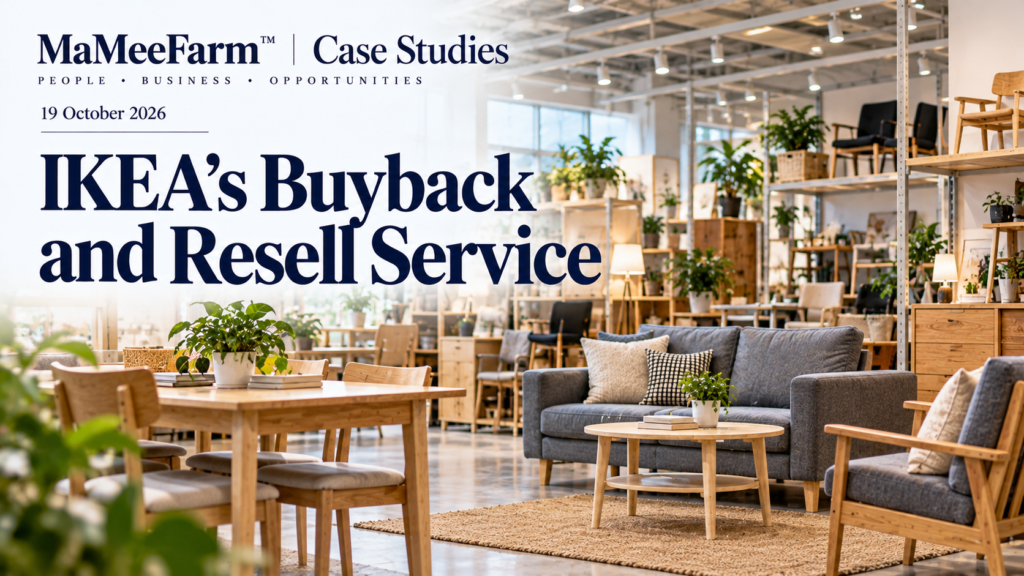
IKEA stores already had designated areas for products outside their regular new-product assortment. These areas, commonly known as As-Is or Re-shop and Re-use, offer items such as customer returns, discontinued products, display furniture, and second-hand goods.
The Buyback service adds another source of inventory to this retail channel.
Instead of selling unwanted furniture independently, eligible customers can return selected IKEA products to participating stores in exchange for store credit.
The furniture can then be offered to another customer through IKEA’s existing resale areas.
This arrangement connects household ownership, product recovery, and retail distribution without requiring an entirely separate second-hand store network.
From Online Estimate to Store Acceptance
The service combines digital valuation with physical inspection.
In the United Kingdom, customers begin by using IKEA’s online Buyback tool to obtain an estimated value for eligible furniture.
They must then bring the product, fully assembled, to a participating IKEA store within 30 days of receiving the estimate.
Store staff inspect the furniture and determine the final purchase offer based on its condition. That offer may differ from the original online estimate.
When the customer accepts the offer, IKEA provides the agreed value through an IKEA refund card. Suitable products can then enter the store’s Re-shop and Re-use section for resale.
The process illustrates the continuing importance of physical retail operations in a digitally supported service.
An online tool can initiate the transaction, but accepting and preparing used furniture still requires staff, space, inspection, and handling.
Not Every Used Product Can Return
The Buyback service does not accept every piece of IKEA furniture.
Under the UK programme’s conditions, eligible products must be complete, functional, clean, properly assembled, and unmodified. Customers must also own the items outright.
These requirements create practical boundaries around the service.
Furniture that remains useful to its owner may still be unsuitable for IKEA’s resale programme if it does not meet the applicable conditions.
The retailer must consider whether the product can be handled and offered for resale through its existing operations.
Acceptance also does not guarantee a subsequent sale.
IKEA’s UK terms explain that products which cannot be resold will be handled through responsible disposal, with recycling where possible.
This means that taking back furniture creates further operational responsibilities. The retailer must manage the product after acquisition, whether it finds a new buyer or requires another form of handling.
Store Credit Connects Resale with Retail
IKEA uses store credit rather than a conventional cash purchase in its UK Buyback service.
For customers, this provides value that can be used for future IKEA purchases under the applicable card conditions.
For the retailer, it connects the acquisition of used furniture with its wider commercial operations.
The arrangement creates a possible link between returning an old product and purchasing another item.
However, that connection does not automatically establish additional sales or profit.
Customers may use the credit for purchases they would have made anyway, while the retailer still incurs costs associated with inspecting, handling, and reselling returned furniture.
The service also operates alongside IKEA’s continuing sale of new products.
Second-hand retail represents an additional commercial activity rather than evidence that the company has replaced its conventional retail model.
Growing Volumes Create Operational Demands
Ingka Group reported that it sourced almost 686,500 used IKEA products through Buyback during FY25, compared with 495,000 in FY24.
The increase demonstrates growth in the number of products entering the programme. It does not necessarily indicate an equivalent increase in completed second-hand sales.
Products received through Buyback must still be assessed, handled, displayed, and purchased by another customer.
The financial result depends on the relationship between the value offered to sellers, operating expenses, and eventual resale revenue.
Ingka Group has also identified regulatory, logistical, and infrastructure challenges, changing customer expectations, and the need for additional capabilities as considerations in expanding circular services.
These challenges become relevant as activity grows across markets and stores.
A service that handles hundreds of thousands of used products must manage the practical differences between selling standardized new inventory and receiving individual items in varying conditions.
Connecting Buyback with Digital Marketplaces
On 7 October 2026, Ingka Group announced plans to test a connection between its Buyback service and its second-hand marketplace in Portugal and Spain by the end of December 2026.
The proposed arrangement would allow eligible sellers to consider an IKEA Buyback offer alongside the possibility of selling directly to another customer.
Customers choosing the Buyback option would still need to bring their furniture to a participating store.
The announcement also described separate delivery-partnership trials intended to help customers transport furniture.
These developments reflect the physical challenges of second-hand furniture transactions.
Digital marketplaces can help connect buyers and sellers, but furniture must still move between locations.
Large or assembled items may require transport arrangements that differ substantially from those involved in purchasing smaller consumer goods.
The planned integration therefore addresses part of the customer transaction while continuing to rely on physical retail infrastructure.
As announced in October 2026, the initiative remained a planned test rather than a completed rollout.
The Business of Bringing Products Back
IKEA’s Buyback and Resell service illustrates how second-hand activity can become part of an established retail business.
The company has created a process through which selected products move from household ownership back into retail inventory.
That process involves eligibility requirements, valuation, inspection, store credit, product handling, and resale facilities.
Each activity contributes to making previously owned furniture available for another customer.
The model also introduces operating demands that differ from conventional new-product retail.
New furniture normally enters stores through established production and distribution channels. Used furniture arrives from individual customers, often in different conditions and quantities.
Managing that variation is part of the business.
The service provides an additional route for extending product use, although the number of items accepted does not by itself establish the programme’s profitability or its net environmental impact.
What the IKEA Case Reveals
The growth of IKEA’s Buyback programme demonstrates that second-hand furniture can be incorporated into a large retailer’s existing operations.
Its significance extends beyond the act of accepting unwanted products.
The retailer must establish conditions for what it can receive, determine the value offered to customers, and manage the goods until they are resold or otherwise handled.
Store credit connects the transaction to the wider retail business, while digital services help customers begin the process before bringing furniture into stores.
The continuing development of marketplace and transport options also shows how the service is evolving beyond a conventional in-store return process.
IKEA’s experience highlights a practical distinction between recovering a product and successfully returning it to commercial use.
Taking ownership of used furniture is only the beginning.
The lasting business challenge is creating an operating system capable of moving that furniture efficiently from one owner to the next.
Sources
- Ingka Group, Annual Summary and Sustainability Report FY24
- Ingka Group, Annual Summary and Sustainability Report FY25
- IKEA UK, Buyback & Resell Service
- IKEA UK, Buyback & Resell Terms and Conditions
- Ingka Group, 7 October 2026, second-hand marketplace announcement
MaMeeFarm™
People • Business • Opportunities