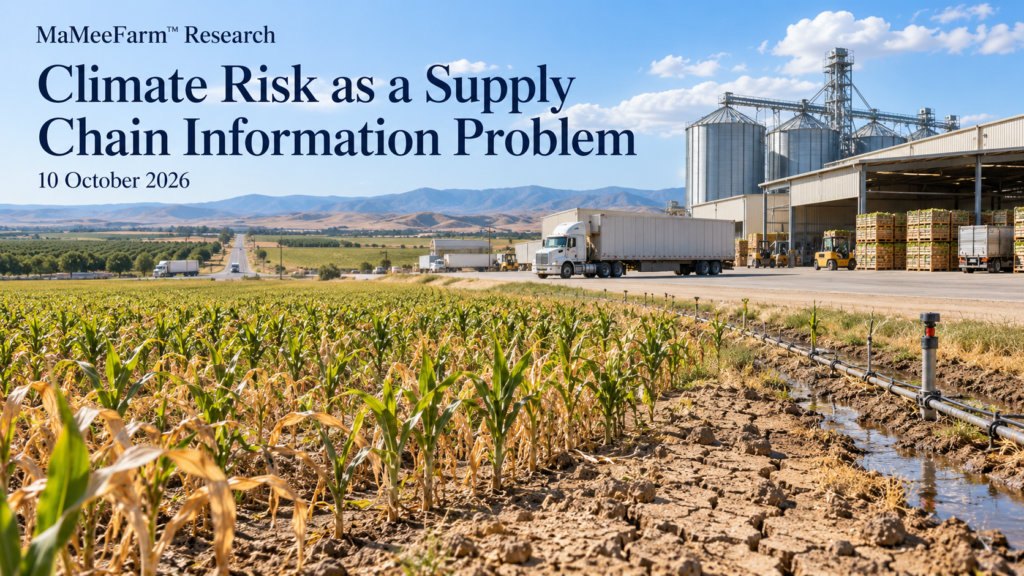
Date: 10 October 2026 Publication Type: Research Project: MaMeeFarm™
Abstract
Climate risk in agricultural supply chains is commonly understood through its physical consequences.
Drought can reduce water availability. Extreme heat can damage crops. Flooding can interrupt production and transportation. Wildfire and other environmental disturbances can affect agricultural land and supporting infrastructure.
Yet physical hazards are only one part of the problem facing food companies.
A business may possess extensive climate information without knowing precisely how those conditions intersect with its own supply chain.
It may know which countries supply its agricultural ingredients but lack reliable information about individual production areas. It may have supplier contracts without knowing whether several suppliers depend on the same watershed. It may identify a high-risk climate zone without knowing whether farms there have irrigation, storage, or other adaptation capacity.
These gaps create uncertainty about where exposure exists and how disruption could affect operations.
Research and industry analysis published in 2026 have drawn attention to this problem.
Reuters reported on 5 October 2026 that climate-risk assessments used in food systems can underestimate interacting hazards and fail to capture important sources of agricultural disruption.
The Food and Land Use Coalition’s Re-WIRE initiative similarly emphasizes the need for stronger evidence and risk modelling to support agricultural resilience investment.
Meanwhile, the World Resources Institute’s Aqueduct Food platform demonstrates how water-risk and agricultural data can support geographic screening, while also documenting limitations that prevent such tools from replacing local assessment.
Together, these sources support an important distinction.
Climate risk becomes a supply-chain information problem when physical hazard information cannot be connected reliably to production locations, supplier vulnerability, business dependency, and operational consequences.
The challenge is not simply the availability of climate data.
It is the ability to translate environmental information into sufficiently grounded decisions about sourcing, investment, and continuity.
This research examines that information gap and its implications for agricultural supply-chain resilience.
1. Research Question
How does incomplete visibility into sourcing locations, climate hazards, crop sensitivity, supplier dependence, and adaptation capacity limit the ability of food companies to assess and manage climate risk across agricultural supply chains?
2. Climate Hazards Are Only the Starting Point
Agricultural production depends on environmental conditions.
Heat, drought, flooding, storms, wildfire, and changes in rainfall can influence agricultural activity.
However, the presence of a hazard does not automatically establish the consequences for a particular company.
A drought may affect one sourcing region while leaving another largely unaffected.
The significance of the event depends on whether the company obtains production from the affected area.
Climate information becomes commercially relevant when it can be connected to actual supply-chain exposure.
3. Hazard and Exposure Are Different
A climate hazard describes a potentially damaging physical condition.
Exposure describes the people, assets, production, or activities located where that condition may occur.
Two companies can face the same regional drought but have very different business exposure.
One may obtain a small proportion of its ingredients from the affected region.
Another may depend heavily on production from that location.
The physical event may be similar, but the consequences for each business can differ substantially.
4. Exposure and Vulnerability Are Different
Two farms may operate within the same drought-affected region.
One may have reliable irrigation, water storage, suitable crop varieties, or stronger financial resources.
The other may have fewer options.
Both farms are exposed to the hazard.
Their ability to withstand its effects may differ.
A location-based climate assessment that does not consider these conditions can therefore provide an incomplete picture of vulnerability.
5. Vulnerability Does Not Guarantee Loss
A vulnerable agricultural operation does not necessarily experience immediate production failure.
The severity and timing of the event matter.
Adaptation measures may reduce the effect.
Other environmental conditions may offset some damage.
A risk assessment should therefore distinguish between potential vulnerability and observed loss.
High risk is not equivalent to a confirmed future outcome.
6. Agricultural Supply Chains Often Lack Precise Origin Information
Food products can pass through farmers, cooperatives, aggregators, traders, processors, and distributors before reaching the final buyer.
A downstream company may know its direct supplier without knowing the location of the original production.
This distinction matters because climate hazards occur in specific geographic areas.
Knowing the supplier’s commercial address is not necessarily equivalent to knowing where the crop was grown.
7. Traceability Has a Climate-Risk Function
Traceability is often associated with product quality, deforestation, labour standards, and regulatory compliance.
It also contributes to climate-risk visibility.
When a company knows where agricultural production occurs, it can connect sourcing information with relevant environmental conditions.
Without reliable origin information, even a detailed climate map may provide limited insight into the company’s actual exposure.
Traceability can therefore support risk identification, although it does not by itself establish vulnerability or resilience.
8. Smallholder Supply Chains Present Additional Challenges
Some agricultural commodities are produced by large numbers of small farms.
Production records may be incomplete or maintained in different formats.
Farm boundaries may not be digitally recorded.
Harvests may be combined before reaching processors.
Supplier relationships may also change between seasons.
These characteristics can make detailed origin mapping difficult.
The problem is not necessarily a complete absence of information, but the difficulty of connecting records across multiple participants.
9. National Averages Can Conceal Local Differences
Climate conditions vary within countries.
Water availability, rainfall, temperature, elevation, and production systems can differ significantly between agricultural regions.
A country-level risk assessment may identify a broad area of concern.
It may not establish the conditions affecting a particular production site.
The geographic precision of the analysis should therefore reflect the precision of the underlying sourcing information.
10. Water Risk Demonstrates the Importance of Location
Water availability depends on local and regional conditions.
Farms growing the same crop can face different risks because they operate in different watersheds, groundwater systems, or rainfall regimes.
The World Resources Institute’s Aqueduct Food platform combines water-risk indicators with agricultural information to help identify potential exposure.
Its value lies in supporting geographic understanding and prioritization.
However, the tool does not establish the vulnerability or expected loss of every individual farm.
11. Global Climate Maps Are Screening Tools
Global datasets can help organizations identify regions that deserve closer examination.
They can support comparisons across countries and production areas.
But broad geographic indicators may conceal substantial local variation.
WRI explicitly documents limitations in the resolution, coverage, and modelling assumptions of Aqueduct Food.
These limitations are particularly important when a business attempts to move from regional screening to farm-level decisions.
12. Data Resolution Determines What Can Be Concluded
A company may know that an ingredient comes from a particular province.
That information can support a provincial or regional exposure assessment.
It does not justify a claim about the exact conditions of an unidentified farm.
Likewise, high-resolution climate data cannot compensate for uncertain production coordinates.
Greater detail in one dataset does not automatically improve the reliability of the complete assessment.
13. Crop Sensitivity Changes the Meaning of Hazard
Agricultural crops respond differently to environmental stress.
The effect of heat depends on the crop, variety, growth stage, and surrounding conditions.
A temperature event during flowering may have a different consequence from an event during another production stage.
Therefore, a temperature map alone cannot establish the expected agricultural outcome.
Crop characteristics and production timing are also relevant.
14. Agricultural Timing Matters
The timing of a climate event can be as important as its intensity.
A dry period may affect production differently depending on planting schedules, soil moisture, irrigation availability, and the stage of crop development.
This creates a mismatch between some climate datasets and the information required for agricultural decisions.
Environmental observations become more useful when they can be interpreted in relation to actual production periods.
15. Climate Scenarios and Procurement Decisions Operate on Different Horizons
Climate scenarios often examine conditions over several decades.
Food companies also make decisions over much shorter periods.
These include seasonal purchasing, annual supplier contracts, inventory planning, and sourcing adjustments.
Long-term scenarios can inform strategic investment and geographic diversification.
Near-term decisions require additional operational information.
Neither time horizon can fully replace the other.
16. A Scenario Is Not a Prediction
Climate scenarios describe possible conditions under specified assumptions.
They do not establish exactly what will occur in a particular field during a particular season.
A projected increase in regional water stress does not mean that every farm in that region will experience production failure.
Scenario information should be interpreted as conditional evidence rather than a guaranteed outcome.
17. Compound Hazards Complicate Agricultural Risk
Agricultural production can face multiple hazards during the same period.
Heat and drought may occur together.
Wildfire can affect land, infrastructure, and transportation.
Environmental conditions may also interact with pest pressure or other production challenges.
Reuters highlighted the limitations of risk assessments that treat important hazards too independently.
The combined effect of multiple hazards can be difficult to estimate.
18. Compound Risk Cannot Be Assumed to Be Additive
The effects of two hazards do not necessarily equal the sum of their separate effects.
Interactions can amplify damage.
In other circumstances, effects may overlap or depend on local conditions.
The relationship requires appropriate evidence and modelling assumptions.
A research assessment should not invent combined-loss estimates simply because several hazards are present.
19. Crop Yield and Supply-Chain Impact Are Different
A reduction in agricultural yield is not necessarily equivalent to an immediate shortage for the final buyer.
A company may have inventory.
Suppliers may redistribute available production.
Alternative sources may exist.
Contracts and logistics arrangements may affect the timing and scale of disruption.
The movement from agricultural damage to business impact depends on several operational conditions.
20. Climate Disruption Can Affect Prices Without Eliminating Supply
A business may continue obtaining an ingredient despite disruption in its original sourcing region.
However, replacement supply may involve higher prices, longer transport distances, additional processing, or different quality characteristics.
This means climate risk can affect procurement economics even when physical supply remains available.
Availability and affordability are separate dimensions of supply-chain resilience.
21. Supplier Diversification May Conceal Shared Exposure
A company may purchase an ingredient from several suppliers.
This can appear to reduce concentration.
However, those suppliers may obtain production from the same agricultural region.
If they depend on the same watershed or climate conditions, their risks may be correlated.
The number of supplier contracts does not necessarily reveal the diversity of the underlying production base.
22. Geographic Diversification Has Trade-Offs
Sourcing from different agricultural regions may reduce dependence on a single local hazard.
However, alternative locations can introduce transport costs, quality differences, regulatory requirements, and contractual complexity.
Geographic diversification is therefore not automatically the lowest-cost or most resilient solution.
Its value depends on the independence of the exposures and the practical availability of alternatives.
23. Business Dependency Changes Risk Significance
Two companies may source from the same climate-exposed region.
One may depend on that region for a small share of its supply.
Another may obtain most of a critical ingredient there.
The same physical hazard can create different business consequences.
A meaningful assessment must therefore consider the importance of the affected production to the company.
24. Substitutability Matters
Some agricultural inputs can be replaced relatively easily.
Others depend on particular growing conditions, product specifications, processing requirements, or limited production regions.
Replacement may require additional qualification, time, or investment.
Low substitutability can increase the operational significance of climate exposure.
25. Inventory Can Delay the Effect of Production Disruption
Inventory can provide temporary protection when agricultural supply is interrupted.
A company with adequate stock may continue production while seeking replacement supply.
Another company with limited inventory may experience disruption sooner.
The duration and effectiveness of this buffer depend on consumption, storage conditions, and the availability of replenishment.
Climate-risk assessment therefore benefits from operational information beyond the farm.
26. Public Climate Data and Private Business Data Serve Different Purposes
Public institutions produce environmental datasets covering rainfall, temperature, drought, flooding, and water stress.
Companies hold information about suppliers, purchasing volumes, contracts, inventories, and sourcing dependencies.
These categories describe different aspects of risk.
Environmental data can indicate where hazards may occur.
Operational data helps establish whether those hazards matter to a particular business.
The combination can support more relevant decisions.
27. Open Data Alone Does Not Establish Supply-Chain Exposure
Making environmental information publicly accessible improves the availability of evidence.
However, a public climate map generally does not identify the private sourcing relationships of every food company.
It cannot establish business dependency without appropriate commercial information.
Open environmental data is therefore useful but insufficient on its own.
28. Information Integration Raises Governance Questions
Combining environmental and commercial information can involve confidential supplier relationships, farm-level records, and commercially sensitive purchasing data.
Access and use may be governed by contracts, privacy requirements, or other legal obligations.
Better risk visibility does not require all underlying information to become public.
It requires appropriate arrangements for using relevant evidence responsibly.
29. Data Provenance Supports Interpretation
Climate-risk results depend on their source data and assumptions.
Different datasets may use different geographic boundaries, time periods, or modelling approaches.
A change in a risk score may reflect new environmental information.
It may also reflect a change in the model or underlying dataset.
Decision-makers therefore need enough context to interpret results correctly.
30. Model Precision Cannot Exceed Input Reliability
A sophisticated model can produce detailed results from incomplete inputs.
Those results may appear more certain than the evidence justifies.
If production location, supplier volumes, or adaptation conditions are uncertain, the final assessment must reflect those limitations.
Precision in presentation should not be confused with confidence in the underlying evidence.
31. Adaptation Capacity Changes Vulnerability
Agricultural operations differ in their ability to respond to environmental stress.
Irrigation, water storage, soil management, drainage, crop selection, financial resources, and technical support can influence outcomes.
These conditions help explain why similar climate exposure may produce different levels of disruption.
However, adaptation measures should not be assumed effective without appropriate evidence.
32. Adaptation Is Difficult to Compare Across Farms
Some adaptation characteristics can be recorded quantitatively.
Others depend on local management practices and conditions.
The presence of irrigation equipment, for example, does not establish that sufficient water will remain available during a prolonged drought.
Likewise, a reported soil-management practice does not automatically demonstrate a specific reduction in climate loss.
Adaptation evidence requires careful interpretation.
33. Resilience Investment Requires Evidence of Outcomes
Food companies may invest in water efficiency, irrigation, soil improvement, supplier support, and alternative sourcing.
Such measures can be intended to reduce climate vulnerability.
However, expenditure alone does not demonstrate success.
Understanding whether resilience has improved requires evidence about the conditions before and after intervention, together with consideration of other factors affecting outcomes.
34. Re-WIRE Highlights the Financing Challenge
The Food and Land Use Coalition’s 2026 Re-WIRE report argues that better evidence and catastrophe-risk modelling could help make agricultural resilience more measurable and investable.
This is a proposal concerning how risk information can support capital allocation.
It should not be interpreted as proof that every resilience investment generates a positive financial return.
Actual outcomes remain dependent on the intervention, location, financing conditions, and realized hazards.
35. Catastrophe-Risk Modelling Can Support Decisions
Catastrophe-risk modelling considers severe events and potential consequences.
It can help organizations examine outcomes that may not be adequately represented by average historical conditions.
Such methods can be relevant where rare but severe disruptions could affect concentrated agricultural supply.
However, models remain dependent on assumptions about hazards, exposure, vulnerability, and available evidence.
They do not eliminate uncertainty.
36. Severe Events Matter Beyond Average Conditions
A supply chain may operate successfully under ordinary weather conditions.
An unusually severe event can nevertheless create substantial disruption.
This is particularly important when production is geographically concentrated or alternative supply is limited.
Risk assessment should therefore distinguish typical operating conditions from plausible severe scenarios.
The presence of a severe scenario does not mean that it will occur.
37. Agricultural Finance Faces Related Information Gaps
Lenders financing agricultural production may understand borrowers’ financial characteristics while possessing limited information about environmental exposure.
Location, water availability, production conditions, and adaptation capacity can influence agricultural operations.
Better information may support risk assessment and financing decisions.
However, climate exposure is only one component of credit risk.
It should not be treated as a substitute for financial and borrower-specific analysis.
38. Insurance Also Depends on Exposure Information
Insurance assessments require information about the insured activity, location, potential hazards, and possible losses.
Incomplete production or location information can make risk assessment more difficult.
Better agricultural and environmental records may support insurance analysis.
Nevertheless, insurance outcomes also depend on policy terms, underwriting methods, historical experience, and market conditions.
39. Climate Information Can Support Several Types of Decisions
Environmental and agricultural evidence can inform procurement, financing, insurance, adaptation, and public planning.
The information required for each decision is not identical.
A procurement team may focus on supply availability and substitution.
A lender may consider repayment capacity.
An insurer may assess covered losses.
A public agency may examine food security or regional exposure.
Shared evidence can be useful across these activities, provided its limitations remain clear.
40. Climate-Risk Mapping Is Already Used in Some Supply Chains
WRI describes examples of agricultural businesses using water-risk information to prioritize sourcing areas and water-management activities.
This demonstrates practical application of geographic screening.
It does not establish that detailed climate-risk mapping is universal across food companies.
Nor does it establish that every company has sufficient farm-level visibility.
41. Screening Results Require Context
A high-risk geographic score can identify a location deserving closer attention.
It does not automatically establish that a supplier should be abandoned.
The supplier may possess effective adaptation capacity.
Alternative sourcing may face equal or greater exposure.
A decision based solely on a broad risk indicator may therefore overlook important operational information.
42. Climate Exposure Changes Over Time
Environmental conditions can change.
Agricultural production may shift between locations.
Water infrastructure can improve or deteriorate.
Adaptation measures may alter vulnerability.
A climate-risk assessment represents conditions and assumptions at a particular point in time.
It should not automatically be treated as permanently valid.
43. Supplier Networks Also Change
Food companies may add suppliers, alter purchasing volumes, or move production between regions.
These changes affect business exposure even if the climate hazard information remains unchanged.
An assessment based on outdated sourcing relationships can therefore become misleading.
Climate-risk visibility depends partly on the continuing relevance of operational records.
44. Historical Evidence Remains Important
Past observations can help explain how agricultural production has responded to drought, heat, flooding, or other conditions.
Historical records can also provide evidence about recovery and adaptation.
However, changing climate conditions may limit the usefulness of assuming that future risks will match historical averages.
Historical evidence and forward-looking scenarios serve different purposes.
45. Climate Risk Is Also a Problem of Evidence Continuity
A one-time assessment can identify current concerns.
Repeated observations can help reveal changes in exposure, vulnerability, production, and operational consequences.
This distinction matters when organizations attempt to evaluate resilience over time.
A change in reported risk may reflect changing conditions, changing sourcing, or changing measurement methods.
Interpretation requires attention to those differences.
46. Better Visibility Can Improve Investment Decisions
A company that identifies concentrated climate exposure may be better positioned to evaluate alternative suppliers, inventory arrangements, or adaptation investment.
However, information alone does not guarantee a better outcome.
Decisions remain constrained by cost, available alternatives, institutional capacity, and uncertainty.
The economic value of climate information depends on whether it changes decisions in a useful way.
47. What Current Evidence Establishes
The reviewed evidence supports several observations.
Agricultural supply chains face physical climate hazards that can affect production and operations.
Food companies may lack detailed visibility into upstream production locations.
Global water-risk datasets can support geographic screening but have documented limitations.
Crop sensitivity, adaptation capacity, and production timing influence the interpretation of environmental exposure.
Multiple climate hazards may interact in ways that are not captured by simpler assessments.
Supplier diversification does not necessarily eliminate common geographic exposure.
Business dependency and operational buffers influence whether agricultural disruption becomes a wider supply-chain problem.
The Re-WIRE initiative identifies better risk evidence and modelling as potential supports for agricultural resilience investment.
Together, these observations support treating climate-risk visibility as an important part of supply-chain management.
48. What Current Evidence Does Not Establish
The reviewed evidence does not establish that:
- All food companies lack climate-risk information.
- A high risk score guarantees future crop failure.
- Global climate maps provide precise farm-level diagnoses.
- Supplier count alone measures climate diversification.
- Traceability automatically creates resilience.
- Compound hazards can be combined through simple arithmetic.
- Climate scenarios predict exact future losses.
- Open data alone resolves commercial exposure gaps.
- Adaptation spending automatically reduces loss.
- Catastrophe-risk models remove uncertainty.
- Improved information guarantees profitable investment.
These stronger conclusions require additional evidence.
49. Research Implications
Climate resilience in agricultural supply chains is often discussed as a question of physical production.
That remains essential.
However, businesses also face the challenge of identifying where environmental conditions intersect with their actual sourcing activities.
The availability of global climate information does not necessarily provide that visibility.
Companies may still need better information about production geography, crop characteristics, supplier relationships, and operational dependency.
This changes the role of climate data.
It is not only information for environmental reporting.
It can also support procurement, continuity planning, and investment decisions.
Its value depends on how reliably it can be connected to the activities that businesses need to protect.
50. Research Limitations
This research draws on public sources available through 10 October 2026, including Reuters reporting, the Food and Land Use Coalition’s Re-WIRE initiative, and World Resources Institute publications.
The research does not independently measure climate exposure for a particular food company.
It does not assess individual farms or calculate expected production losses.
It does not establish the financial return of specific adaptation investments.
The reviewed sources differ in purpose.
Reuters provides contemporary reporting.
Re-WIRE presents a research and policy-oriented case for improving resilience evidence and investment.
WRI provides data tools, methodological documentation, and examples of practical use.
These sources should not be interpreted as interchangeable forms of evidence.
The analysis therefore focuses on the structural information problem rather than producing a quantified forecast of agricultural losses.
51. Research Conclusion
Climate risk affects agricultural supply chains through physical environmental conditions.
Drought, heat, flooding, wildfire, and other hazards can influence production and supporting infrastructure.
But the consequences for a food company depend on more than the presence of those hazards.
The company must also understand where its agricultural inputs originate, how production responds to environmental stress, and how dependent its operations are on the exposed supply.
These relationships are not always visible.
A business may possess detailed climate maps but lack reliable farm locations.
It may know its direct suppliers but not the production areas supplying them.
It may have several supplier contracts while remaining concentrated in one watershed.
It may identify an exposed farm without knowing whether adaptation measures reduce its vulnerability.
And it may estimate potential production damage without understanding how inventory, substitution, and procurement arrangements affect the business.
Each gap limits the usefulness of the available climate information.
The reviewed evidence supports the importance of improving this connection.
WRI’s Aqueduct Food demonstrates how geographic water-risk information can support agricultural screening while also documenting the limitations of broad datasets.
Reuters’ October 2026 reporting highlights weaknesses in approaches that do not adequately capture interacting hazards.
The Re-WIRE initiative argues that stronger risk evidence could support more informed agricultural resilience investment.
These sources do not establish that better information can eliminate climate risk.
They support a narrower and more practical conclusion.
Climate risk becomes a supply-chain information problem when physical hazard information cannot be connected reliably to the production locations, vulnerabilities, and business dependencies that determine operational consequences.
The central challenge is therefore not simply to produce more climate data.
It is to make existing and future evidence relevant to the decisions that agricultural supply chains must make.
Better information may help companies identify concentrated exposure, understand potential disruption, and evaluate resilience options before a damaging event occurs.
However, the quality of those decisions remains dependent on the reliability of the evidence and the availability of practical responses.
The final research question is:
Can agricultural supply chains identify their climate exposure clearly enough to make informed decisions before physical hazards become operational disruptions?
That question places information quality alongside physical adaptation as an important dimension of food-system resilience.
References
Reuters. (5 October 2026). Food companies are flying blind to the escalating climate threats to supply chains. Here’s what needs to change. https://www.reuters.com/sustainability/land-use-biodiversity/food-companies-are-flying-blind-escalating-climate-threats-supply-chains-heres–ecmii-2026-10-05/
Food and Land Use Coalition, World Business Council for Sustainable Development, and Systemiq. (15 September 2026). Re-WIRE Agricultural Resilience: From Cost to Investment Opportunity. https://www.foodandlandusecoalition.org/knowledge-hub/re-wire-agricultural-resilience/
World Resources Institute. (2021). Aqueduct Food. https://www.wri.org/data/aqueduct-food
World Resources Institute. Aqueduct: Frequently Asked Questions. https://www.wri.org/aqueduct/faq
World Resources Institute. How Agribusiness Can Mitigate Water Risk. https://www.wri.org/insights/water-risk-agribusiness-supply-chains
World Resources Institute. Aqueduct Tools. https://www.wri.org/aqueduct/tools