Publication Date: 20 October 2026 Category: Research Region: Brazil / Global Focus: Carbon Finance · Agriculture · Silvopasture · Land Restoration
Abstract
Carbon markets are commonly discussed as mechanisms for purchasing verified environmental outcomes. Yet land-based carbon removal often requires substantial physical investment before those outcomes can be delivered.
Trees must be established, agricultural practices adjusted, and land monitored over time. Farmers may need technical assistance and financial support while transitioning to new management systems.
This raises an important question: can long-term carbon-removal contracts help finance improvements to productive agricultural land?
On 19 October 2026, Reuters reported that Google and McKinsey had agreed to purchase 320,000 metric tons of carbon removal credits over ten years from a Brazilian silvopasture initiative developed by Working Trees.
The first phase covers approximately 8,700 hectares of degraded and semi-degraded pastureland, within a broader planned project covering 50,000 hectares.
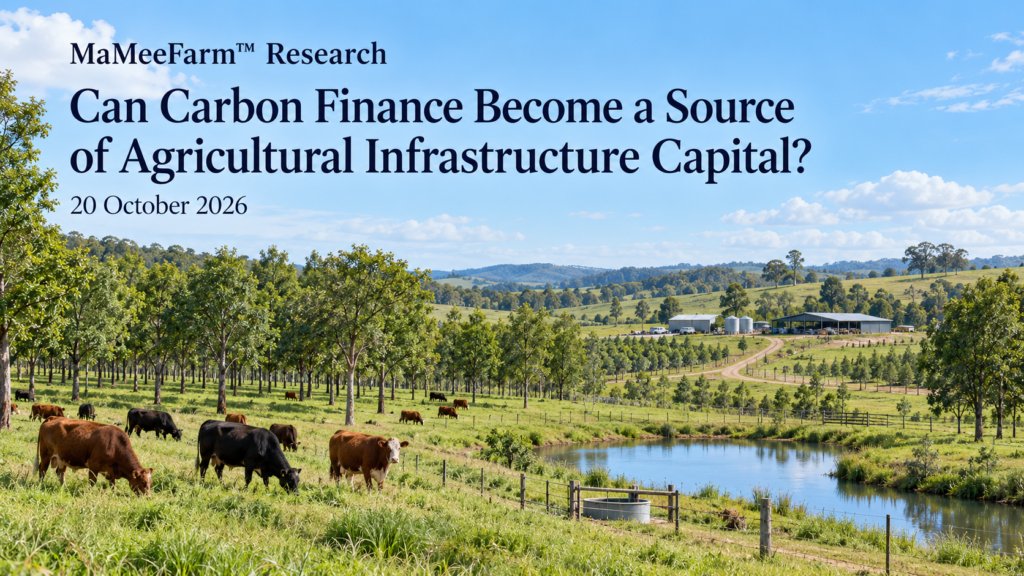
The initiative integrates trees into existing cattle-grazing systems, seeking to combine agricultural activity with carbon removal.
The agreement illustrates how corporate demand for environmental outcomes may help support physical investment in agriculture.
However, the existence of a long-term purchase contract does not by itself establish how much capital reaches farmers, when payments occur, or whether the resulting land-management changes will deliver their intended benefits.
This research examines the conditions under which carbon finance could become a meaningful source of agricultural transition capital.
1. Carbon Removal Begins With Physical Investment
Carbon credits are financial instruments associated with quantified environmental outcomes.
For land-based carbon removal, however, those outcomes depend on activities taking place in real landscapes.
A silvopasture project may require tree planting, fencing, grazing adjustments, technical planning, and long-term maintenance.
These activities involve expenditure before the full environmental benefits can be measured and credited.
That creates a financing challenge.
Farmers and project developers must fund the transition while future carbon revenue remains dependent on implementation, measurement, verification, and delivery.
Long-term carbon purchase agreements may help address this challenge by providing greater visibility over future demand.
They do not necessarily eliminate the need for upfront financing.
Their practical value depends on contractual terms, payment timing, delivery obligations, and the ability of project participants to obtain capital against expected future revenue.
The distinction is important because a commitment to purchase carbon removals is not equivalent to an immediate transfer of the full contract value.
2. The Brazilian Silvopasture Agreement
The agreement announced on 19 October 2026 involves Google and McKinsey purchasing 320,000 metric tons of carbon removal credits over ten years.
The purchases form part of the companies’ commitments through the Symbiosis Coalition, which supports long-term procurement of nature-based carbon removal.
Working Trees is developing the underlying project across parts of Brazil’s southeastern Amazon and Cerrado regions.
According to Reuters, the initial phase will restore approximately 8,700 hectares of degraded and semi-degraded pastureland.
The broader project is intended to reach approximately 50,000 hectares.
The model introduces rows of native and commercial tree species into existing cattle pastures while retaining space for grazing.
This is significant because the land is not necessarily removed from agricultural production.
Instead, the project seeks to combine livestock activity with additional tree cover and associated carbon storage.
Working Trees has stated that its approach can improve cattle productivity and create future timber revenue.
These are project-developer expectations rather than independently established outcomes for the full planned area.
The agreement provides evidence of corporate willingness to contract future removals from a productive agricultural landscape.
It does not yet demonstrate the project’s final financial or environmental performance.
3. Why Long-Term Contracts Matter
Agricultural land restoration often involves costs that occur earlier than the resulting benefits.
Tree establishment requires investment, while biomass growth and associated carbon removal take time.
A long-term purchase agreement can reduce uncertainty about whether buyers will exist for future verified removals.
That revenue visibility may support investment decisions.
Project developers could potentially use contracted revenue to attract equity, obtain financing, or support the initial costs of implementation.
This resembles financing arrangements used in other sectors where future contracted output helps justify present investment.
However, carbon-removal projects carry risks that differ from those of conventional infrastructure.
Biological growth is affected by weather, land management, fire, disease, and other environmental conditions.
The quantity and timing of verified carbon removal may therefore differ from initial expectations.
A buyer’s commitment does not eliminate those risks.
It also does not establish that a lender will treat the contract as sufficient security for financing.
The practical financing value depends on the reliability of future delivery, the creditworthiness of the buyer, and the allocation of risk between participants.
For the Brazilian agreement, publicly available reporting does not disclose enough contractual detail to calculate the amount of financing that the purchase commitments could support.
4. Agricultural Productivity Remains Essential
Silvopasture differs from land-restoration approaches that remove agricultural land entirely from production.
It combines trees, pasture, and livestock within a managed landscape.
This creates the possibility of generating environmental benefits while maintaining agricultural activity.
Trees may provide shade and other ecological functions, while some systems can create additional economic opportunities through timber or other products.
However, the outcome depends on local conditions and management.
Tree species, planting density, rainfall, soil conditions, and grazing practices can influence both carbon storage and agricultural productivity.
Adding trees does not automatically improve livestock performance.
In some circumstances, excessive canopy cover or poorly adapted management may reduce available forage or create additional costs.
Farmers considering participation therefore face more than an environmental decision.
They must evaluate whether the new system supports the economic viability of their land.
Carbon payments may help compensate for transition costs or uncertainty.
But a durable agricultural project also needs a credible productive future, particularly after the original carbon purchase agreements end.
The Brazilian initiative is relevant because it seeks to integrate environmental outcomes with ongoing livestock production.
Whether it achieves that balance at scale will require evidence from actual farm performance.
5. Carbon Integrity Determines the Value of the Environmental Outcome
Carbon finance depends on confidence that environmental outcomes are real and appropriately quantified.
For land-based removal projects, several issues are especially important.
Additionality concerns whether credited removals exceed what would reasonably have occurred without the project or relevant carbon-finance incentives.
Measurement and verification concern whether the amount of carbon removed can be credibly estimated and independently assessed.
Permanence concerns the risk that stored carbon may later be released through events such as fire, drought, disease, or land-use change.
Leakage concerns whether activities displaced from the project area cause emissions or environmental damage elsewhere.
These requirements affect the commercial value of carbon credits.
They also create costs.
Projects may need field measurements, remote sensing, independent verification, monitoring systems, and arrangements to address reversal risk.
Those expenses mean that gross carbon revenue cannot be treated as money entirely available for planting, farm improvements, or farmer payments.
High-integrity accounting is essential to the credibility of the environmental product.
However, it also makes the financing model more demanding.
A carbon project must generate sufficient revenue to support implementation and monitoring while meeting the applicable environmental requirements.
6. The Distribution of Capital Matters
A large carbon-removal agreement can attract attention because of its contracted volume or the prominence of its buyers.
For agricultural development, the distribution of financial benefits is equally important.
Carbon revenue may be allocated across several activities, including land establishment, farmer compensation, technical support, project administration, measurement, verification, and risk management.
The amounts reaching farms can therefore differ substantially from the gross value of carbon-credit sales.
Working Trees describes an approach that includes upfront support, project design, technical assistance, and monitoring for participating ranchers.
This indicates an intention to connect carbon-market demand with practical land-management changes.
However, the reviewed public information does not establish the exact payment schedule or the share of project revenue received by participating landholders.
It also does not provide a verified per-hectare breakdown of establishment costs, ongoing expenses, and expected farmer returns.
Without those figures, the project’s financial effectiveness cannot yet be quantified.
The existence of a long-term contract supports the possibility of mobilizing capital.
Whether that capital produces substantial and fairly distributed agricultural benefits remains a separate question.
7. Scaling the Model Introduces New Challenges
The first phase of the Brazilian initiative covers approximately 8,700 hectares.
The broader project is planned to extend across 50,000 hectares.
Expanding from an initial implementation area to a larger program requires more than additional carbon buyers.
It may require suitable planting material, nursery capacity, trained workers, participating landholders, technical advisers, and monitoring systems.
Land tenure and contractual arrangements can also affect implementation.
Long-term carbon projects depend on land-management commitments that may extend across changes in ownership, agricultural conditions, and commodity prices.
The financial arrangements must also account for uncertainty.
Drought, fire, or poor tree establishment could affect both agricultural performance and expected carbon removal.
Such risks may be correlated rather than independent.
For example, a severe drought could reduce pasture productivity while also limiting tree growth.
The presence of two potential revenue streams does not guarantee financial diversification if both are exposed to the same environmental event.
Scaling therefore requires credible evidence that the agricultural and carbon-removal components can function together across different farms and environmental conditions.
A successful pilot can support confidence, but it does not establish that the same performance will be achieved across the entire planned area.
8. What the Agreement Establishes and What Remains Uncertain
The Brazilian agreement establishes that major corporate buyers are willing to make long-term commitments to carbon removal associated with productive agricultural land.
It also demonstrates a project structure in which future environmental outcomes are intended to support the transformation of degraded pastureland.
These are meaningful developments for agricultural finance.
However, the available public evidence does not establish several critical financial and operational outcomes.
The contract price has not been disclosed in the reviewed reporting.
The amount of capital paid upfront is not established.
The share of revenue reaching farmers is not known.
The final effects on livestock productivity have not been independently demonstrated across the full planned project area.
Nor does the purchase commitment represent confirmation that all contracted carbon removals have already occurred or been verified.
These limitations prevent a definitive conclusion that the project has already converted its full contracted carbon volume into completed agricultural infrastructure.
What can be concluded is narrower but important.
Long-term demand for carbon removal can create a potential financing pathway for agricultural land restoration.
Whether that pathway produces durable benefits depends on implementation, financial arrangements, environmental integrity, and the continuing viability of the agricultural system.
Research Conclusion
Carbon finance has the potential to become a source of agricultural infrastructure capital, particularly when future environmental revenue helps fund physical changes to productive land.
The Brazilian silvopasture agreement involving Google, McKinsey, and Working Trees illustrates this possibility.
A ten-year commitment to purchase 320,000 metric tons of carbon removal credits provides a commercial foundation for a project seeking to integrate trees into cattle-grazing landscapes.
The first phase covers approximately 8,700 hectares, with a larger program planned across 50,000 hectares.
However, the scale of the purchase agreement should not be confused with the amount of capital already invested or the quantity of verified carbon removal already delivered.
The financial significance of the agreement depends on whether future contracted revenue can support the initial and continuing costs of land transformation.
Its environmental significance depends on whether the resulting removals are measurable, additional, and sufficiently durable.
Its agricultural significance depends on whether participating farms remain productive and economically viable.
These outcomes are connected, but they are not interchangeable.
The strongest opportunity for carbon finance is not simply to create another revenue stream associated with farmland.
It is to help fund land-management improvements that might otherwise be delayed or remain financially difficult to implement.
Yet that opportunity must be demonstrated through actual investment, credible carbon accounting, and observed agricultural performance.
Carbon finance becomes meaningful agricultural transition capital when future environmental revenue supports durable improvements on the land, rather than remaining only a commitment to purchase future credits.
The Brazilian initiative offers an important case for examining whether that transformation can be achieved at scale.
Evidence and Limitations
This research uses Reuters reporting published on 19 October 2026, together with publicly described project arrangements and established principles of carbon-credit integrity.
The reported purchase volume, contract duration, and project areas are treated as announced commitments and plans, not completed environmental outcomes.
Claims concerning improved cattle productivity and future timber revenue are identified as expectations associated with the project model.
The research does not estimate undisclosed contract prices, farmer payments, or financing amounts.
It does not independently verify future carbon-removal delivery or establish the final agricultural performance of the planned project.
References
- Reuters. (19 October 2026). Google, McKinsey strike Brazil carbon removal deal with silvopasture project.
- Working Trees. Project developer information on silvopasture, land restoration, and farmer participation.
- Symbiosis Coalition. Coalition information on long-term procurement of nature-based carbon removal.
- Verra. Verified Carbon Standard program and methodology documentation relevant to land-based carbon projects.
- FAO. Research and guidance concerning sustainable livestock production and integrated agricultural land management.
MaMeeFarm™
People • Business • Opportunities