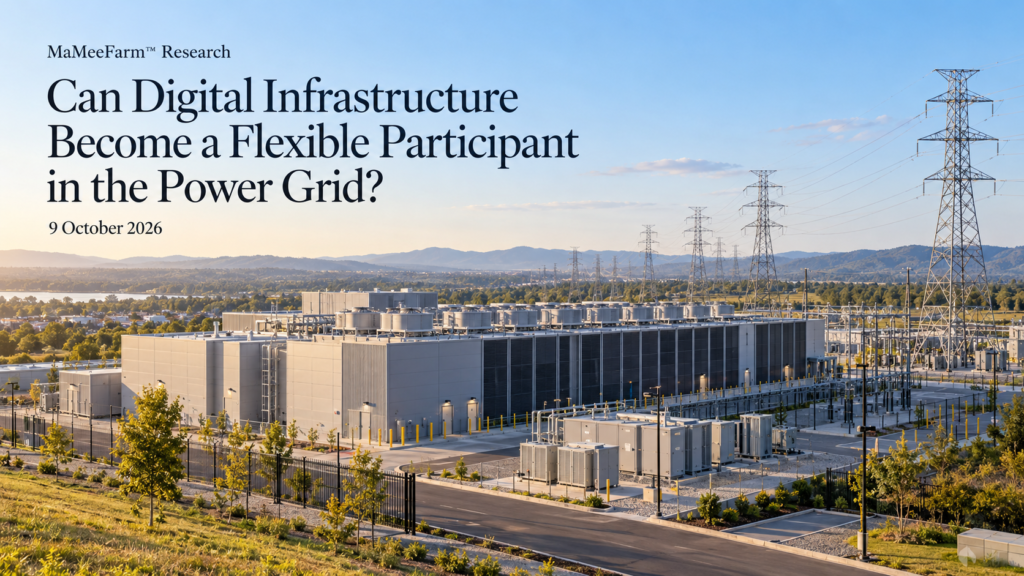
Date: 9 October 2026 Publication Type: Research Project: MaMeeFarm™
Abstract
Data centres are becoming a major source of new electricity demand in several power systems.
The conventional response to growing electricity consumption is to expand generation, transmission, substations, and other infrastructure until sufficient capacity becomes available.
However, some digital infrastructure has an operating characteristic that creates another possibility.
Certain computing workloads can be delayed, rescheduled, or transferred between locations. Some facility electricity consumption can be adjusted through cooling systems. Batteries can temporarily reduce electricity drawn from the grid, while onsite generation can provide another source of supply.
These capabilities raise a question about the future relationship between digital infrastructure and electricity systems.
Could data centres become more than large electricity consumers?
Could some facilities also provide dependable demand flexibility when power systems experience constraints?
Reuters reported on 8 October 2026 that utilities, technology companies, researchers, and regulators were increasingly examining this possibility.
According to the reporting, data centres surveyed by the Electric Power Research Institute (EPRI) identified potential peak-power reductions of approximately 10% to 30%, depending on facility type. Some hyperscale operators indicated greater potential.
The same reporting cited Duke University research suggesting that widespread large-load flexibility could reduce or defer approximately US$40 billion to US$150 billion in power-system capital investment over the coming decade.
These figures describe estimated capabilities and modeled economic possibilities. They are not verified industry-wide performance levels or realized financial savings.
Separate Duke University research examining the PJM electricity system found that, under modeled 2023 conditions, substantial additional flexible load could potentially be accommodated with relatively limited annual curtailment.
The findings suggest that changing when electricity is consumed can sometimes have a larger effect on peak capacity requirements than on total annual energy consumption.
The central research finding is:
Digital infrastructure can become a flexible grid participant when some of its electricity demand can be adjusted during constrained periods without compromising essential computing services, and when that capability is sufficiently reliable to support power-system operations.
This research examines the technical potential, economic implications, operational limits, and institutional requirements of flexible digital infrastructure.
1. Research Question
Under what technical, operational, and institutional conditions can data centres shift from being large passive electricity consumers to flexible grid participants, and how much can that flexibility reduce peak demand, accelerate interconnection, or defer new power-system investment without compromising digital-service reliability?
2. Digital Infrastructure Is Increasing Electricity Demand
Data centres support cloud computing, communications, artificial intelligence, scientific computing, financial services, and other digital activities.
Their electricity requirements include both computing equipment and supporting facilities.
Rapid expansion of AI infrastructure has increased attention to the capacity of electricity systems to accommodate new large loads.
EPRI estimates cited by Reuters indicate that U.S. data-centre electricity consumption could rise from approximately 177–192 terawatt-hours in 2024 to 383–793 terawatt-hours by 2030.
The 2030 range is a forecast, not observed consumption.
Its breadth reflects uncertainty about the pace and characteristics of future development.
3. The Conventional Grid Planning Relationship
Large electricity customers traditionally request a level of connection capacity based on expected operating requirements.
Utilities and system planners then assess whether existing infrastructure can serve the load.
Where capacity is insufficient, additional investment may be required.
This approach remains necessary for facilities whose electricity demand must be supplied continuously.
However, not every component of digital electricity consumption is equally inflexible.
4. Computing Activities Have Different Time Requirements
Digital infrastructure supports a wide range of workloads.
Some require immediate response.
Others can tolerate delays.
Interactive applications, communications, financial transactions, and many cloud services have strict availability or latency requirements.
Certain batch-processing, simulation, software-testing, and AI-training activities may have more flexible completion schedules.
These differences affect whether computing-related electricity demand can move between hours.
5. AI Workloads Are Not Uniformly Flexible
AI training and AI inference have different operating characteristics.
Some training jobs can be scheduled or paused.
Others involve deadlines, synchronization requirements, or expensive interruption costs.
Real-time inference serving active users may require continuous low-latency performance.
It would therefore be inaccurate to conclude that AI computing as a whole is flexible.
The more defensible finding is that some AI workloads may provide flexibility under suitable technical and commercial conditions.
6. Energy Efficiency and Load Flexibility Are Different
Energy efficiency reduces the electricity required to perform a given activity.
Load flexibility changes when, where, or how electricity is drawn from the grid.
A facility may perform approximately the same amount of computing while moving part of its electricity consumption to another period.
Annual electricity consumption may remain similar.
Peak electricity demand can nevertheless change.
This distinction is central to the economic argument for flexible digital infrastructure.
7. Peak Demand Can Create Disproportionate Infrastructure Requirements
Electricity systems must maintain sufficient capacity to serve demand during constrained periods.
Some periods of high demand occur for relatively few hours each year.
If a large customer can reliably reduce its electricity withdrawal during those periods, the reduction may help relieve capacity constraints.
The annual energy reduction may be small even when the temporary peak reduction is significant.
However, the resulting infrastructure benefit depends on the location, duration, reliability, and timing of the response.
8. Duke Research Provides a System-Specific Illustration
A 2026 Duke University study examined the potential for flexible large loads to use available headroom in the PJM electricity system.
The researchers estimated that the modeled 2023 PJM system could accommodate up to 32 gigawatts of additional flexible load under the study’s assumptions.
The analysis required curtailment of approximately 0.1% of the flexible loads’ annual electricity consumption during approximately 1.2% of annual hours.
These results illustrate the potential importance of short periods of demand adjustment.
They do not establish that PJM has actually connected 32 gigawatts of additional load using this approach.
9. Modeled Headroom Is Not Guaranteed Future Capacity
The Duke researchers noted that their analysis relied on a relatively mild historical weather year.
Extreme temperatures, generation outages, changes in demand, or other operating conditions could produce different requirements.
The study therefore provides evidence of potential flexibility under specified assumptions.
It should not be interpreted as a universal guarantee that equivalent capacity can be accommodated during every future system condition.
10. Workloads Can Sometimes Move Through Time
Some digital tasks can be rescheduled.
A batch-processing job originally planned for a constrained period may be completed later.
This can reduce electricity demand during the original period without eliminating the computational activity.
However, the delayed work still requires resources.
The practical value depends on whether the later period has sufficient computing and electricity capacity.
11. Delayed Computing Can Create Rebound Demand
When workloads are postponed, electricity consumption may return after the constrained period ends.
If many facilities resume delayed tasks simultaneously, demand may rise sharply.
This creates a potential rebound effect.
A temporary reduction cannot be assessed independently of the subsequent recovery in consumption.
The complete electricity-demand profile matters.
12. Computing Can Sometimes Move Between Locations
Operators with multiple data centres may be able to transfer selected workloads between regions.
This could allow computing activity to move away from a constrained electricity system.
However, geographic redistribution requires available computing capacity, network connectivity, data access, suitable software, and acceptable latency.
Data-localization rules and other regulatory requirements may also restrict movement.
Geographic flexibility is therefore conditional rather than universal.
13. Digital Infrastructure Has Distinctive Operational Characteristics
Some physical industries cannot relocate production activity rapidly without moving materials, equipment, or workers.
Certain computing workloads can be transferred through digital networks.
This creates opportunities to adjust electricity demand through software and operational scheduling.
However, these opportunities depend on the computing service involved.
The existence of a distributed computing network does not mean every workload can move freely.
14. Facility Electricity Demand Extends Beyond Computing
Data-centre electricity use includes supporting systems.
These can include cooling equipment, pumps, fans, power conversion, lighting, and other facility operations.
Some supporting systems may provide flexibility without directly interrupting computing.
This creates a distinction between changing the electricity consumption of computing hardware and adjusting the facilities that support it.
15. Cooling Systems Offer Potential Flexibility
EPRI reported in September 2026 that cooling systems can account for approximately 30% to 40% of data-centre electricity load.
Its research identifies cooling as a comparatively underused opportunity for grid flexibility.
This does not mean that 30% to 40% of total data-centre electricity demand can be curtailed.
It identifies the reported scale of cooling-related consumption.
The portion that can be adjusted depends on equipment, operating conditions, thermal limits, and facility design.
16. Thermal Flexibility Has Physical Limits
Some facilities may adjust cooling schedules, use thermal storage, or temporarily modify supporting equipment operation.
These measures can change electricity withdrawal without necessarily reducing computing output.
However, server temperatures and equipment reliability must remain within safe operating limits.
High ambient temperatures or high computing loads may reduce the available margin.
Cooling flexibility should therefore not be assumed to remain constant under all conditions.
17. Batteries Can Temporarily Reduce Grid Withdrawal
Battery systems can supply electricity during constrained periods.
This can reduce the power drawn from the grid while the battery discharges.
Some data centres already use batteries for backup and uninterruptible power supply.
However, using battery capacity for grid support must remain compatible with the facility’s reliability requirements.
Capacity reserved for emergency protection cannot automatically be treated as freely available for routine demand response.
18. Battery Discharge Does Not Eliminate Energy Demand
Electricity used from a battery must generally be replenished.
The charging process also involves losses.
Battery-supported flexibility can therefore shift electricity withdrawal between periods without necessarily reducing annual energy consumption.
Its economic value may lie in reducing demand during particularly constrained hours.
The timing of recharging remains important.
19. Onsite Generation Creates Another Option
Some data centres have onsite generation systems.
These may reduce grid withdrawal during periods of constrained electricity supply.
However, their use depends on equipment availability, fuel supply, permits, operating restrictions, and reliability requirements.
Onsite generation should also be distinguished from electricity conservation.
A reduction in grid withdrawal does not necessarily mean a reduction in total energy consumption.
20. Grid Benefits and Environmental Benefits Must Be Evaluated Separately
A facility may reduce electricity drawn from the grid by operating onsite fossil-fuel generation.
That action can provide grid relief while increasing local emissions.
Battery use also depends on when and how the stored electricity was generated.
Flexible demand may support better alignment with low-carbon electricity availability, but that outcome is not automatic.
Grid resilience, operating cost, and environmental performance are related but distinct considerations.
21. Flexible Computing Is Being Actively Investigated
Lawrence Berkeley National Laboratory describes ongoing work on data-centre load flexibility and grid integration.
Its activities include workload management, optimized controls, energy storage, utility programmes, and regulatory approaches.
These efforts demonstrate that the subject has progressed beyond theoretical discussion.
However, active research and demonstration do not establish industry-wide commercial maturity.
22. Technical Capability Is Not the Same as Dependable Grid Support
A facility may be technically capable of reducing demand under selected conditions.
Grid operators must consider whether that reduction can be relied upon when required.
A statement of potential flexibility is different from a demonstrated, enforceable operational commitment.
This distinction becomes particularly important when flexibility is used to support electricity-system planning.
23. Contracts Influence the Reliability of Demand Response
A formal demand-response arrangement can define when a facility is expected to adjust electricity consumption.
Commercial terms may address notification, event duration, operating limits, compensation, and performance requirements.
These arrangements can make participation more predictable.
However, the presence of a contract does not alone establish that the facility will perform successfully under every relevant condition.
Operational evidence remains necessary.
24. Measurement Is Necessary to Establish Performance
A claimed reduction in electricity demand must be supported by credible measurement.
Actual electricity withdrawal during a response event can be observed.
Determining the amount of demand avoided also requires an appropriate estimate of what consumption would otherwise have been.
This creates a measurement challenge.
Without a reliable comparison, it may be difficult to determine how much grid relief a facility actually provided.
25. Real-Time Coordination Creates Opportunities and Responsibilities
Large flexible loads may communicate with utilities or grid operators through monitoring and control arrangements.
This can improve awareness of current demand and available response capability.
However, deeper coordination also introduces operational dependencies.
Cybersecurity, data confidentiality, and system reliability become important considerations.
Flexibility should not create new vulnerabilities that outweigh its benefits.
26. Electricity Prices Can Influence Flexibility
Time-varying tariffs, demand charges, and demand-response payments can encourage customers to change electricity consumption.
A facility may be more willing to delay a workload when the financial benefit exceeds the associated operating cost.
But incentives must reflect actual constraints and customer requirements.
Poorly designed arrangements may produce limited participation or unreliable responses.
27. Flexibility Has Costs for Data-Centre Operators
Moving or delaying computing activity may create commercial costs.
Battery operation can increase equipment wear.
Geographic workload transfers may involve network expenses.
Cooling adjustments can reduce operational margins.
Additional controls and storage may require capital investment.
Demand flexibility should therefore not be treated as a cost-free resource.
28. Reliability Remains a Critical Boundary
Many data-centre services support continuous business operations.
Unplanned interruption can have serious consequences.
A flexibility arrangement must respect the facility’s service obligations.
For some workloads, interruption may be unacceptable.
For others, limited delay or relocation may be possible.
The relevant question is not whether a facility can reduce electricity demand under any circumstances.
It is whether it can do so while meeting its required service standards.
29. Extreme Conditions Can Reduce Available Flexibility
Electricity systems may face their greatest stress during extreme heat or cold.
Those same conditions can increase data-centre cooling requirements or affect equipment operation.
Consequently, flexibility available during an ordinary peak period may not remain available during an extreme event.
Performance under normal conditions should not automatically be generalized to severe system stress.
30. Reported Flexibility Percentages Require Context
Reuters reported that data centres surveyed by EPRI identified peak-power reduction potential of approximately 10% to 30%, depending on facility type.
This range is not an industry-wide guarantee.
The actual contribution of a facility depends on the amount of load that can be adjusted, the duration of adjustment, operating conditions, and reliability constraints.
A short reduction and a sustained reduction are different electricity-system resources even when their initial magnitude is identical.
31. Flexible Demand May Affect Grid Interconnection
Large new electricity loads can require substantial network upgrades before connection.
Under some arrangements, a customer may accept temporary operating restrictions when the grid is constrained.
Such agreements can potentially allow new facilities to connect before all infrastructure that would otherwise be required for unrestricted service is available.
The benefit depends on utility rules, system conditions, and the enforceability of the arrangement.
32. Conditional Connection Is Different From Firm Supply
A facility requiring uninterrupted access to its full contracted load creates different planning obligations from a facility willing and able to reduce demand under defined conditions.
This difference may influence how much firm capacity is required.
However, conditional service can also impose restrictions on the customer.
The arrangement must therefore be evaluated in relation to both grid reliability and the facility’s commercial requirements.
33. Faster Connection Does Not Eliminate Future Infrastructure Needs
Flexible interconnection can reduce immediate constraints in some circumstances.
It does not guarantee that generation, transmission, substations, or distribution upgrades will never be required.
Load growth may continue.
Other customers may connect.
Flexibility may be insufficient during prolonged periods of system stress.
A temporary solution should not automatically be treated as a permanent replacement for infrastructure investment.
34. Deferred Investment and Avoided Investment Are Different
Demand flexibility may allow an infrastructure project to be postponed.
Alternatively, sustained changes in demand or operating requirements may make some investment unnecessary.
These outcomes are economically different.
Deferral changes the timing of expenditure.
Avoidance means the expenditure is no longer required.
Both may create value, but they should not be combined without evidence.
35. Investment Deferral Can Have Economic Value
Delaying infrastructure expenditure can reduce near-term financing requirements.
It can also allow planners to observe how much demand actually materializes.
This is relevant when large-load forecasts remain uncertain.
However, the financial benefit depends on the cost of delay, future demand, and the availability of other options.
Investment deferral is not automatically beneficial under every condition.
36. Interconnection Queues Are Not Final Demand
EPRI’s October 2026 work on data-centre demand forecasting cautions that requested interconnection capacity should not be treated directly as realized future electricity consumption.
Projects may be delayed, cancelled, resized, or energized in stages.
This distinction matters because electricity infrastructure decisions often require substantial capital commitments.
A planning process that treats every queue request as guaranteed demand may overstate future requirements.
37. Flexibility May Help Manage Forecast Uncertainty
Demand flexibility can provide additional operating options while the scale and timing of new electricity consumption become clearer.
This may reduce the need for immediate irreversible investment under some circumstances.
However, flexibility does not eliminate forecasting uncertainty.
Nor does it guarantee that the system will avoid either overbuilding or underbuilding.
It is one possible response to uncertainty, not a complete solution.
38. Large Modeled Savings Must Be Interpreted Carefully
Reuters cited Duke University research suggesting that broader large-load flexibility could reduce or defer approximately US$40 billion to US$150 billion in capital investment over the coming decade.
The range represents modeled potential.
It is not an observed amount of savings.
Its realization depends on assumptions about electricity demand, participation, available flexibility, infrastructure costs, and system planning.
The estimate should not be interpreted as a guaranteed economic benefit.
39. Flexibility May Preserve Computing Activity While Changing Electricity Demand
Some demand-response strategies reduce productive activity.
Flexible computing offers a different possibility.
A workload may be completed later or at another location while preserving its intended output.
This can change the timing or location of electricity consumption without eliminating the computing service.
However, delays, transfers, and recovery periods may create additional costs or constraints.
The ability to preserve output is workload-specific.
40. Renewable Electricity Can Create Scheduling Opportunities
Solar and wind generation vary across hours and locations.
Some computing activity may be scheduled during periods when additional renewable electricity is available.
This could improve alignment between flexible demand and variable generation.
But the opportunity depends on electricity-market conditions, network capacity, service deadlines, and available computing resources.
Renewable availability alone does not establish that a workload can be moved.
41. Not Every Data Centre Has the Same Flexibility
Facilities differ in size, workload, cooling design, battery systems, location, customer requirements, and connection arrangements.
A hyperscale AI-training campus may have a different operating profile from a facility supporting financial transactions or essential communications.
A single percentage assumption should not be applied uniformly across the sector.
Flexibility must be interpreted in relation to the actual facility and its services.
42. Grid Constraints Differ by Location
An electricity system may be constrained by generation capacity, transmission availability, substation equipment, or local distribution infrastructure.
Demand flexibility may help with some constraints more than others.
Reducing peak electricity withdrawal can relieve certain capacity pressures.
It cannot automatically resolve every equipment shortage, permitting delay, or persistent energy deficit.
The value of flexibility depends on the nature of the constraint.
43. Flexibility Can Change Where Investment Is Needed
If some peak demand can be reduced reliably, certain infrastructure requirements may change.
However, demand may still increase over time.
New facilities may require additional transmission, generation, or other supporting infrastructure.
Flexible demand can influence investment timing and configuration without removing the underlying need to supply electricity.
This distinction is important when interpreting the strategic value of flexible computing.
44. Commercial Incentives Influence Participation
Data-centre operators are unlikely to provide substantial flexibility if participation creates uncompensated service risk or operating cost.
Potential benefits may include lower electricity charges, demand-response payments, or faster connection.
The commercial arrangement must provide sufficient value to support participation.
Technical capability alone does not establish a functioning flexibility market.
45. Governance and Accountability Matter
As flexible data-centre arrangements expand, utilities, regulators, and operators may need clearer rules concerning service obligations, performance, compensation, and data access.
These questions become more important when system planners begin relying on customer demand response.
Institutional arrangements must support reliable operations while respecting commercially sensitive information.
Flexible computing is therefore not solely an engineering issue.
46. What Current Evidence Establishes
The reviewed evidence supports several findings.
Data-centre electricity demand is increasing, and future consumption remains subject to substantial uncertainty.
Some digital workloads can be rescheduled or moved between locations.
Cooling systems, batteries, and other facility resources may provide additional demand flexibility.
EPRI has reported meaningful potential peak reductions for certain surveyed data-centre facilities.
Duke University research demonstrates that relatively limited curtailment can create substantial modeled headroom under specified PJM conditions.
LBNL is actively studying and demonstrating data-centre flexibility mechanisms.
Reuters reports growing industry and regulatory interest in demand response.
These observations establish flexible computing as a credible area of research and emerging operational development.
They do not establish universal deployability.
47. What Current Evidence Does Not Establish
The evidence does not establish that:
- Every data centre can provide significant flexibility.
- All AI workloads can be delayed or relocated.
- A 10% to 30% reduction is achievable across the entire sector.
- The Duke PJM results apply to all electricity systems.
- Modeled investment savings have already been realized.
- Battery discharge necessarily reduces annual electricity consumption.
- Onsite generation is automatically low-carbon.
- Flexible interconnection permanently eliminates grid upgrades.
- Demonstration projects prove industry-wide operational reliability.
- Flexibility available during ordinary conditions remains available during every extreme event.
- Technical flexibility can be counted as dependable system capacity without appropriate evidence.
These claims would exceed the reviewed evidence.
48. Research Implications
The growth of digital infrastructure is commonly discussed as a challenge of expanding electricity supply.
That challenge remains substantial.
However, the demand side may also have characteristics that affect infrastructure planning.
Some computing activity can be shifted through time or location.
Some supporting facility loads can be adjusted.
These capabilities may reduce electricity withdrawal during selected constrained periods.
The potential benefit is not necessarily lower annual electricity consumption.
It may be a reduction in the amount of capacity required at particular times and locations.
For power systems, this creates an additional question beyond the scale of projected demand.
How much of that demand must be supplied continuously, and how much can respond without compromising essential services?
49. Research Limitations
This research focuses primarily on U.S. electricity-system developments and data-centre flexibility studies available through 9 October 2026.
The Duke PJM findings depend on specific historical conditions and modeling assumptions.
The reported EPRI flexibility percentages should not be generalized to every data-centre type.
The capital savings reported by Reuters are modeled estimates rather than realized investment reductions.
Research and pilot programmes demonstrate technical possibilities but do not establish full commercial deployment.
The analysis does not independently calculate the flexible capacity of any particular facility.
Nor does it establish the financial return of a specific demand-response agreement.
50. Research Conclusion
Digital infrastructure is creating substantial new electricity demand.
That demand requires investment in generation, transmission, substations, and other supporting systems.
However, the electricity requirements of digital infrastructure are not entirely uniform.
Some computing workloads require immediate and continuous service.
Others can tolerate scheduling changes.
Some workloads can move between facilities.
Cooling systems and batteries may provide additional ways to adjust electricity withdrawal.
These characteristics create the possibility that certain data centres can participate more actively in electricity-system operations.
The reviewed evidence supports that possibility.
Research from Duke University demonstrates that limited curtailment can produce significant modeled capacity headroom under specified system conditions.
EPRI has identified potential peak-demand reductions among certain data-centre facilities and highlighted the role of cooling systems.
LBNL is studying operational and institutional approaches to integrating flexible computing with the grid.
Reuters has documented growing interest in these mechanisms as electricity demand expands.
Nevertheless, technical potential should not be confused with dependable system capacity.
A facility’s ability to adjust consumption must be understood in relation to its workloads, equipment, service obligations, and operating conditions.
The actual response must also be sufficiently predictable for electricity-system operators to rely on it.
Flexibility does not eliminate the need for power infrastructure.
It may change the timing, location, or scale of some investments.
It may also help certain facilities connect more quickly under appropriate conditions.
These benefits remain dependent on technical performance, commercial arrangements, and system constraints.
The central research finding is:
Digital infrastructure can become a flexible grid participant when some of its electricity demand can respond reliably to power-system constraints without compromising the services it is required to deliver.
This represents a potential change in the relationship between electricity supply and digital demand.
Power systems will still need to accommodate growing computing activity.
But some computing activity may also adapt to the conditions of the power systems that support it.
The final research question is therefore:
Which parts of digital electricity demand require firm power at all times, and which parts can provide dependable flexibility when the grid is most constrained?
Answering that question may become increasingly important as digital infrastructure and electricity-system investment continue to expand.
References
Duke University. (2026). Estimating Headroom and Demand Flexibility Requirements for Fast Large-Load Integration: A PJM Case Study. https://scholars.duke.edu/publication/1917768
Duke University, Nicholas Institute for Energy, Environment & Sustainability. (2026). Leveraging Large Load Flexibility to Facilitate Access to Power While Protecting Customers: Considerations for State Regulators. https://scholars.duke.edu/publication/1710435
Electric Power Research Institute. (2026, September 30). Data Center Cooling: Implications for Data Center Flexibility. https://dcflex.epri.com/deliverables
Electric Power Research Institute. (2026, October 7). Planning for Data Center Demand: Forecasting Regional Load Growth with Interconnection Queue Data. https://dcflex.epri.com/deliverables
Lawrence Berkeley National Laboratory. Data Center Load Flexibility & Grid Integration. https://datacenters.lbl.gov/load-flexibility-grid-integration
Lawrence Berkeley National Laboratory. (2026). Speed to Power: Solutions for Accelerating Large Load Connections. https://datacenters.lbl.gov/news/beyond-bottleneck-new-report-identifies-solutions-accelerating-large-load-connections
Reuters. (2026, October 8). Data Centers’ ‘Flexible’ Power Usage Could Save the Grid Billions. Can They Scale? https://www.reuters.com/business/energy/data-centers-flexible-power-usage-could-save-grid-billions-can-they-scale-2026-10-08/