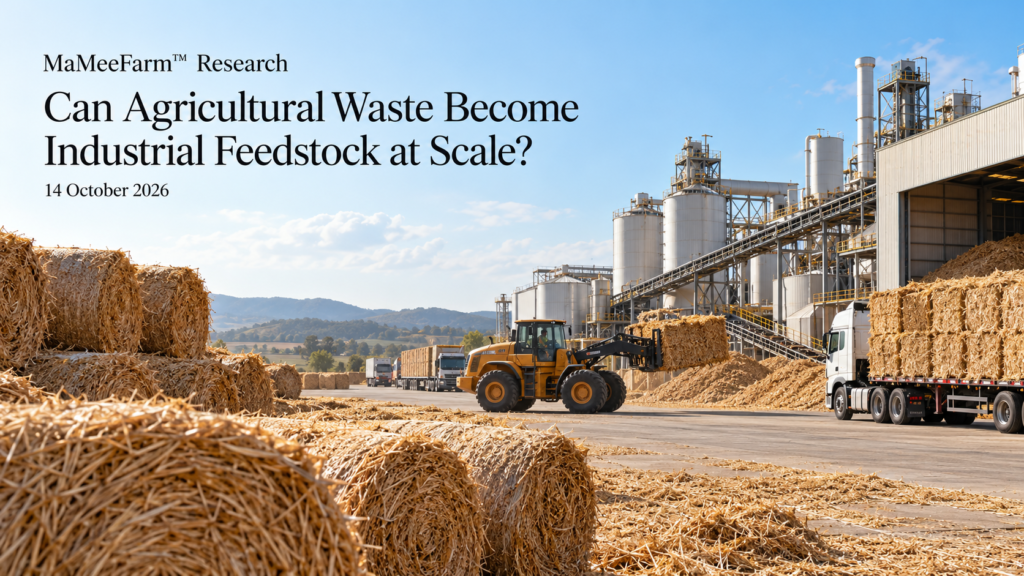
Date: 14 October 2026 Publication Type: Research Project: MaMeeFarm™
Abstract
Agricultural residues are increasingly being considered as alternative raw materials for industrial production.
Wheat straw, rice straw, bagasse, and other crop by-products contain materials that can be used in paper, packaging, and certain textile-fibre applications.
The opportunity appears substantial because agricultural production generates residues every year, while industrial manufacturers require dependable supplies of raw materials.
However, the existence of agricultural residues does not automatically establish the availability of industrial feedstock.
Some residues already serve agricultural and local economic functions. Others are geographically dispersed, available only during harvest periods, or unsuitable for particular industrial processes without additional treatment.
Recent industry initiatives and technical studies demonstrate the potential for converting agricultural residues into useful fibre products. Yet successful processing at a laboratory or pilot scale does not establish commercial viability across different regions and applications.
This research examines the conditions under which agricultural residues can become reliable industrial inputs, with particular attention to material availability, agricultural requirements, supply-chain infrastructure, processing compatibility, commercial demand, and environmental performance.
The central finding is that industrial-scale utilization depends not only on the ability to convert agricultural residues into usable materials, but also on the reliability and economics of supplying those materials to industrial facilities.
1. Research Question
Under what technical, agricultural, logistical, and commercial conditions can crop residues become reliable industrial feedstocks for paper, packaging, and textile-fibre production?
2. Agricultural Residues as Industrial Resources
Agricultural production generates materials beyond the principal harvested crop.
These include cereal straw, sugarcane bagasse, and other plant residues.
Their physical and chemical properties can make them suitable for industrial applications.
However, these materials originate within agricultural systems rather than supply chains designed specifically for industrial manufacturing.
Their availability, composition, and location reflect farming practices and seasonal production conditions.
The transition from agricultural by-product to industrial input therefore involves more than identifying a potential use for the material.
3. Agricultural Waste Is Not Necessarily Unused Material
The term agricultural waste can obscure existing uses.
Crop residues may provide soil cover, contribute organic matter, support nutrient cycling, or serve as animal feed, bedding, and household fuel.
In some locations, residues are already traded commercially.
Industrial procurement can therefore create competition for materials that are not genuinely surplus to existing requirements.
This matters because removing material from agriculture may affect both farm management and local markets.
The amount generated cannot automatically be treated as the amount available for industrial use.
4. Resource Abundance and Industrial Availability
Large agricultural regions may produce substantial quantities of crop residues.
However, national or regional production totals do not directly measure commercially available supply.
Collection feasibility varies with farm size, field access, terrain, harvest practices, and local infrastructure.
Economic availability also depends on transportation costs and competing uses.
Industrial suitability introduces further limitations because manufacturing processes require particular material characteristics.
A large theoretical resource can therefore support a much smaller commercially usable supply.
5. Agricultural Sustainability Limits Removal
Residues left in fields can help protect soil from erosion and contribute to soil organic matter and nutrient cycling.
Excessive removal may affect these functions.
The appropriate quantity available for collection depends on local conditions, including soil characteristics, climate, crop rotation, and farming practices.
A removal level appropriate in one region may not be suitable elsewhere.
Industrial expansion therefore cannot be evaluated independently of agricultural sustainability.
A commercially attractive procurement system must still operate within the limits of the farming system supplying it.
6. Geography Influences Feedstock Economics
Agricultural residues are distributed across fields and farms.
Industrial processing facilities generally require concentrated deliveries.
This geographic difference creates a transportation challenge.
Regions with concentrated crop production may be better positioned to support industrial collection than regions producing similar aggregate quantities across widely dispersed farms.
Road access, distance to processing facilities, and available transportation services influence the cost of delivered material.
Consequently, the location of residue production matters alongside the total quantity generated.
7. Collection Requires Additional Infrastructure
Crop residues do not necessarily leave farms through the same supply chains as harvested grain or other primary products.
Collecting straw for industrial use may require dedicated machinery, handling equipment, transportation services, and storage facilities.
These resources involve capital and operating costs.
Harvest timing can also create concentrated demand for equipment and labour.
Even when a region generates enough material annually, limited collection capacity during the harvest period may restrict the quantity that can be recovered.
The existence of residue therefore does not guarantee its timely collection.
8. Transport Characteristics Affect Commercial Viability
Straw and similar materials often have relatively low bulk density.
This can make transportation expensive because vehicles may reach their volume limits before their weight limits.
Baling and other preparation methods can improve handling and transportation efficiency.
However, these operations introduce additional costs and equipment requirements.
The commercial advantage depends on whether the resulting logistics improvements justify the added expenditure.
Transport economics can therefore influence which agricultural regions are suitable for industrial sourcing.
9. Seasonality Creates a Supply Challenge
Agricultural residues are generally generated around harvesting periods.
Industrial processing facilities may require raw materials throughout the year.
This creates a difference between the timing of agricultural production and industrial consumption.
Storage can help bridge that difference.
However, storage facilities require space, investment, handling systems, and appropriate operating conditions.
Seasonality is therefore an important consideration when evaluating whether agricultural residues can support continuous industrial production.
10. Storage Affects Feedstock Quality
Stored agricultural materials can be affected by moisture, biological degradation, contamination, and fire risk.
The severity of these risks depends on material characteristics and local conditions.
Humid environments may require different storage arrangements from dry regions.
Poor storage conditions can reduce the quantity or quality of material available for processing.
Storage should therefore be understood as an active component of feedstock supply rather than a neutral holding period.
11. Industrial Processes Require Consistent Materials
Agricultural residues vary naturally.
Crop variety, growing conditions, harvesting practices, and storage can influence their physical and chemical properties.
Industrial manufacturing requires greater consistency than may be available from untreated agricultural by-products.
Variations in moisture, contamination, fibre characteristics, and composition can affect processing efficiency and final product quality.
Commercial production therefore depends partly on the ability to obtain materials that meet appropriate specifications.
The required consistency will differ by industrial application.
12. Rice Straw and Wheat Straw Are Not Interchangeable
Rice straw and wheat straw are both cereal residues, but their processing characteristics differ.
Differences in mineral content, fibre characteristics, and chemical composition can affect their suitability for particular technologies.
Rice straw can present challenges associated with silica and other inorganic constituents during some pulping and chemical-recovery processes.
Wheat straw has been investigated as a source of fibre for paper and packaging applications.
These differences matter when considering whether processing results from one residue can be applied to another.
The existence of a successful process for one material does not establish equivalent performance or economics for all agricultural residues.
13. Industrial Applications Have Different Requirements
Paper, packaging, and textile-fibre production do not require identical raw materials.
Certain paper and packaging applications may accommodate agricultural fibres as part of a broader fibre mixture.
Textile-oriented cellulose applications can require more extensive purification and tighter material specifications.
These differences affect processing requirements, product quality, and commercial costs.
A residue suitable for one market may not be suitable for another without additional treatment.
The potential industrial market must therefore be considered in relation to the specific material and manufacturing process.
14. Technical Research Demonstrates Possibilities
Published studies have examined the conversion of wheat straw into pulp and its use in paper and packaging-related applications.
Research indexed by FAO AGRIS includes investigations of sodium-carbonate pulping and wheat-straw reinforcement fibres.
Such work provides evidence that agricultural residues can serve as sources of industrial fibre under specified processing conditions.
However, technical feasibility does not establish that a process will be competitive at commercial scale.
The results of individual studies must be interpreted within their material, technological, and experimental conditions.
15. Textile Applications Present Additional Challenges
Alternative cellulose sources have attracted interest from textile and fashion supply chains seeking to diversify their raw-material inputs.
Agricultural residues are among the materials being investigated.
Initiatives described by Canopy, including Project Latvus, illustrate efforts to develop textile-oriented fibre pathways from agricultural residues.
These developments indicate industrial interest and technical experimentation.
They do not establish that agricultural-residue textiles have reached universal commercial competitiveness.
Processing requirements, material consistency, production cost, and buyer specifications remain important considerations.
16. Pilot Production and Commercial Scale Are Different
Laboratory and pilot projects can demonstrate that a material can be processed successfully.
Commercial production introduces additional requirements.
Industrial facilities must operate with reliable material supply, consistent quality, suitable equipment, and sufficient market demand.
A process that performs well with carefully selected inputs may encounter different conditions when supplied by numerous agricultural producers.
Pilot results are therefore evidence of technical progress, not proof of broad industrial scalability.
17. Processing Infrastructure Influences Expansion
Existing pulp and paper facilities are generally designed around particular feedstocks and processing technologies.
Introducing agricultural residues may require changes to material handling, pulping, washing, chemical recovery, and environmental controls.
The feasibility and cost of such changes depend on the existing facility and the material being processed.
Purpose-built facilities offer different design possibilities but require substantial investment.
Neither adapting existing infrastructure nor constructing new facilities is automatically the preferable option.
Commercial viability depends on the specific circumstances.
18. Scale Does Not Always Favour Larger Facilities
Larger industrial plants can benefit from economies of scale in processing.
However, they may also require material from a wider agricultural area.
Longer sourcing distances can increase transportation expenses and coordination requirements.
The economic advantages of a larger facility can therefore be affected by higher feedstock costs.
This creates a potential difference between the most efficient processing scale and the most economical supply arrangement.
Industrial expansion may consequently take different forms across agricultural regions.
19. Regional Conditions Matter
The viability of agricultural-residue processing depends strongly on location.
Crop concentration, farm structure, transport infrastructure, climate, labour availability, and nearby industrial demand can all influence commercial outcomes.
A model that works in one agricultural region may not produce equivalent results elsewhere.
Regions with favourable combinations of agricultural supply and industrial infrastructure may offer stronger conditions for commercial development.
However, the presence of a large residue resource alone is insufficient to establish regional competitiveness.
20. Agricultural Residues Are Not Cost-Free Inputs
Agricultural residues are sometimes described as low-cost or free raw materials.
At industrial scale, this assumption can be misleading.
Material collection, preparation, storage, transportation, and quality management all create costs.
Farmers or other suppliers may also require payment.
Where residues already have local uses, industrial demand can compete with existing buyers.
The economic value of the material can change as demand develops.
Industrial feedstock costs therefore extend beyond the apparent price of material remaining after harvest.
21. New Industrial Demand Can Affect Rural Markets
Industrial use of agricultural residues may create additional revenue opportunities for farmers and collection businesses.
However, the distribution of those benefits depends on commercial arrangements and local market conditions.
New demand can also affect existing users of straw and other crop by-products.
Livestock producers, energy users, and local manufacturers may face stronger competition for materials.
The economic effects are therefore not necessarily uniform.
A new industrial market can create opportunities while also changing the availability and price of agricultural inputs.
22. Supply Reliability Influences Industrial Economics
Industrial facilities require sufficient material to maintain operations.
Interruptions in agricultural supply can affect production and asset utilization.
Crop yields, weather conditions, harvest timing, and changes in planted area may all influence residue availability.
Industrial facilities using agricultural residues therefore inherit some of the variability associated with farming.
The reliability of feedstock supply can be as important as the total quantity available over a year.
23. Commercial Relationships Support Supply Continuity
Agricultural producers and industrial processors operate under different commercial conditions.
Farmers make production decisions within agricultural cycles.
Industrial manufacturers require dependable inputs and predictable costs.
Supply agreements can help establish expectations around quantities, delivery timing, quality, and payment.
Similarly, commitments from industrial buyers can improve confidence in future demand.
These relationships may support investment in collection and processing infrastructure.
However, contractual arrangements cannot eliminate agricultural variability or technical risk.
24. Financing Depends on More Than Technology
Commercial processing facilities can require significant investment.
Capital may be needed for machinery, buildings, storage, transport infrastructure, processing systems, and environmental controls.
Investors must consider the availability of raw materials, operating costs, product quality, market demand, and financial risk.
Technical feasibility alone is insufficient to establish investment viability.
25. Industrial Demand Must Be Credible
Manufacturers are more likely to invest in alternative materials when they have confidence that buyers will accept the resulting products.
Paper, packaging, and textile markets have different technical and commercial requirements.
Interest from major brands may encourage development, but expressions of interest do not necessarily constitute binding purchasing commitments.
Commercial expansion depends on whether products can meet buyer requirements at acceptable cost and quality.
Demand certainty therefore influences the development of processing capacity.
26. Environmental Benefits Are Conditional
Agricultural fibres are sometimes presented as environmentally preferable alternatives to forest-derived materials.
However, environmental performance depends on the complete production system.
Residue collection, transport, processing energy, water consumption, chemicals, and waste management can all affect environmental outcomes.
Removing residues from fields can also have agricultural consequences.
A material’s non-wood origin does not automatically establish a lower environmental impact.
Comparisons require consistent boundaries and evidence relevant to the actual production conditions.
27. Avoided Burning Depends on Existing Practices
In regions where crop residues are routinely burned, alternative uses may reduce the incentive for open-field burning.
However, not all residues would otherwise be burned.
Some are already used productively or retained for agricultural purposes.
Environmental claims based on avoided burning therefore depend on the actual practices that industrial procurement replaces.
The same industrial use may have different environmental implications across regions.
28. Water, Energy, and Chemical Use Matter
Converting agricultural residues into industrial fibres may involve significant processing requirements.
Pulping and cellulose preparation can use water, energy, and chemicals.
Environmental performance depends partly on process efficiency, treatment systems, energy sources, and chemical management.
Different technologies and feedstocks may produce different outcomes.
The benefits of using agricultural residues therefore need to be considered alongside the impacts of industrial conversion.
29. Agricultural Fibres May Complement Existing Materials
Agricultural residues do not necessarily need to replace conventional fibre sources completely.
Some applications may use agricultural fibres in combination with recycled or other materials.
Research into wheat-straw reinforcement fibres illustrates one potential role in packaging applications.
The suitability of such combinations depends on product requirements and processing conditions.
Partial substitution may provide commercially relevant opportunities without requiring complete replacement of established materials.
30. Recycling Remains an Important Comparison
Agricultural fibres enter markets where recycled and virgin fibres already serve different purposes.
Recycled-fibre systems have their own technical requirements and limitations.
Some products require additional fibre inputs to achieve desired characteristics.
Agricultural residues may provide an alternative source in certain applications.
However, their relative advantages depend on performance, cost, and environmental conditions.
Their role should therefore be evaluated alongside existing material systems rather than in isolation.
31. Industrial Expansion Changes Agricultural Relationships
When crop residues become commercially valuable, agricultural production becomes more closely connected to industrial demand.
Farmers may gain additional markets for by-products.
At the same time, industrial buyers become exposed to agricultural production conditions.
This relationship can create new commercial opportunities and new dependencies.
Changes in harvest output, local demand, or farming practices may affect industrial supply.
The development of agricultural-residue industries therefore links two systems that operate under different economic and seasonal conditions.
32. Public Policy Can Influence Commercial Conditions
Policies affecting agricultural burning, waste management, industrial investment, and environmental standards can influence the use of crop residues.
Public support may encourage infrastructure development or technical experimentation.
However, policy incentives do not guarantee commercial viability.
Projects remain dependent on material availability, processing performance, operating costs, and market demand.
Policies encouraging residue utilization also need to account for agricultural sustainability and existing local uses.
33. What Current Evidence Establishes
Published technical research supports the feasibility of using selected agricultural residues in paper and packaging applications.
Industry initiatives also demonstrate interest in textile-oriented alternatives.
The available literature identifies material characteristics, collection, storage, processing compatibility, and environmental conditions as relevant considerations.
Agricultural residues are seasonal and geographically distributed.
Their use in industry requires additional infrastructure and commercial organization.
These observations support the conclusion that industrial development depends on more than the technical ability to extract fibre.
34. What Current Evidence Does Not Establish
The available material does not establish that all agricultural residues are available for industrial use.
It does not show that rice straw and wheat straw have equivalent processing characteristics or commercial costs.
It does not demonstrate that pilot projects are necessarily competitive at full industrial scale.
It does not establish that agricultural fibres always have lower environmental impacts than forest-derived alternatives.
Nor does it show that larger processing facilities are always more economical, that existing mills can all be adapted affordably, or that new industrial demand can expand without affecting agricultural and local markets.
Such conclusions require additional evidence relevant to particular materials, regions, technologies, and markets.
35. Research Limitations
This research draws on the supplied technical literature, industry publications, and reported developments concerning alternative fibres.
It does not independently measure regional residue availability, sustainable removal rates, delivered feedstock costs, commercial conversion yields, or lifecycle environmental performance.
The cited studies and initiatives cover different technologies, materials, and stages of development.
Their findings cannot automatically be generalized across all agricultural residues or industrial applications.
Industry assessments of investment needs and market opportunities are treated as sector perspectives rather than independently verified universal estimates.
The conclusions are therefore limited to the documented technical possibilities and the structural conditions relevant to industrial development.
36. Research Implications
Agricultural-residue utilization is often discussed as a question of material substitution.
However, industrial production requires more than identifying an alternative source of cellulose or fibre.
It requires dependable material supply, suitable processing infrastructure, and products that meet commercial requirements.
Agricultural conditions influence how much material can be collected sustainably.
Geography and seasonality influence supply reliability.
Processing technology determines which materials can be used and what products can be produced.
Market demand influences whether investment can be sustained.
The industrial opportunity therefore depends on the interaction between agricultural production and manufacturing requirements.
37. Research Conclusion
Agricultural residues have demonstrated potential as sources of industrial fibre.
Technical research has established processing pathways for materials such as wheat straw, while industry initiatives are exploring additional applications, including textile-oriented cellulose products.
These developments provide evidence of technical possibilities.
However, industrial scale requires conditions that extend beyond successful conversion.
Agricultural residues originate in production systems with existing environmental and economic functions.
Not all material generated after harvest is available for industrial collection.
Some must remain in agricultural use.
Other material may be difficult or expensive to recover, store, transport, or process.
The commercial viability of agricultural fibres also depends on regional conditions.
Crop concentration, infrastructure, material quality, processing compatibility, and industrial demand influence whether a particular residue can become a reliable manufacturing input.
Environmental benefits must likewise be evaluated in relation to existing agricultural practices and the impacts of processing.
A residue used in one region may provide different economic and environmental outcomes from the same material used elsewhere.
The available evidence therefore supports a qualified conclusion.
Agricultural residues can become industrial feedstocks, but their ability to support commercial-scale production depends on reliable supply, appropriate processing technology, economic viability, and agricultural sustainability.
This distinction matters because physical abundance is not equivalent to industrial availability.
A large quantity of crop residue may exist without being accessible at a cost, quality, or frequency suitable for manufacturing.
Conversely, a region with a smaller but dependable supply may provide more favourable conditions for industrial development.
The central research question is therefore not simply whether agricultural waste can be used.
It is whether particular agricultural residues, under specific regional and industrial conditions, can support dependable production without undermining their existing agricultural functions.
That is the difference between demonstrating an alternative material and establishing a viable industrial feedstock.
References
- Reuters. (14 October 2026). As pressure on forests mounts, fashion and paper brands turn to alternative fibres.
- Canopy. (2026). From Wheat Straw to Wardrobes: Project Latvus.
- Canopy. (2026). Hot Button Progress Report 2026.
- FAO AGRIS. (2024). Sodium Carbonate Pulping of Wheat Straw—An Alternative Fiber Source for Various Paper Applications.
- FAO AGRIS. (2024). Reinforcement Fiber Production from Wheat Straw for Wastepaper-Based Packaging Using Steam Refining with Sodium Carbonate.
- FAO. Panels, Paper and Paperboard from Agricultural Residues.
- FAO AGRIS. System Analysis of Grain Straw for Centralised Industrial Usages in China.