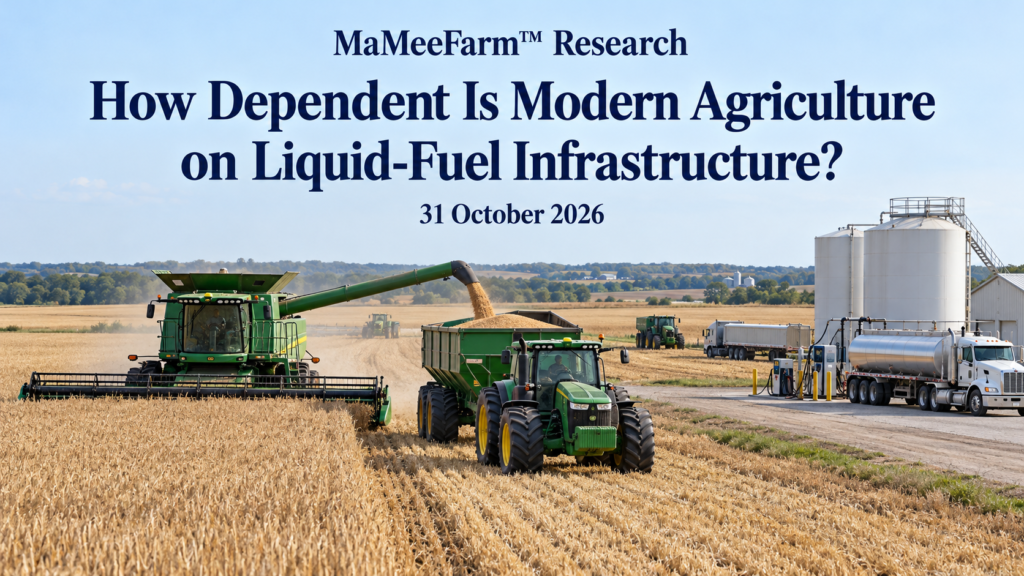
Publication Date: 31 October 2026 Category: Research Region: United States / Global Focus: Agriculture · Energy Infrastructure · Diesel · Electrification · Food-System Resilience
Abstract
Modern agriculture is increasingly connected to electricity, automation, and digital technology.
Irrigation pumps, cooling systems, ventilation equipment, and some agricultural vehicles can operate using electricity. Battery-powered machinery is also emerging in applications where operating requirements are compatible with available energy-storage technology.
However, this transition does not mean agriculture has eliminated its dependence on liquid fuels.
Large tractors, combine harvesters, and other high-power mobile machines continue to rely heavily on diesel in many agricultural systems.
Their operating requirements differ from those of stationary equipment.
They must carry energy into fields, operate under substantial loads, and often complete essential work within narrow seasonal windows.
This makes liquid fuel more than an operating expense. It is also part of the infrastructure that enables agricultural production.
In September 2026, the United States Department of Agriculture forecast that American farm fuel and oil expenses would increase by approximately US$4.8 billion, or 28.8%, compared with 2025.
An October announcement of US$8 billion in agricultural diesel assistance further highlighted the financial exposure of farmers to changing fuel costs.
Neither development, however, establishes that the United States experienced a nationwide physical diesel shortage.
This research examines how agricultural dependence on liquid fuel varies by operation, why fuel distribution matters to production continuity, and how electrification may change rather than eliminate infrastructure vulnerabilities.
The central question is not whether agriculture should remain dependent on diesel indefinitely.
It is how agricultural systems can reduce fuel exposure without compromising the timely completion of essential work.
1. Agricultural Energy Dependence Varies by Operation
Agriculture uses energy for many different purposes.
Field preparation, planting, irrigation, harvesting, drying, refrigeration, ventilation, transport, and processing all require energy, but they do not share identical operating conditions.
A stationary irrigation pump may operate near a fixed electricity connection.
A livestock ventilation system may draw power continuously from a distribution network.
A combine harvester, by contrast, must move through fields while performing energy-intensive work.
These differences influence which energy technologies are practical.
Stationary equipment can often use electricity without carrying its energy source.
Mobile equipment must either store energy onboard or receive it through another suitable delivery arrangement.
The distinction becomes particularly important for machinery that operates at high power for extended periods.
Liquid fuels provide a combination of energy density, transportability, on-site storage, and rapid refuelling.
These characteristics remain operationally valuable in agricultural settings where charging facilities are limited or where interruptions could delay critical fieldwork.
However, dependence should not be generalized across the entire sector.
Agricultural energy use is not equivalent to liquid-fuel consumption.
Liquid-fuel consumption is not necessarily equivalent to diesel consumption.
And diesel consumption alone does not establish how vulnerable a particular farm is to a supply disruption.
A farm’s exposure depends on which operations require fuel, when those operations must occur, and whether alternatives or sufficient reserves are available.
2. Harvesting Creates a Time-Sensitive Fuel Requirement
Agricultural production is governed partly by biological and seasonal conditions.
Crops must be planted, maintained, and harvested within periods determined by growth, weather, soil conditions, and market requirements.
Some delays can be managed.
Others may reduce crop quality or cause irreversible losses.
Harvesting is especially sensitive because mature crops remain exposed to rain, storms, lodging, spoilage, and other deterioration while waiting to be collected.
For farms relying on diesel-powered harvesters, fuel availability is therefore directly connected to the ability to complete production.
A sharp increase in fuel prices can reduce farm margins.
A physical shortage of fuel can prevent machinery from operating altogether.
These are different forms of risk.
The financial effect of higher fuel prices depends on consumption, crop revenue, contracts, and other production expenses.
The operational effect of unavailable fuel depends on whether the farm can obtain sufficient energy before its critical work window closes.
On-farm fuel storage can provide temporary protection against delivery delays.
However, stored fuel is finite and requires capital, maintenance, and appropriate safety arrangements.
A reserve that covers ordinary operations for several days may not be sufficient during an unusually intensive harvest period.
Fuel resilience therefore depends on the relationship between available inventory, critical workload, and the time required to restore supply.
3. Rural Fuel Distribution Is Part of Agricultural Infrastructure
Farm diesel reaches machinery through a supply network extending beyond oil production and refining.
Fuel may pass through terminals, storage facilities, transport operators, regional distributors, delivery vehicles, and on-farm tanks before reaching agricultural equipment.
Each stage performs a practical function.
Even when national fuel supply is sufficient, local delivery can be affected by transport disruption, distribution constraints, or limited access to rural locations.
This distinction is important.
The existence of fuel in a national market does not automatically guarantee timely availability at every farm.
Agricultural operations may be geographically dispersed, and demand can become concentrated during planting and harvesting periods.
Rural distribution arrangements therefore influence whether fuel can reach equipment when it is needed.
Maintaining additional suppliers or on-site reserves may reduce some vulnerabilities.
Yet these arrangements do not create complete independence.
Alternative distributors may rely on the same terminal or transport corridor.
Stored fuel may eventually be exhausted.
A farm may also lack the financial resources or physical facilities required to maintain substantial inventory.
Consequently, fuel resilience is not determined solely by the amount of diesel consumed annually.
It also depends on the reliability of the infrastructure connecting energy supply with agricultural operations.
4. Rising Fuel Costs Affect Farm Economics but Not Food Prices Equally
The USDA Economic Research Service forecast published in September 2026 provides evidence of significant financial pressure from energy costs.
It projected that total U.S. farm fuel and oil expenses would rise by approximately US$4.8 billion, or 28.8%, from 2025 levels.
This was a forecast for the 2026 calendar year, not a finalized expenditure total.
The increase formed part of a broader projected rise in farm production expenses.
Fuel costs matter because agricultural producers must purchase energy alongside fertilizer, seed, machinery, labour, feed, land services, and other inputs.
Higher energy expenditure can reduce operating margins when farmers cannot offset the increase through productivity gains or higher revenue.
However, rising fuel costs do not translate directly into an equivalent increase in consumer food prices.
Food prices reflect many additional stages, including processing, storage, transport, wholesale distribution, retail operations, and market conditions.
Different agricultural products also have different fuel requirements.
Mechanically harvested field crops may have a different direct energy-cost structure from livestock systems or greenhouse production.
The relationship between farm energy costs and consumer prices therefore varies by commodity and supply chain.
The October 2026 announcement of US$8 billion in U.S. diesel assistance illustrates a further distinction.
Government support may help offset increased costs and preserve producer liquidity.
But financial assistance does not itself change the energy requirements of existing machinery.
A diesel-powered combine remains dependent on suitable fuel even when some of its operating costs are reimbursed.
Cost relief can support short-term continuity.
Reducing structural dependence requires changes in technology, operating practices, energy supply, or infrastructure.
5. Electrification Is More Practical for Some Agricultural Functions Than Others
Agricultural electrification is not a single technological transition.
Different applications have different power requirements, operating durations, and access to infrastructure.
Stationary pumps, cooling systems, ventilation equipment, and certain material-handling operations are often stronger candidates for electrification where reliable electricity is available.
These systems can operate through fixed connections and do not need to carry large quantities of energy while moving through fields.
Smaller agricultural vehicles and machines with shorter operating cycles may also be suitable for batteries.
They may work near buildings, return regularly to charging locations, or perform tasks requiring less sustained power.
Heavy field machinery presents a different challenge.
Large tractors and combine harvesters may need substantial energy over long operating periods.
Battery-electric equipment must carry enough stored energy to perform that work or depend on charging opportunities compatible with agricultural schedules.
U.S. Department of Energy research has examined the technical implications of alternative agricultural powertrains, including the substantial battery requirements associated with some high-load tractor configurations.
Such modelling demonstrates potential constraints but does not establish one universal battery requirement for every tractor.
Actual feasibility depends on machine design, duty cycle, operating conditions, charging arrangements, and technological development.
Battery weight may also affect machinery configuration and soil interaction.
Large-scale charging may require upgrades to rural electrical distribution systems.
These constraints do not make agricultural electrification technically impossible.
They indicate that adoption must be evaluated by application rather than assumed to be equally practical across all farm equipment.
6. Electrification Changes Infrastructure Dependence Rather Than Eliminating It
Diesel-powered agriculture depends on liquid-fuel production, storage, transport, distribution, and refuelling.
Electrified agriculture depends on electricity generation, transmission, distribution, transformers, charging equipment, and potentially batteries or local energy storage.
The energy source changes.
The supporting infrastructure also changes.
This can create important benefits.
Electrification may reduce exposure to petroleum-price volatility and fuel-delivery interruptions.
Electric motors may offer operational advantages in suitable applications.
On-site electricity generation and battery storage can provide additional flexibility for some agricultural loads.
However, new dependencies emerge.
A farm using electric machinery may become more exposed to grid outages, inadequate transformer capacity, charging-equipment failure, or insufficient electricity during peak operating periods.
These risks are particularly important when agricultural work cannot be delayed.
A diesel tractor with available fuel can continue operating during a local electricity outage.
An electric tractor may also continue working if its battery is charged, but subsequent operation depends on access to sufficient charging capacity.
Local solar generation and stationary batteries can reduce some grid dependence.
Their contribution depends on system size, weather conditions, operating schedules, and the energy requirements of the equipment being supported.
A system adequate for irrigation controls or ventilation may not be sufficient to charge large field machinery repeatedly.
Agricultural electrification therefore requires coordination between equipment technology and rural electricity infrastructure.
Replacing the engine without addressing the energy-delivery system may leave important operational constraints unresolved.
7. A Mixed Energy System May Provide Greater Operational Flexibility
Agricultural energy transition does not necessarily require replacing every diesel-powered machine with a battery-electric equivalent.
Several technologies and operating arrangements may coexist.
Stationary equipment can use electricity where suitable infrastructure exists.
Smaller vehicles may adopt batteries.
Hybrid systems may reduce fuel consumption in selected applications.
Alternative liquid fuels may preserve some advantages of conventional fuel systems where equipment compatibility and supply conditions permit.
Heavy mobile machinery may continue using liquid fuel where other options cannot yet satisfy operational requirements.
This mixed approach can provide flexibility, although it does not automatically guarantee greater resilience.
Different energy sources are most useful as alternatives when they do not share the same vulnerabilities.
For example, on-site electricity generation may help during a grid outage, while stored liquid fuel may support critical field operations when charging infrastructure is unavailable.
However, alternative fuels still require production, transport, storage, and distribution.
Hybrid systems may retain dependence on liquid fuel.
Electric equipment may require substantial investment in chargers and grid capacity.
The economic feasibility of each pathway depends on purchase price, operating costs, maintenance, financing, equipment utilization, and expected service life.
Agricultural machinery also has long replacement cycles.
Even when new technologies become commercially attractive, existing equipment may remain in service for many years.
The pace of transition will therefore vary among farms and regions.
A large agricultural business may have the scale to support dedicated charging infrastructure.
A smaller producer may depend on shared facilities, contractors, or conventional machinery for longer.
Technology choice should follow actual operating requirements and economic conditions rather than a uniform assumption about the entire agricultural sector.
8. Food-System Resilience Requires Continuity of Critical Agricultural Work
The ultimate purpose of agricultural energy infrastructure is to support production.
This means resilience cannot be assessed only through litres of diesel consumed, electricity demand, or the number of electric machines purchased.
The more important question is whether essential agricultural operations can continue when energy systems experience disruption.
Different activities require different levels of protection.
Harvesting may be highly time-sensitive.
Livestock ventilation and cooling may require continuous operation.
Irrigation may have some scheduling flexibility, depending on crop and weather conditions.
Post-harvest storage may need reliable electricity to preserve product quality.
These differences influence which backup arrangements provide the greatest value.
Improving energy efficiency can reduce the amount of fuel or electricity needed for critical work.
Changes in tillage practices, machinery use, and field operations may also reduce energy demand.
Such measures can lower operating costs and the scale of reserves required during disruption.
Food-system resilience also extends beyond the farm.
Harvested products must often pass through transport, processing, refrigeration, and distribution systems that retain their own energy dependencies.
Electrifying farm machinery does not automatically eliminate liquid-fuel exposure throughout the food supply chain.
Public policy therefore faces two related but separate responsibilities.
Short-term assistance may be necessary when energy costs place immediate financial pressure on producers.
Long-term infrastructure planning must address reliable energy access, equipment transition, rural distribution systems, and the continuity of critical agricultural operations.
Neither objective should be confused with the other.
A financially supported farm can remain operationally vulnerable.
A technically advanced farm can also remain exposed if its energy infrastructure is unreliable.
Resilience requires attention to both affordability and the physical ability to complete essential work.
Research Conclusion
Modern agriculture remains connected to liquid-fuel infrastructure, but the degree of dependence varies substantially by activity.
Stationary agricultural systems are often more suitable for electrification because they can access fixed power supplies.
Smaller mobile machines may also transition where battery capacity and charging arrangements match their operating requirements.
Large tractors, combine harvesters, and other heavy field equipment face more demanding conditions.
Their need for high power, mobility, extended operation, and rapid refuelling helps explain the continuing importance of liquid fuels.
The September 2026 USDA forecast illustrates the financial significance of this dependence.
Higher fuel expenditure can place substantial pressure on farm operating costs.
The October U.S. diesel-assistance announcement demonstrates how public support may respond to those pressures.
However, neither higher fuel costs nor government assistance proves that a physical fuel shortage has occurred.
The distinction between affordability and availability remains essential.
Agricultural energy security also depends on infrastructure beyond the farm.
Refineries, terminals, distributors, transport networks, and on-farm storage influence whether liquid fuel reaches machinery when required.
Electrification can reduce exposure to some of these systems, but it introduces greater dependence on electricity networks, transformers, charging equipment, and energy storage.
The transition therefore changes the structure of agricultural energy risk rather than eliminating infrastructure dependence.
Modern agriculture should not be described simply as diesel-dependent or ready for complete electrification. Its energy vulnerability must be understood through the requirements of individual agricultural operations.
A mixed transition may allow farms to reduce liquid-fuel consumption while preserving reliable energy for difficult-to-electrify activities.
Energy efficiency, appropriate technology selection, alternative supplies, and reliable rural infrastructure can all contribute.
Yet no single arrangement will be suitable for every farm, commodity, or region.
The central resilience objective is not to preserve diesel use indefinitely.
Nor is it to electrify every agricultural function regardless of operational conditions.
It is to reduce energy vulnerability while maintaining the ability to plant, irrigate, harvest, protect, and deliver agricultural products when required.
This is where agricultural energy transition becomes a question of food-system resilience.
Evidence and Limitations
This research draws on USDA Economic Research Service farm-cost forecasts, Reuters reporting from October 2026, U.S. Department of Energy research on agricultural machinery and alternative powertrains, and USDA materials concerning agricultural energy use and equipment.
The USDA estimate of a US$4.8 billion, or 28.8%, increase in farm fuel and oil expenses is a forecast for 2026 relative to 2025, not a finalized expenditure figure.
The October 2026 U.S. diesel-assistance programme is discussed as an announced financial-support measure. It does not establish a nationwide physical diesel shortage or demonstrate that assistance had already been distributed.
Technical modelling of battery-electric tractors represents specific machine configurations and operating assumptions. It should not be generalized to every tractor or agricultural duty cycle.
The research does not establish a universal percentage of agricultural energy supplied by diesel in 2026.
It does not assume that all farms have on-site fuel storage, that all stationary equipment can be economically electrified, or that battery-electric heavy machinery is technically impossible.
The relationship between higher farm energy costs and consumer food prices is indirect and varies by commodity and supply chain.
The potential resilience benefits of diversified energy systems are conditional on infrastructure independence, operating requirements, and economic feasibility.
References
- Reuters. (23 October 2026). Trump Administration’s $8 Billion Diesel Aid for Farmers to Arrive After Election, Official Says.
- USDA Economic Research Service. (3 September 2026). Farm Sector Income Forecast.
- USDA National Agricultural Statistics Service. (2025). Farm Production Expenditures 2024 Summary.
- U.S. Department of Energy. (2024). A Market and Technology Assessment for Off-Road Vehicle & Equipment Energy and Emissions Innovation.
- U.S. Department of Energy Vehicle Technologies Office. (2024). Vehicle Technologies Office Analysis Program 2023 Annual Progress Report.
- U.S. Department of Energy Alternative Fuels Data Center. (2024). Simulation-Based Assessment of Energy Consumption of Alternative Powertrains in Agricultural Tractors.
- USDA Economic Research Service. Energy Consumption in Agriculture Increased in 2016, Driven Mainly by Diesel and Fertilizer Use.
- USDA Economic Research Service. Commodity Costs and Returns: Documentation.
- USDA Natural Resources Conservation Service. Energy Consumption Awareness Tool: Tillage.
- USDA Natural Resources Conservation Service. Combustion Engine to Electric Motor, 75 to 149 Horsepower.
MaMeeFarm™
People • Business • Opportunities