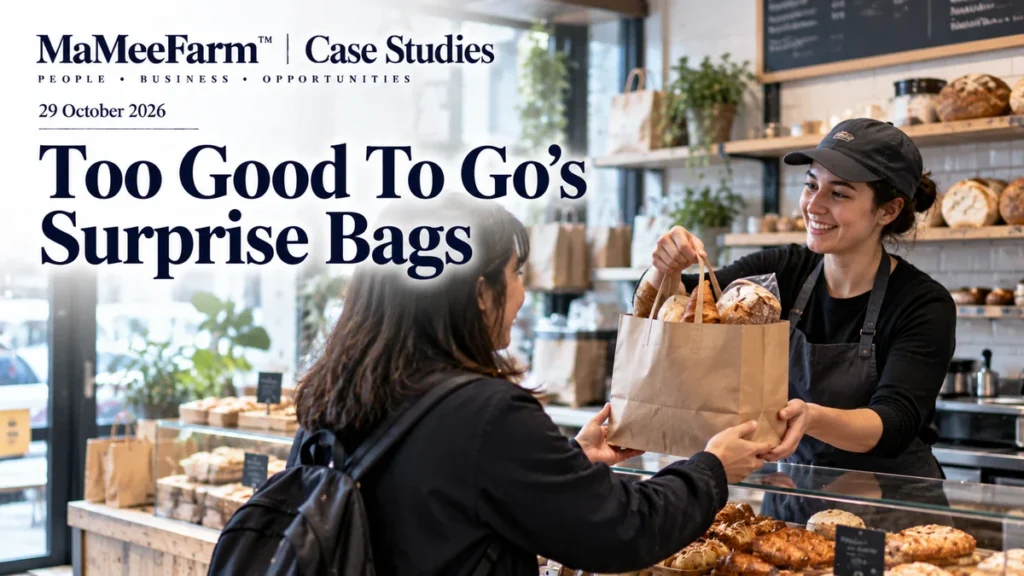
MaMeeFarm™ Case Studies | Food Retail • Digital Marketplaces • Business Operations
29 October 2026
A bakery may finish the day with bread still on its shelves. A supermarket may have prepared meals that remain unsold. These products can retain value, but the time available to find another buyer is limited.
Too Good To Go’s Surprise Bag service connects that remaining stock with nearby customers through an app.
The service combines a digital reservation with a physical collection. Its operation depends on coordinating uncertain stock, customer expectations and a defined pickup window.
Selling an Assortment That Can Change
Too Good To Go’s consumer guide describes a straightforward process. Customers find nearby businesses with surplus available, reserve and pay through the app, then collect their bag during the store’s designated window. At collection, they confirm the order through the app.
The Surprise Bag format accommodates an important feature of surplus: the exact assortment can vary.
For the customer, that means accepting less choice over individual products. For the store, it creates a way to offer a bundle without promising the same contents every day.
The category, stated value and collection arrangements help define the offer even when its contents are uncertain.
Connecting the Listing with the Counter
Too Good To Go’s business-facing service describes stores creating Surprise Bag listings, setting prices and allocating pickup times.
Customers discover the listing, reserve it and show their order when collecting.
The platform provides digital functions for coordinating orders and tracking sales activity. Specific merchant payment schedules and fees depend on the applicable commercial arrangements.
Those digital functions still depend on store operations.
Staff must identify the available goods, assemble the bags and hand them to the correct customers. The collection window connects those tasks with the customer’s journey.
A reservation can bring demand to the store. Completing the sale requires the goods and the customer to meet while collection remains possible.
Whole Foods Market’s Rollout
A joint announcement in July 2024 provides a concrete retail example.
Too Good To Go and Whole Foods Market announced availability at more than 450 United States stores.
The offer included two types of Surprise Bags:
- Prepared Foods Surprise Bag: Priced at US$9.99, with a stated retail value of US$30.
- Bakery Surprise Bag: Priced at US$6.99, with a stated retail value of US$21.
These were announced prices for the 2024 rollout, rather than verified current prices for every location.
A subsequent announcement in 2025 described expansion to more than 530 Whole Foods Market stores.
The companies also announced additional Surprise Bag categories covering produce, meat, seafood, frozen foods, refrigerated groceries, dry goods and floral products.
The expansion illustrates how the service can extend beyond bakery items and prepared meals into other departments of a grocery retailer.
However, the announcement does not establish that every category was available at every location or that each store offered the same selection every day.
Actual availability depends on the surplus products remaining at participating stores.
Revenue Recovered Is Not the Same as Profit
Selling surplus creates receipts from goods that have not sold through the original offer.
The commercial result, however, depends on more than the amount paid by the customer.
Platform charges, packaging and staff time affect what the store retains.
The timing of collection can also affect how easily the activity fits into existing work.
A retailer may be able to prepare Surprise Bags using existing staff and facilities, but the process still requires time to identify suitable products, assemble orders and hand them to customers.
The public material reviewed does not provide a complete merchant fee schedule or store-level cost records.
It therefore does not support a calculation of incremental profit.
The relevant distinction is between generating a sale and establishing that the sale improves the business’s overall economics.
A Sale and Its Environmental Outcome
The same distinction applies to food-waste claims.
A completed collection documents a transaction.
Establishing the resulting reduction in food waste requires knowing what would otherwise have happened to the food and whether it was subsequently consumed.
Alternative routes can include another markdown, donation or disposal.
Whole Foods Market’s 2024 announcement also placed the Too Good To Go partnership alongside its existing food-donation activities.
This matters because an additional sales channel may change how surplus products are distributed without establishing that every item would otherwise have been discarded.
The available evidence supports the existence of an additional sales channel for surplus food.
It does not establish that every Surprise Bag represents an equivalent quantity of food diverted from disposal.
The environmental outcome depends on the circumstances surrounding each product and what happens after collection.
Making Time-Sensitive Stock Available to Customers
Too Good To Go connects two activities that must occur within a limited period.
Retailers need to make surplus products available before their remaining selling time expires.
Customers need to discover, purchase and collect those products during the designated pickup window.
The digital marketplace helps coordinate these activities.
It allows participating businesses to list available Surprise Bags and gives nearby customers a way to reserve them.
The retailer remains responsible for preparing the order and making it available at the collection point.
This arrangement allows stores to offer products whose exact quantities and assortments may change from day to day.
The Surprise Bag format accommodates that uncertainty by offering a category and stated value without guaranteeing a fixed selection of individual items.
For customers, the trade-off is reduced product choice in exchange for access to a discounted assortment.
For retailers, the service creates another opportunity to sell suitable goods that remain available near the end of their normal selling period.
What the Too Good To Go Case Reveals
Too Good To Go demonstrates how a digital marketplace can support the sale of time-sensitive surplus food through existing retail locations.
The platform connects nearby customers with participating businesses, manages reservations and payments, and establishes collection arrangements.
Stores supply the available products and complete the transaction through physical handover.
The Whole Foods Market partnership illustrates how this model can be introduced across a large grocery network and expanded into additional departments.
The commercial opportunity comes from making suitable surplus goods available to another group of customers before their remaining selling time expires.
However, reported participation and sales activity do not automatically establish retailer profitability or the environmental benefit of each transaction.
Those outcomes depend on operating costs, alternative uses for the products and what happens after collection.
The broader business significance lies in combining flexible product assortments with a defined collection window.
Too Good To Go shows how a marketplace can create an additional retail service around goods whose availability is uncertain and whose remaining selling time is limited.
Its value ultimately depends on the coordination between digital reservations, store preparation, customer collection and the commercial conditions under which those activities take place.
Sources
- Too Good To Go – How the App Works
- Too Good To Go for Business – Marketplace
- Too Good To Go and Whole Foods Market – July 2024 Partnership Announcement
- Too Good To Go and Whole Foods Market – 2025 Surprise Bag Expansion
MaMeeFarm™
People • Business • Opportunities