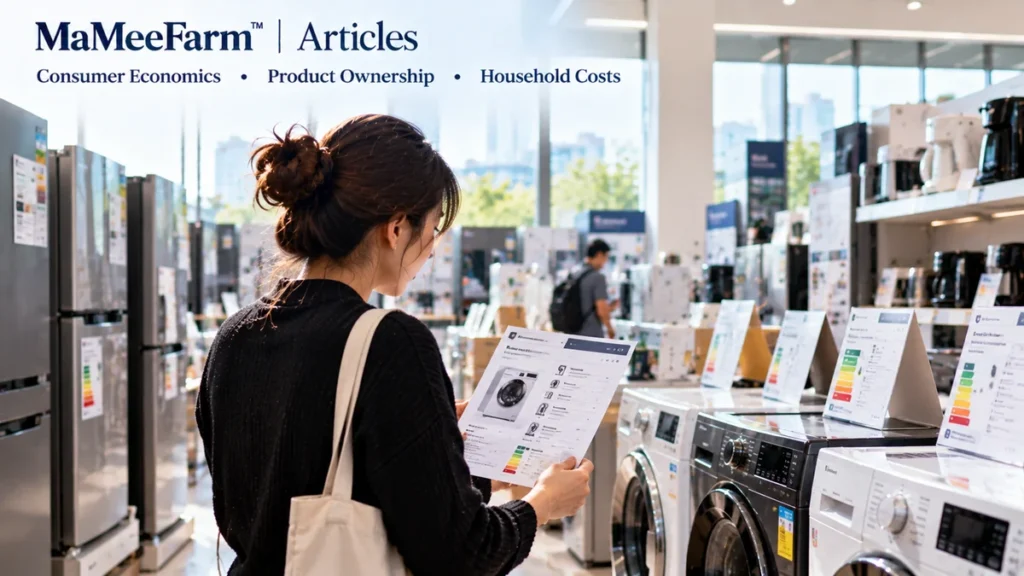
Two products can perform the same basic task while displaying very different prices on the shelf.
The cheaper option may appear to offer an immediate saving. But after purchase, the owner may need to pay for electricity, water, replacement parts, consumables, servicing, and eventually another product.
A more expensive alternative may have lower operating costs, although that is not guaranteed.
This distinction is central to the concept of total cost of ownership, or TCO: the costs associated with acquiring, using, maintaining, and eventually replacing or disposing of a product over a defined period.
The purchase price is usually the most visible expense. It is not necessarily the largest or the most important over time.
The Price Tag Describes a Moment, Not an Entire Ownership Period
A price tag answers an immediate question: how much must the buyer pay to acquire the product?
It may not include delivery, installation, accessories, or other initial requirements.
It also says little about what the product will cost once it becomes part of everyday life.
A refrigerator requires electricity. A printer needs ink or toner and paper. A vehicle requires energy, maintenance, and replacement components.
These products differ in purpose and complexity, but each can generate expenses after the original transaction.
A product with a low purchase price may therefore have relatively high running costs.
The opposite is also possible. A more expensive product may fail to generate enough savings during its useful life to justify its higher initial cost.
Neither outcome can be established from the price tag alone.
What Total Cost of Ownership Includes
Total cost of ownership examines expenses across the period during which a product is acquired, operated, maintained, and eventually replaced or disposed of.
Depending on the product, relevant costs may include the purchase price, installation, energy, water, consumables, maintenance, repairs, and end-of-use arrangements.
Resale or residual value may also affect the overall financial result.
Research published by Nicola Saccani, Marco Perona, and Andrea Bacchetti in the International Journal of Production Economics examines the application of TCO to durable consumer goods.
Their study extends ownership-cost analysis to consumer purchasing decisions and includes an empirical application involving washing machines.
The research illustrates why expenses incurred after purchase can matter substantially when evaluating a product.
However, TCO does not make future costs perfectly predictable.
Some expenses are known when the product is purchased. Others depend on future use, service requirements, and circumstances that cannot be established with certainty.
A useful ownership-cost comparison therefore distinguishes known expenses from estimates.
Frequency of Use Can Change the Result
Two households can purchase the same product and experience different ownership costs.
An appliance used every day may accumulate electricity, water, or consumable expenses much faster than one used occasionally.
If one model requires less energy per use, its operating-cost advantage may become more significant as usage increases.
For a lightly used product, the savings may remain too small to offset a higher purchase price.
The washing-machine application reported by Saccani and colleagues found that customer habits, including usage frequency and detergent consumption, were particularly important in determining TCO within the study.
That finding concerns the products and conditions examined in the research. It should not be treated as a universal ranking of cost factors for every product category.
The broader implication is that ownership costs depend partly on how a product is used.
A comparison that ignores usage patterns may not reflect the circumstances of the intended buyer.
Energy Costs Depend on More Than Efficiency
Energy efficiency can influence the operating costs of refrigerators, air conditioners, washing machines, and other appliances.
Energy labels and product information can help consumers compare the energy performance of different models.
The European Commission’s energy labelling system provides a framework for communicating efficiency information for covered product categories.
In the United States, the Department of Energy also recognises the role of estimated operating costs in helping consumers compare appliances.
However, an efficiency rating does not guarantee a particular household electricity bill.
Actual spending depends on energy prices, frequency of use, operating settings, local conditions, and the length of time the product remains in service.
A more efficient appliance may consume less electricity under comparable conditions.
Whether that reduction produces enough financial savings to justify a higher purchase price is a separate question.
Energy efficiency and financial savings are related, but they are not interchangeable.
Consumables Can Become a Major Expense
Some products depend on materials that must be purchased repeatedly.
Printers require ink or toner. Coffee machines may use capsules or filters. Cleaning equipment may need replacement bags, pads, or cleaning solutions.
These recurring expenses can become significant over time.
A low-priced printer, for example, may cost more to operate than expected if replacement cartridges are expensive or need frequent replacement.
Compatibility and availability can also affect ownership costs.
A product that accepts widely available consumables may provide different purchasing options from one that requires specialised supplies.
However, a higher consumable price does not automatically make a product a poor choice.
Performance, convenience, reliability, and frequency of use may influence the value a customer receives.
The important distinction is between the cost of acquiring the product and the additional purchases required to keep using it.
Maintenance and Repair Introduce Uncertainty
Many durable products require servicing or occasional repairs.
Some expenses are relatively predictable, such as scheduled filter replacement or routine maintenance.
Unexpected failures are harder to forecast.
Repair costs may depend on labour charges, spare-parts availability, warranty conditions, and access to qualified service providers.
A product designed to be repaired may remain useful longer, but repairability alone does not establish its lifetime cost.
A replacement component may be inexpensive while installation labour is costly.
A product may be repairable in principle but difficult to service in a particular location.
Similarly, a longer warranty may reduce exposure to certain expenses without covering every failure or associated cost.
These factors introduce uncertainty into comparisons involving products expected to remain in service for several years.
The cheapest product to purchase is not necessarily the cheapest to maintain.
But a higher purchase price does not guarantee lower repair expenses either.
Lifespan Is Important, but It Is Not the Whole Answer
A product that remains functional for longer may reduce the need for an earlier replacement.
If two products provide comparable performance, the longer-lasting option may spread its acquisition cost over a greater period of useful service.
However, longevity does not automatically produce a lower total cost.
A durable product may cost substantially more upfront.
It may also consume more energy, require expensive repairs, or eventually become unsuitable for the owner’s changing needs.
Some consumers replace products before the end of their technical life because they move, change jobs, alter household arrangements, or require different features.
A ten-year ownership estimate may therefore be inappropriate for someone who expects to use the product for only two years.
The relevant period is not simply how long the product could last.
It is how long the buyer realistically expects to use it and obtain value from it.
Comparisons Need Consistent Conditions
Ownership-cost estimates can be misleading when products are compared under different assumptions.
One calculation may assume daily use, while another assumes occasional use.
One may include repairs and installation, while another counts only electricity.
Different ownership periods can also change the apparent result.
A higher purchase price spread across ten years may look less significant than the same expense spread across two years.
However, that comparison depends on whether the product is actually likely to remain in use for the assumed period.
A meaningful comparison requires broadly comparable functions, usage patterns, cost categories, and time horizons.
For some decisions, the timing of future expenses also matters.
Life-cycle costing methods may account for this by expressing future costs on a comparable present-value basis.
The US National Institute of Standards and Technology describes formal life-cycle costing methods in its guidance for the Federal Energy Management Program.
That guidance concerns federal energy and water-related investment evaluations. Its principles help explain why the timing of costs matters, but it should not be mistaken for a consumer-product study.
For ordinary household purchases, a simpler estimate may be sufficient.
The important requirement is that the assumptions behind the comparison remain clear.
A Simple Example of How the Result Can Change
Consider two hypothetical appliances that perform the same task.
The first has a lower purchase price but uses more electricity.
The second costs more initially but consumes less electricity under comparable operating conditions.
For a household that uses the appliance frequently over many years, lower electricity spending may offset some or all of the higher purchase price.
For a household that uses it rarely or replaces it after a short period, the savings may not recover the additional upfront expense.
If the more expensive appliance also requires costly repairs, the result could change again.
These are illustrative possibilities, not measured findings about particular appliance models.
They show why the same product comparison may produce different financial outcomes for different users.
Ownership Cost and Environmental Impact Are Not the Same
Total cost of ownership concerns expenses associated with a product from the owner’s financial perspective.
Environmental life-cycle assessment addresses a different question.
It considers environmental impacts associated with stages such as raw-material extraction, manufacturing, transport, use, and end-of-life treatment.
The two perspectives can overlap.
Lower energy consumption may reduce both operating expenses and certain environmental impacts.
However, the relationship is not automatic.
A product with low private financial costs may still have substantial environmental impacts.
A product with lower environmental impacts may not have the lowest total financial cost for its owner.
Environmental impacts may also occur outside the stages for which the consumer directly pays.
A financial ownership-cost comparison should therefore not be presented as a complete environmental assessment.
Each approach answers a different question.
Why the Cheapest Product Is Not Always the Least Expensive
Purchase price remains an important part of consumer decision-making.
For households with limited cash available, a lower upfront payment may be necessary even when another product could have lower estimated costs over a longer period.
Access to credit, uncertainty about future income, and the ability to pay for repairs can all influence what is financially practical.
A product with lower projected lifetime costs may still be unaffordable at the time of purchase.
Likewise, future savings are not guaranteed.
Actual ownership costs depend on usage, operating prices, maintenance needs, and the period of ownership.
Total cost of ownership is therefore not an instruction to choose the more expensive product.
It is a way of recognising that financial costs occur at different times and in different forms.
A higher-priced product may be the less expensive choice over time in one situation.
A lower-priced product may remain the more economical choice in another.
The outcome depends on the product, the owner, and the assumptions used to compare them.
Looking Beyond the Day of Purchase
The purchase price is visible before a product enters a home or workplace.
Many other expenses emerge gradually.
Electricity, water, consumables, maintenance, repairs, and replacement can change the financial picture over time.
Some costs can be estimated with reasonable confidence. Others remain uncertain until the product is actually used.
Recognising those differences helps consumers understand why two products with similar functions can have different ownership costs.
It also explains why a single advertised price cannot capture every financial consequence of a purchasing decision.
The price paid on the day of purchase is the beginning of a product’s financial story, not necessarily its total cost.
MaMeeFarm™
People • Business • Opportunities
Sources and References
- Saccani, N., Perona, M., & Bacchetti, A. (2017). The total cost of ownership of durable consumer goods: A conceptual model and an empirical application. International Journal of Production Economics, 183, 1-13. https://doi.org/10.1016/j.ijpe.2016.09.021
- US Department of Energy. Affordable Energy for Consumers. https://www.energy.gov/topics/affordable-energy-consumers
- Kneifel, J. D., & Webb, D. H. (2022). Life Cycle Costing Manual for the Federal Energy Management Program. NIST Handbook 135e2022. National Institute of Standards and Technology. https://doi.org/10.6028/NIST.HB.135e2022
- European Commission. Understanding the Energy Label. https://energy-efficient-products.ec.europa.eu/ecodesign-and-energy-label/understanding-energy-label_en