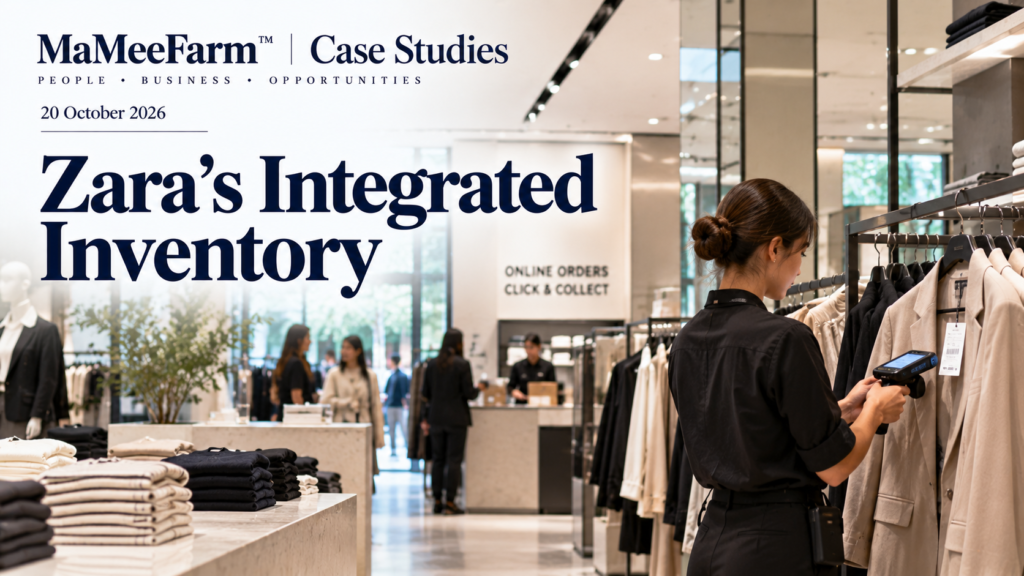
MaMeeFarm™ Case Studies | Retail Operations • Inventory Management • Digital Commerce
20 October 2026
A garment can be available in a store while remaining unavailable to a customer shopping online. The product exists, but the connection between its physical location and the customer’s order may be missing.
Zara’s development of item identification and integrated inventory illustrates how a retailer can connect those two situations. It also shows why making stock visible across sales channels changes more than the customer’s shopping experience.
The transformation began before the pandemic, as Zara’s parent company, Inditex, developed technology connecting its physical stores with its growing online business.
Identifying Individual Products
In its 2015 Annual Report, Inditex described how radio-frequency identification (RFID) technology allowed Zara garments to be identified individually as they moved from logistics platforms through to sale.
The company explained that garments were coded when security tags were attached at logistics centres.
Store employees could use the system to check product availability in their own location, nearby stores, or through Zara.com. RFID was also integrated with checkout systems.
This gave the retailer a more detailed view of where individual garments were located within its operations.
Rather than relying solely on broader product-level stock information, the technology connected physical items with digital inventory records. That capability supported inventory checks, replenishment, and customer enquiries.
During 2015, Inditex reported RFID implementation across 1,542 stores in 63 markets. The scale of this deployment demonstrates that Zara’s inventory technology development was already underway several years before the disruption caused by COVID-19.
Connecting Store Inventory with Online Shopping
Knowing where a product is located is one part of inventory management. Making that product available to customers through different purchasing channels requires additional coordination.
A garment held in a physical store may be suitable for an online order, but the retailer must still confirm its availability, process the purchase, retrieve the item, and arrange collection or delivery.
In June 2020, Inditex announced further investment in technology designed to connect its online and physical retail operations. The company’s plans included services allowing customers to view stock available at a particular store and purchase products for same-day collection.
These initiatives formed part of a wider programme of investment in stores, technology, and digital commerce.
The development extended the role of physical stores beyond serving customers who visited them in person. Store inventory could increasingly support purchases initiated through digital channels.
However, this also required coordination between inventory information, order management, store employees, and fulfilment processes.
The Pandemic Accelerated the Importance of Connected Stock
The COVID-19 pandemic created a major disruption for fashion retailers. Temporary store closures and restrictions on physical shopping reduced customers’ ability to purchase goods through conventional retail channels.
At the same time, inventory remained distributed across stores and logistics facilities. Inditex’s integrated retail operations allowed store-held products to contribute to fulfilling online demand.
The company’s 2020 financial results reflected the significant shift in shopping activity.
Inditex reported that online sales increased by 77% in constant currency during 2020, while total group sales declined by approximately 28% on a reported basis.
Both figures describe Inditex’s group-wide performance, rather than Zara’s individual results. They illustrate the contrasting performance of digital and physical retail activity during an exceptional trading period.
The figures do not mean that inventory integration alone generated the increase in online sales. Store restrictions, changing consumer behaviour, and the wider expansion of digital commerce also shaped the operating environment.
Nevertheless, the ability to use inventory across channels provided an important operational capability during a period when physical store access was disrupted.
When Stores Become Fulfilment Locations
Connecting store inventory to online orders also changes the work performed inside retail locations.
A store traditionally focuses on displaying merchandise, serving visiting customers, and completing purchases at checkout. When store inventory is used for online fulfilment, additional activities become necessary.
Employees may need to locate ordered garments, prepare them for shipment, package them, and coordinate their movement into the delivery network.
Research by Tatiana López and colleagues, first published in December 2021, examined digital transformation and changing work practices at Zara and H&M.
The study drew on participatory research, union-network discussions, documentary material, and 15 interviews conducted between March 2017 and April 2021.
For Zara, the researchers described how ship-from-store operations involved retail employees picking and packing products for online customers. The findings illustrated how digital retail integration can redistribute work within physical stores.
Inventory visibility makes products accessible to more customers, but completing an online order still requires physical handling.
The study included evidence gathered across several countries, including Spain and Germany. Its findings provide insight into changing retail tasks rather than a comprehensive measurement of working conditions across Zara’s entire international store network.
Inventory Visibility and Operating Costs
An integrated inventory system creates additional options for how retailers use the products they already hold.
A garment located in a store may be sold to a visiting customer, reserved for collection, or used to fulfil an online purchase. This flexibility can make existing inventory available through more than one sales channel.
However, each fulfilment method carries different operational requirements.
Shipping a product from a store can involve employee time, packaging, order preparation, and transportation. Fulfilling the same order from a distribution centre may involve a different combination of costs and logistical requirements.
The most economical option depends on factors such as product location, customer destination, available capacity, and the retailer’s distribution arrangements.
Integrated inventory therefore expands fulfilment possibilities without automatically making every order less expensive.
For Zara, the documented development demonstrates greater coordination between stores and online operations, although publicly available information does not establish a uniform cost advantage for store-based fulfilment.
Nor does it establish that every online order is sourced from the nearest store or that all inventory is available across every market.
A Different Role for Physical Stores
Zara’s experience illustrates a wider change in how physical retail infrastructure can support digital commerce.
A store is not necessarily limited to the customers who enter its doors. When its inventory is connected to an online ordering system, the location can become part of a broader network serving customers through multiple purchasing channels.
This changes the relationship between physical and digital retail. Online commerce still depends on physical products, storage locations, employees, and transportation.
Physical stores, meanwhile, can contribute to digital sales by providing access to inventory already positioned within the retail network.
The result is a closer operational relationship between two activities that were previously managed more separately. Technology provides the information connection, while retail operations determine how products reach customers.
What the Zara Case Reveals
Zara’s integrated inventory development demonstrates how product identification can support a broader transformation in retail operations.
RFID technology improved the ability to identify and locate individual garments. Further integration connected store inventory with digital shopping and fulfilment capabilities.
The pandemic made the importance of that connection particularly visible, as retailers faced restrictions on physical shopping while online demand expanded.
The transformation also changed the responsibilities of physical stores.
Inventory that had previously served primarily local shoppers could contribute to fulfilling orders placed through another channel, provided the necessary operational arrangements were in place.
The significance of integrated inventory is therefore not limited to more accurate stock information. It lies in the ability to connect product availability with purchasing and fulfilment across a retail network.
Zara’s experience shows that digital commerce does not eliminate the importance of physical stores. Instead, connected inventory can give those stores a broader role in how a retailer serves its customers.
Sources
- Inditex, Annual Report 2015, RFID and customer service
- Reuters, June 2020, Inditex integrated retail investment
- Inditex, Annual Report 2020
- Inditex, 2020 Chairman’s Letter
- López et al., Global Networks, first published December 2021
MaMeeFarm™
People • Business • Opportunities