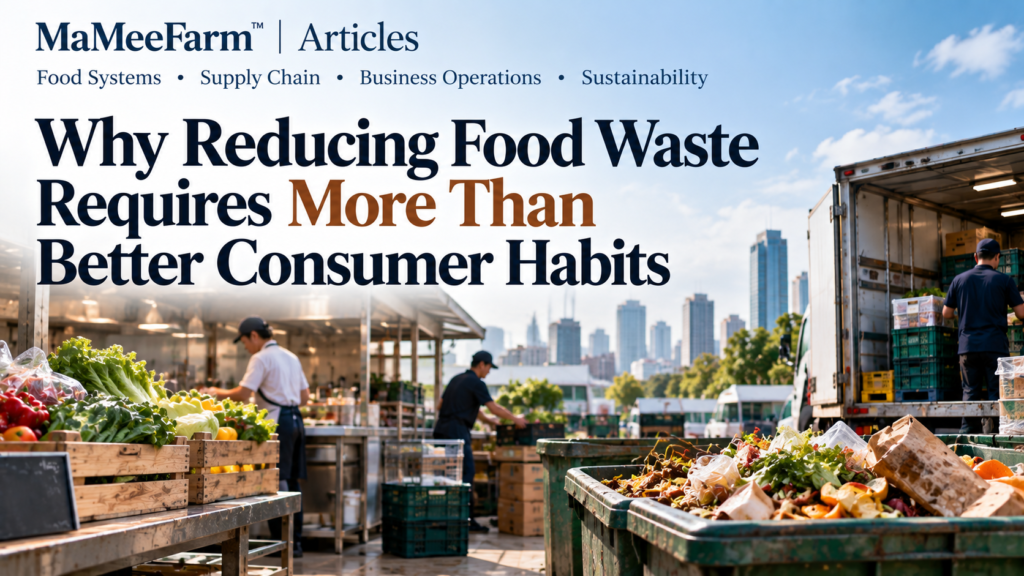
Reducing food waste is often presented as a matter of personal responsibility. Consumers are encouraged to buy only what they need, store food properly, and make better use of leftovers.
These habits matter. But food waste is not created by household decisions alone.
The amount of food that eventually goes uneaten can also be influenced by how products are packaged, how retailers manage inventory, how restaurants serve meals, and how food is stored throughout the supply chain.
According to the United Nations Environment Programme (UNEP), approximately 1.05 billion tonnes of food waste were generated worldwide in 2022 across households, food services, and retail.
Households accounted for the largest share, but a substantial amount of waste occurred within commercial food operations.
The figures highlight a broader reality: reducing food waste requires attention not only to what people do with food, but also to how food is distributed, offered for sale, stored, and served.
Where Food Waste Occurs
UNEP’s Food Waste Index Report 2024 estimates that households accounted for approximately 60% of global food waste in 2022, followed by food services at 28% and retail at 12%.
Together, food services and retail represented about 40% of the estimated total.
These figures include food and associated inedible parts discarded within the three sectors. They do not mean that every tonne recorded was edible or could have been prevented.
They also exclude food lost at earlier stages of the supply chain.
International measurement distinguishes between two related concepts.
Food loss generally refers to food lost after harvest and before the retail stage, including losses associated with storage, transportation, and processing.
Food waste, as measured by UNEP’s Food Waste Index, concerns food discarded by retailers, food service providers, and households.
The distinction matters because food that deteriorates during transportation and food left uneaten at a restaurant arise under different operating conditions.
Both represent challenges within the wider food system, but they occur at different stages.
How Packaging Shapes Food Waste
Packaging affects more than the appearance of a product.
It can influence how much food customers purchase, how easily products can be stored, and how long food remains suitable for consumption.
A product sold only in large packages may be convenient for households that use it frequently. For smaller households, the same package may contain more food than can reasonably be consumed before it deteriorates.
Multipack offers can also encourage purchases that exceed immediate needs.
These arrangements do not automatically result in waste. Their effects depend on the product, its shelf life, and how customers use it.
Packaging can also protect food from damage, contamination, and spoilage.
Reducing packaging material without considering its protective function may create a different problem if more food becomes damaged or unusable.
The issue is therefore not simply whether packaging should be reduced.
It is whether package sizes, product protection, and storage characteristics are appropriate for how food is purchased and consumed.
Smaller portions, resealable packaging, and different product formats may offer practical options in some circumstances. Their effectiveness depends on the resulting food waste and packaging impacts.
Retail Decisions Influence What Remains Unsold
Food retailers must make inventory decisions before knowing exactly how much customers will purchase.
They estimate demand, order products, maintain displays, manage expiry dates, and decide when to discount goods.
These activities create a continuing balance between product availability and unsold stock.
If a retailer orders too little, customers may find empty shelves.
If it orders too much, perishable products may remain unsold beyond their commercially useful period.
Promotions and product presentation can also influence purchasing patterns.
Discounts may help move products before they deteriorate. However, promotions that encourage customers to purchase more than they can use may shift potential waste from the store to the household.
A reduction in discarded food at a retail outlet does not necessarily demonstrate that less food was wasted across the entire system.
There is evidence that organized retail waste-reduction programmes can be associated with measurable improvements.
The UK-based organization WRAP reported that retailers providing comparable data for 2018 and 2021 reduced their recorded food waste by more than 19,000 tonnes, equivalent to approximately 8%.
This finding applies to the participating retailers covered by the comparison. It does not establish that all retailers achieved the same result or identify the effect of any single intervention.
Nevertheless, it demonstrates that food waste can be addressed as part of retail operations rather than treated solely as a household concern.
Storage Conditions Matter Across the Food System
Food storage is another factor affecting whether products remain usable.
Different foods require different handling conditions. Temperature, storage duration, packaging integrity, and the movement of goods between facilities can all influence product deterioration.
Storage problems can occur before food reaches a retailer, within a store, in a restaurant kitchen, or at home.
The stage matters for statistical classification.
Food lost during transportation or pre-retail storage generally falls within the food-loss measurement framework. Food discarded by retailers or households falls within the food-waste framework.
Although the classifications differ, suitable storage remains important throughout the food system.
Retailers and food service operators can influence storage conditions through equipment, stock rotation, handling procedures, and inventory management.
Households face their own constraints, including refrigeration capacity, available space, and the time they have to prepare meals.
Good storage practices can help preserve food, but they cannot eliminate every cause of waste.
A product may remain safe and suitable for consumption while still going unused because demand was overestimated or purchasing decisions exceeded actual needs.
Storage is therefore one component of a wider food-management system.
Food Services Face Different Sources of Waste
Restaurants, cafeterias, catering operations, and other food service providers manage food under conditions that differ from those of households.
They purchase ingredients, prepare meals, estimate customer demand, and decide how much food to serve.
Waste may arise during preparation, from meals prepared but not sold, or from food left on customers’ plates.
Kitchen preparation practices can affect ingredient use.
Menu planning and demand forecasting can influence how much food is prepared.
Portion sizes and serving formats can affect how much food remains after meals.
Buffet operations face additional challenges because food availability must be maintained even when customer demand is uncertain.
These differences explain why a single instruction to reduce food waste cannot address every food service setting.
WRAP’s final report on its UK Hospitality and Food Service Agreement documented an 11% reduction in greenhouse gas emissions associated with food and packaging waste against the agreement’s baseline.
The programme also reported approximately 24,000 tonnes of food waste avoided over its lifetime.
The 11% result was measured in carbon dioxide equivalent, rather than representing an 11% reduction in the physical weight of food waste alone.
The findings relate to the participating organizations and do not establish that any individual operational measure caused the entire improvement.
They nevertheless illustrate how food-related waste can be addressed through organized efforts within commercial food services.
Consumer Choices Are Shaped by What Businesses Offer
Consumers make decisions about what to buy, how much to prepare, and whether to keep leftovers.
Yet those decisions take place within a commercial environment.
A household chooses among the package sizes available in stores.
A restaurant customer chooses among the portions and menu options offered.
A shopper responds to prices, discounts, product information, and available storage options.
These conditions do not remove individual responsibility.
They demonstrate that consumer behavior and business practices interact.
A household may want to purchase a small quantity of a perishable ingredient but find that it is sold primarily in larger packages.
A customer may prefer a smaller restaurant meal but have no such option.
In these situations, reducing waste may require changes in both purchasing habits and the products or services available.
Businesses influence the choices consumers face, while consumers influence demand for different product formats and services.
Food waste reduction therefore involves decisions on both sides of the transaction.
Why Measuring Results Matters
Not every activity described as food waste reduction produces the same outcome.
Preventing surplus food from being generated is different from redistributing food that has already become surplus.
Both may have practical value, but they should not be measured as though they are identical.
Likewise, reducing waste at one business does not necessarily mean that waste has fallen across the wider food system.
A retailer may sell more food before its expiry date, while some of that food may later be discarded by customers.
A restaurant may reduce kitchen waste but continue to generate substantial plate waste.
These possibilities do not mean that operational improvements are ineffective.
They show that improvements at one stage do not automatically establish improvements across every stage.
UNEP’s global estimates provide an important picture of where food waste occurs, but they do not identify the effectiveness of every possible intervention.
The underlying evidence also varies between countries and sectors, with important gaps in direct measurement.
Reported reductions must therefore be understood in relation to the operations included, the type of waste measured, and the period covered.
A reduction in food waste at a particular business is meaningful, but it should not automatically be treated as evidence of an equivalent reduction throughout the food system.
A Wider Responsibility Across the Food System
Households remain central to efforts to reduce food waste.
UNEP’s estimates show that they account for the largest share of recorded waste across the retail and consumption stages.
However, the same evidence shows that retailers and food service businesses also contribute substantially to the total.
Their operating decisions influence how food is packaged, offered for sale, stored, prepared, and served.
These decisions can shape the conditions under which consumers make their own choices.
The available evidence supports a broader understanding of food waste reduction, one that considers household behavior alongside commercial practices and the physical conditions of food handling.
It does not establish that a single measure will work equally well across every product, business, or community.
Better consumer habits remain important.
But progress also depends on how businesses manage the food they purchase, sell, store, prepare, and serve.
Reducing food waste is not only about what people throw away. It is also about the decisions that shape how much food becomes waste in the first place.
MaMeeFarm™
People • Business • Opportunities
Sources and References
- United Nations Environment Programme (UNEP). Food Waste Index Report 2024. https://wedocs.unep.org/items/dbe2cd4c-8384-4636-8359-5847f42b9711
- UNEP. Food Waste Index Report 2024 – Methodological Appendix. https://wedocs.unep.org/items/423eafe4-e4e8-47c0-b261-dbd3701be842
- Food and Agriculture Organization of the United Nations (FAO). Food Loss Measurement and the Food Loss Index. https://www.fao.org/platform-food-loss-waste/food-loss/food-loss-measurement/
- WRAP. Food Waste Reduction Roadmap: Progress Report 2022. https://www.wrap.ngo/resources/report/food-waste-reduction-roadmap-progress-report-2022
- WRAP. The Hospitality and Food Service Agreement: Taking Action on Waste – Final Report. https://www.wrap.ngo/resources/case-study/hospitality-and-food-service-agreement-taking-action-waste-final-report