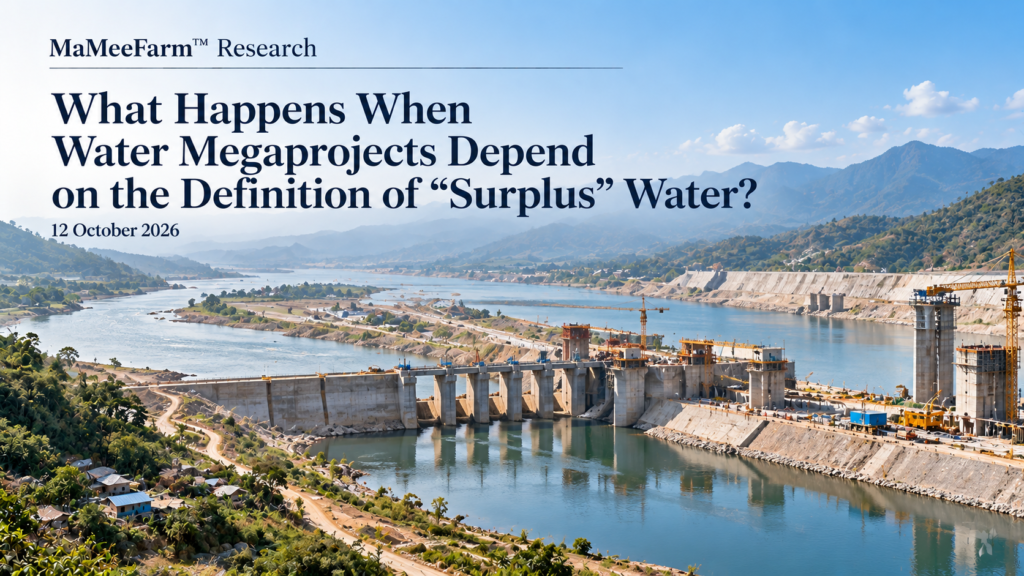
Date: 12 October 2026 Publication Type: Research Project: MaMeeFarm™
Abstract
Large inter-basin water-transfer projects are often presented through a straightforward proposition.
One river basin has water available beyond its requirements. Another basin faces water scarcity. Infrastructure can therefore transfer water from the first to the second.
The engineering proposition is understandable.
The difficulty lies in determining how much water is genuinely available for transfer.
A river does not contain a naturally identified quantity called surplus water. That quantity is established through hydrological assessment, statistical reliability criteria, estimates of existing and future demand, downstream commitments, and environmental requirements.
Different assumptions can produce different estimates of transferable water.
India’s river-linking programme provides a contemporary case through which to examine this issue.
Reuters reported on 12 October 2026 that opposition continues around India’s large river-interlinking programme, including concerns about displacement, ecological consequences, compensation, and the designation of particular basins as having surplus water.
The Ken-Betwa Link Project illustrates the relationship between hydrological classification and infrastructure planning.
Official project materials describe a planned diversion of 1,074 million cubic metres (MCM) from the proposed Daudhan Dam through the Ken–Betwa link arrangement, of which 659 MCM is described as reaching the Betwa River after en-route uses. These are planned transfer quantities, not independently established measurements of a permanent basin-wide surplus.
The National Water Development Agency also publishes detailed project reports documenting the planning framework. The underlying water-balance methodology must be examined separately from the planned diversion volumes.
However, they represent results of a particular assessment. They should not be interpreted as permanent physical characteristics of the Ken River.
The distinction matters because water-transfer infrastructure can remain in operation for decades while the hydrological, agricultural, environmental, and economic conditions underlying its original assessment may change.
This research examines how the definition of surplus shapes inter-basin transfer planning, why statistical dependability and seasonal availability matter, and how uncertainty can affect the distribution of benefits and risks.
The central finding is that surplus water is a conditional planning estimate, not a permanent physical attribute of a river basin. Its significance depends on the assumptions used to determine how much water remains transferable after competing requirements are considered.
1. Research Question
How does the methodology used to classify a river basin as having surplus water shape the technical justification for inter-basin transfers, particularly when hydrology, dependability, future demand, ecological requirements, and downstream commitments remain uncertain or contested?
2. Water Transfer Begins With a Classification
Inter-basin water transfers require a distinction between a source basin and a recipient basin.
The source is assessed as having water available for diversion.
The recipient is assessed as requiring additional supply.
This classification helps establish the rationale for dams, reservoirs, canals, tunnels, and other transfer infrastructure.
However, the need for additional water in one basin does not automatically demonstrate that another basin can supply it reliably.
The two conditions require separate evidence.
3. Surplus Is a Calculated Quantity
River flow can be observed or estimated.
Rainfall can be measured.
Reservoir levels can be monitored.
Surplus is different.
It emerges after water availability is assessed against other requirements.
Those requirements may include existing consumption, future development, downstream uses, environmental flows, and operational constraints.
A surplus estimate therefore depends on both hydrological evidence and planning assumptions.
It is not simply the amount of water passing through a river.
4. Water Availability Is Not the Same as Transferable Water
A river may carry a substantial volume of water while supporting numerous existing functions.
These can include irrigation, drinking-water supply, industrial activity, aquatic ecosystems, and downstream communities.
Some of these functions depend on seasonal flows rather than annual totals.
The presence of water in a river therefore does not establish that the same volume can be diverted without consequence.
Transferable water must be considered after relevant requirements and constraints have been assessed.
5. Dependability Changes the Estimate
River flows vary from year to year.
Water-resource planning therefore often uses statistical measures of dependable availability.
A quantity assessed at 75% dependability is associated with a specified level of historical or modeled availability.
It is not a guarantee that the same quantity will be available every year.
A volume calculated using a 50% dependability criterion can differ from one calculated using a 75% criterion.
Consequently, a basin may appear to have more transferable water under one reliability standard than another.
The reliability criterion is therefore part of the meaning of the surplus estimate.
6. A Reliability Standard Does Not Eliminate Drought Risk
A 75% dependable-yield estimate is a planning measure.
It does not establish that the river will provide the assessed quantity during every dry year.
Periods of unusually low flow can still occur.
For infrastructure intended to operate over many decades, this distinction is significant.
A project designed around one dependable-yield estimate may face different operating conditions during prolonged drought or changes in hydrological patterns.
The estimate provides a technical basis for planning, but it does not remove uncertainty.
7. Annual Availability Can Conceal Seasonal Constraints
A basin may receive substantial water during the monsoon season while experiencing scarcity during dry months.
Annual flow totals can therefore obscure the timing of availability.
A transfer project must consider when water can be captured, stored, and moved.
It must also consider when the recipient requires water and when the source basin needs to retain it.
An annual surplus estimate does not automatically establish year-round transferable supply.
Seasonal distribution is part of transfer feasibility.
8. Downstream Water Has Existing Functions
Water flowing beyond a proposed diversion point may support downstream agriculture, settlements, ecosystems, or other uses.
These requirements can be physical, economic, ecological, or legal.
Their inclusion affects the quantity identified as available for transfer.
A water-balance assessment that accounts for upstream requirements but inadequately represents downstream needs may produce a different result from one that incorporates both.
This makes the definition and treatment of downstream commitments important to the surplus calculation.
9. Environmental Flow Is Not Optional to the Analysis
Rivers perform ecological functions beyond supplying water for direct human use.
Flow conditions influence aquatic habitats, sediment movement, water quality, and floodplain processes.
Environmental-flow assessments seek to identify water requirements associated with these functions.
Different assessment methods can produce different requirements.
The selected methodology can therefore affect how much water remains available for diversion.
A positive hydrological balance does not, by itself, establish that a proposed transfer is ecologically harmless.
10. Future Source-Basin Demand Matters
A source basin’s current water use may not represent its future requirements.
Agricultural expansion, urban growth, industrial activity, and changing land use can alter demand.
Future water requirements also depend on policy choices.
Irrigation efficiency, cropping patterns, conservation measures, and development priorities can influence how much water is expected to be needed.
There is no single physically inevitable demand forecast.
Consequently, estimates of future source-basin requirements contain assumptions that affect the classification of surplus.
11. Future Demand Is Also a Development Decision
Water transferred from a source basin cannot simultaneously support every potential future use within that basin.
A transfer decision can therefore involve competing development priorities.
One region may gain additional irrigation or drinking-water supply.
Another may retain less flexibility to expand certain uses in the future.
This does not automatically make a transfer inappropriate.
It means that the decision involves more than hydrological measurement.
The distribution of development opportunities is part of the wider assessment.
12. The Ken-Betwa Link Project Provides a Concrete Case
The Ken-Betwa Link Project is a major component of India’s river-interlinking programme.
Its stated objectives include supporting irrigation, drinking-water supply, and power generation, particularly in drought-prone Bundelkhand.
The project involves transferring water between the Ken and Betwa river systems.
Official project planning relies on hydrological assessments to establish the water available for diversion.
This makes Ken-Betwa a relevant case for examining how surplus is defined and applied in infrastructure design.
13. The Published Water-Balance Figures Require Careful Interpretation
An official technical appraisal document for Ken–Betwa Phase II describes the Phase I scheme as envisaging diversion of 1,074 million cubic metres (MCM) from the proposed Daudhan Dam on the Ken River.
It further states that, after en-route utilisation, 659 MCM would be diverted to the Betwa River upstream of the existing Parichha Weir.
| Quantity described in official appraisal material | Volume |
|—|—:|
| Planned diversion from Daudhan Dam under Phase I | 1,074 MCM |
| Planned delivery to the Betwa River after en-route uses | 659 MCM |
These are project-design diversion quantities. They should not be relabelled as an independently verified hydrological surplus.
Earlier water-balance materials have reported dependable-yield and net-availability figures, but their exact definitions, deductions, and relationship to the subsequently described diversion arrangement cannot be reconstructed from the verified sources used in this revision. Accordingly, this research does not reproduce those figures as a reconciled calculation.
The official National Water Development Agency publishes the Ken–Betwa comprehensive report and the Ken–Betwa Link Project Authority provides access to detailed project documents. Those reports are the appropriate primary materials for further examination of the water-balance assumptions.
14. A Planned Diversion Is Not a Natural Constant
The planned diversion of 1,074 MCM is a project-design quantity, not a physical constant of the Ken River.
Likewise, the 659 MCM figure describes a proposed downstream transfer after en-route uses; it does not independently establish the amount of surplus water available in all years.
To establish a surplus under a particular planning framework, the relevant assessment must specify its hydrological record, dependability criterion, upstream and downstream requirements, environmental provisions, and other deductions.
This distinction does not invalidate the project’s engineering documentation. It prevents the use of a diversion figure as a substitute for the underlying water-balance evidence.
A modeled result can be technically useful without representing a permanent property of the river.
15. Hydrological Records Have Time Boundaries
Water-balance assessments rely on observations, reconstructed flow series, or hydrological models.
These sources represent particular periods and conditions.
Historical records are essential to water-resource planning.
However, they do not guarantee that future rainfall, evaporation, runoff, or land-use conditions will remain unchanged.
The relevance of an estimate therefore depends partly on the period represented by the underlying data.
For long-lived infrastructure, the age and continuing applicability of hydrological evidence are important considerations.
16. Climate Variability Complicates Long-Term Dependability
Changes in rainfall distribution, evaporation, and runoff behaviour can affect water availability.
Such changes may influence both annual volumes and seasonal timing.
A dependable-yield estimate derived from historical conditions may therefore require reassessment when hydrological patterns change materially.
This does not mean that historical data should be discarded.
It means that historical evidence and uncertainty about future conditions should be considered together.
17. Groundwater Can Affect the Water Balance
Surface water and groundwater interact in many river basins.
Rivers can contribute to groundwater recharge.
Groundwater can support river flow.
Pumping and land-use changes can alter these relationships.
A water-balance methodology that treats connected resources differently may produce estimates that are not directly comparable with those from another methodology.
Groundwater accounting therefore matters when evaluating the meaning and consistency of surplus estimates.
18. Changes in Methodology Can Change the Result
Two assessments may produce different estimates even when they examine the same river basin.
Differences can arise from updated hydrological records, revised demand projections, or changed accounting conventions.
An apparent increase or decrease in surplus does not necessarily indicate an equivalent physical change in river flow.
It may reflect a methodological revision.
Research should distinguish changes in environmental conditions from changes in how those conditions are assessed.
19. The Recipient Basin’s Need Must Be Evaluated Separately
Water scarcity in the recipient basin can provide a strong rationale for additional supply.
However, need does not create water in the source basin.
A credible transfer assessment must therefore address two distinct questions.
Does the recipient basin require additional water?
Can the source basin provide the proposed quantity under the relevant reliability and environmental conditions?
Evidence supporting one question cannot substitute for evidence supporting the other.
20. Projected Benefits Are Not Yet Realized Benefits
Official descriptions of Ken-Betwa identify potential benefits involving irrigation, drinking water, and electricity generation.
These objectives are relevant to the project’s development rationale.
However, projected benefits should be distinguished from completed outcomes.
An irrigation target does not automatically demonstrate that water has reached farmers.
A completed reservoir does not establish that every associated distribution system is operating as intended.
The realization of benefits depends on construction, operation, delivery arrangements, and actual use.
21. Water Transfers Redistribute More Than Water
Inter-basin projects can change conditions in both the source and recipient regions.
The recipient may gain access to additional water.
The source region may experience land submergence, changes in river flow, or restrictions on future water use.
Communities can also face land acquisition or relocation.
These effects are not captured fully by the transferable-water estimate.
Hydrological feasibility is one part of a broader infrastructure assessment.
22. Ecological and Social Effects Require Separate Evidence
The Ken-Betwa project has been associated with concerns about land submergence, affected communities, and ecological impacts, including those involving the Panna Tiger Reserve.
These issues are material to evaluating the project.
However, the existence of an ecological concern does not itself demonstrate that a particular water-balance calculation is incorrect.
Likewise, a technically supported surplus estimate does not establish that ecological or social consequences are negligible.
Each issue requires evidence appropriate to the question being examined.
23. Compensation Is Part of Project Performance
Land acquisition and displacement can impose substantial costs on affected communities.
Compensation, rehabilitation, and livelihood restoration are therefore relevant to the wider performance of a water-transfer project.
A project may have an established national development rationale while still generating significant local disruption.
Counting affected households is useful.
It does not necessarily capture every consequence involving livelihoods, social relationships, or long-term resettlement.
The distribution of costs and benefits remains important.
24. Approval Does Not Mean the Absence of Impact
Regulatory approval indicates that a project has passed through specified administrative or legal processes.
It should not be interpreted as proof that no ecological or social impacts will occur.
Similarly, public opposition does not by itself prove that a project is technically infeasible.
Official assessments and criticism should be examined according to the evidence they provide.
A balanced evaluation does not require treating all claims as equally substantiated.
It requires distinguishing what each source can establish.
25. Uncertainty Becomes More Consequential in Long-Lived Infrastructure
Large dams, canals, and transfer systems can shape water allocation for decades.
Their physical capacity may remain relatively fixed even as water availability and demand change.
This creates a difference between infrastructure life and the conditions represented in the original assessment.
If a project’s operating assumptions become less applicable, the consequences may extend beyond technical performance.
They can affect agriculture, public expenditure, environmental conditions, and relationships between regions.
26. A Single Surplus Estimate Has Limits
A single reported figure can be useful for describing an approved planning assessment.
However, it may conceal sensitivity to important assumptions.
Different reliability criteria, future demand estimates, ecological requirements, or climatic conditions can produce different transferable-water quantities.
Where these differences are material, a range of assessed outcomes may communicate uncertainty more effectively than one figure.
This does not imply that every published estimate is unreliable.
It means that its conditions of validity should remain visible.
27. Robustness Is Different From Maximum Transfer Capacity
An infrastructure design may seek to move the largest quantity supported by a particular assessment.
A different planning objective is to understand how much water remains transferable under a wider range of plausible conditions.
These questions are related but not identical.
A project that appears feasible under one set of assumptions may be more sensitive to drought or future demand than another.
The distinction is important when evaluating long-term reliability.
28. Operating Rules Can Matter as Much as Physical Capacity
A canal or reservoir has physical limits.
The quantity transferred through it may still vary according to operating rules.
Water availability, storage conditions, environmental requirements, and competing demands can influence those decisions.
This creates a distinction between the maximum capacity of infrastructure and the quantity that can appropriately be transferred at a particular time.
Physical infrastructure and allocation rules therefore need to be considered together.
29. Water Shortages Create Distributional Decisions
If less water becomes available than expected, competing users may face reduced allocations.
The consequences depend on how shortages are managed.
A reduction may affect the source basin, the recipient basin, or both.
This creates governance questions that cannot be resolved by engineering capacity alone.
Water-transfer planning therefore involves decisions about how hydrological uncertainty is shared.
30. Methodological Transparency Supports Accountability
A reported surplus estimate is easier to evaluate when its underlying assumptions are clearly documented.
Relevant information includes the hydrological record, observation period, dependability criterion, demand projections, downstream requirements, and treatment of environmental flows.
The purpose of transparency is not to assume that the assessment is incorrect.
It is to make the basis of the conclusion understandable and open to examination.
This is particularly important when infrastructure decisions have long-term consequences.
31. Updated Evidence Should Remain Comparable
Water-balance assessments may be revised as new information becomes available.
Revisions can improve planning.
However, comparing old and new estimates requires understanding whether their definitions and methods are consistent.
If the methodology changes, the reason for the change should be distinguishable from changes in the physical water system.
Preserving the context of earlier estimates supports meaningful comparison over time.
32. The Language of Surplus Can Conceal Assumptions
Terms such as surplus, deficit, unused, and excess can appear to describe objective physical conditions.
In water-resource planning, they often depend on decisions about which uses are recognized and which future demands are included.
Calling water surplus does not mean that the water has no other possible function.
It means that the assessment has classified a particular quantity as available after applying its defined criteria.
This is a narrower and more defensible statement.
33. What the Current Evidence Establishes
The reviewed research materials support several observations.
India’s river-interlinking programme seeks to transfer water between river basins as part of a wider infrastructure and development strategy.
The Ken-Betwa Link Project is a major implementation case.
Official planning materials use dependable water availability and water-balance assessments to support the technical case for diversion.
Official technical appraisal material reports planned diversion quantities of 1,074 MCM from Daudhan and 659 MCM to the Betwa River after en-route uses; these are not treated here as direct measurements of hydrological surplus.
Official project materials identify intended irrigation, drinking-water, and power-generation benefits.
The project also involves ecological and social considerations, including land submergence and affected communities.
Reuters reported continuing opposition to India’s river-linking programme on 12 October 2026.
Together, these observations establish that the definition of surplus is central to the technical justification and wider evaluation of large water-transfer projects.
34. What the Current Evidence Does Not Establish
The reviewed materials do not establish that:
- The Ken basin has no transferable water.
- The Ken basin has a permanently fixed quantity of surplus water.
- A 75% dependable-yield estimate guarantees availability every year.
- Recipient-basin scarcity proves source-basin surplus.
- One annual water-balance figure fully describes seasonal availability.
- Environmental approval eliminates ecological impacts.
- Community opposition proves that the hydrological methodology is invalid.
- Projected irrigation and drinking-water benefits have already been fully realized.
- The same surplus estimate will remain applicable throughout the project’s operating life.
These stronger conclusions require additional evidence.
35. Research Limitations
This research draws on the official and journalistic sources identified in the underlying research materials.
The planned diversion figures are taken from official technical appraisal material. The present research does not independently reconstruct the underlying hydrological surplus assessment, verify its intermediate calculations, or reconcile differing historical project documents.
It does not conduct a new basin-wide water-balance model, climate projection, or ecological-flow assessment.
It does not independently estimate the project’s full economic, environmental, or social costs.
The research also does not determine whether the Ken-Betwa Link Project should proceed.
Its purpose is to examine the methodological significance of surplus classification and the limits of conclusions drawn from that classification.
36. Research Implications
The central issue extends beyond India’s river-linking programme.
Any major inter-basin transfer depends on an assessment of water availability and competing requirements.
The quantity classified as transferable can influence infrastructure size, investment commitments, operating arrangements, and expectations of future benefit.
If that quantity depends on assumptions, those assumptions become relevant to the infrastructure decision.
This does not make hydrological modeling inherently unreliable.
It makes the interpretation and continuing relevance of the model important.
For long-lived water infrastructure, the quality of the evidence supporting the design is part of the project’s overall risk profile.
37. Research Conclusion
Water-transfer megaprojects are often justified through the difference between water availability in one region and water scarcity in another.
The concept is straightforward.
Its application is not.
A river basin does not contain a naturally designated quantity called surplus water.
Surplus emerges through an assessment of dependable availability, current and future demand, downstream requirements, ecological conditions, and other planning constraints.
The Ken-Betwa Link Project illustrates the importance of that process.
Official technical materials describe planned diversion quantities, while the underlying classification of transferable water depends on the water-balance framework and its assumptions.
That provides a basis for infrastructure planning.
However, the estimate should not be treated as a permanent physical characteristic of the Ken River.
Its interpretation depends on the assumptions and methods used to produce it.
Different reliability standards, changing demand, environmental requirements, or future hydrological conditions may alter the quantity considered transferable.
The consequences of these assumptions become more important when infrastructure is designed to operate for decades.
The same project can also produce benefits and costs in different locations.
Recipient communities may gain access to water.
Source-basin communities and ecosystems may experience changes associated with storage, diversion, or land acquisition.
These effects require evaluation beyond the hydrological balance.
The research therefore reaches a specific conclusion:
Surplus water is best understood as a conditional planning estimate rather than a permanent attribute of a river basin.
This distinction does not determine whether a particular water-transfer project is justified.
It clarifies the evidence required to understand the project.
The stronger question is not simply whether the source basin has surplus water.
It is:
Under which hydrological, developmental, ecological, and reliability assumptions does water remain transferable, and how does that conclusion change when those assumptions are revised?
For water infrastructure with long-term economic and environmental consequences, that distinction is fundamental.
The strength of a transfer project depends not only on the physical infrastructure that moves water.
It also depends on the reliability and continuing relevance of the evidence used to determine how much water can be moved.
References
National Water Development Agency. (2022). Comprehensive Report of Ken-Betwa Link Project, Volumes I–II. Official report repository. https://www.nwda.gov.in/content/innerpage/comprehensive-dpr-of-kblp.php
Ken-Betwa Link Project Authority. Project Documents: Detailed Project Reports and Environmental Documentation. Official document repository. https://kblpa.gov.in/Project_Documents
Government of India, Ministry of Environment, Forest and Climate Change. Detailed Project Report of Ken-Betwa Link (Phase-II): Technical Appraisal Note. Official document; states 1,074 MCM planned diversion from Daudhan and 659 MCM reaching the Betwa River after en-route uses. https://environmentclearance.nic.in/writereaddata/online/EC/17022022oyqzl1nhpiq30682377FinalTACNOTE.pdf
Press Information Bureau, Government of India. (21 August 2026). Ken-Betwa Link Project: Frequently Asked Questions. https://www.pib.gov.in/FaqDetails.aspx?ModuleId=4&NoteId=159679&lang=2®=48
Press Information Bureau, Ministry of Jal Shakti. (12 December 2019). Ken-Betwa River Inter-Linking Project. Historical project-clearance context; not a current implementation status report. https://www.pib.gov.in/newsite/PrintRelease.aspx?lang=2®=48&relid=195823
Reuters. (12 October 2026). As rising waters flood homes and temples, villagers protest India’s $87 billion river-linking project. Contemporary reporting on opposition and project impacts. https://www.reuters.com/business/environment/rising-waters-flood-homes-temples-villagers-protest-indias-87-billion-river-2026-10-12/