MaMeeFarm™ Insight Signal
Publication Date: 10 October 2026
Domain: Thailand / Investment / Productivity / Structural Growth
Observable Development
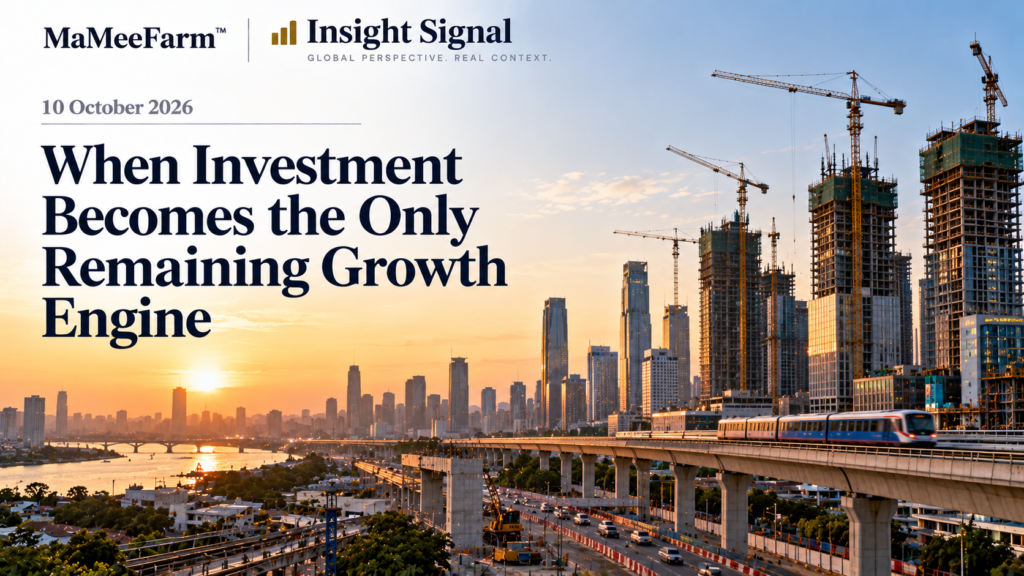
When several traditional growth engines weaken at the same time, investment becomes more important.
Thailand provides a useful current example.
Household consumption is constrained by high debt, tourism has not fully returned to its previous role, and external demand remains exposed to global trade uncertainty.
This increases the importance of capital formation.
But investment becomes structurally powerful only when it creates productive capability, not merely physical assets.
Investment Volume Is Not the Same as Productive Impact
A country can attract large amounts of capital without generating equally large gains in productivity or domestic capability.
New factories, data centers, industrial zones, machinery, and energy infrastructure can all add to the capital stock.
The broader economic effect depends on what those investments actually enable once they become operational.
Capital entering the economy is not the same as productive capability remaining in the economy.
Approved Investment Is Not Yet Realized Growth
A large pipeline of approved projects can indicate investor interest and policy momentum.
But approval is only an early stage.
Economic impact appears when capital is deployed, facilities are built, production begins, and activity spreads through the wider economy.
Headline investment therefore needs to be interpreted separately from delivered output.
Why This Matters
When consumption, tourism, and external demand provide less support, investment carries more of the burden of growth.
That makes the quality of investment increasingly important.
The long-term value of capital formation depends on whether it strengthens productive capability inside the domestic economy rather than simply expanding the asset base.
Evidence Boundary
Investment can support growth, but it does not operate independently from consumption, exports, tourism, public infrastructure, or broader macroeconomic conditions.
Approved investment is not the same as realized investment, and realized investment does not automatically produce higher productivity.
Different sectors also generate different employment, supplier, technology, and value-added effects.
The title should therefore be understood as a structural signal rather than a literal claim that every other growth engine has disappeared.
The available evidence supports a narrower observation:
when other growth engines weaken, investment becomes more important, but its structural value depends on the productive capability it creates.
Insight Signal
Investment can carry more of the burden of growth when other engines weaken.
But headline capital inflows and investment approvals are not, by themselves, evidence of stronger long-term productive capacity.
The more important question is what remains after the capital is deployed: operating capability, productivity, domestic value creation, and a stronger production base.
The real objective is not investment attraction. It is capability creation.
Sources
- Reuters. Thailand investment-led growth and post-1997 structural challenges reporting. 9 October 2026.
- Reuters. Thailand household debt and growth constraints reporting. 8 October 2026.
- World Bank. Thailand economic outlook and industries-of-the-future analysis. 2026.
- World Bank. Thailand Economic Monitor: advanced green manufacturing, investment, productivity, and structural growth.
MaMeeFarm™
Insight Signal
Thailand / Investment / Productivity / Structural Growth
Public under the MaMeeFarm™ Ecosystem
Under the DGCP™ Framework