MaMeeFarm™ Insight Signal
Publication Date: 9 October 2026
Domain: Telecom / Spectrum / Satellite Infrastructure / Network Convergence
Observable Development
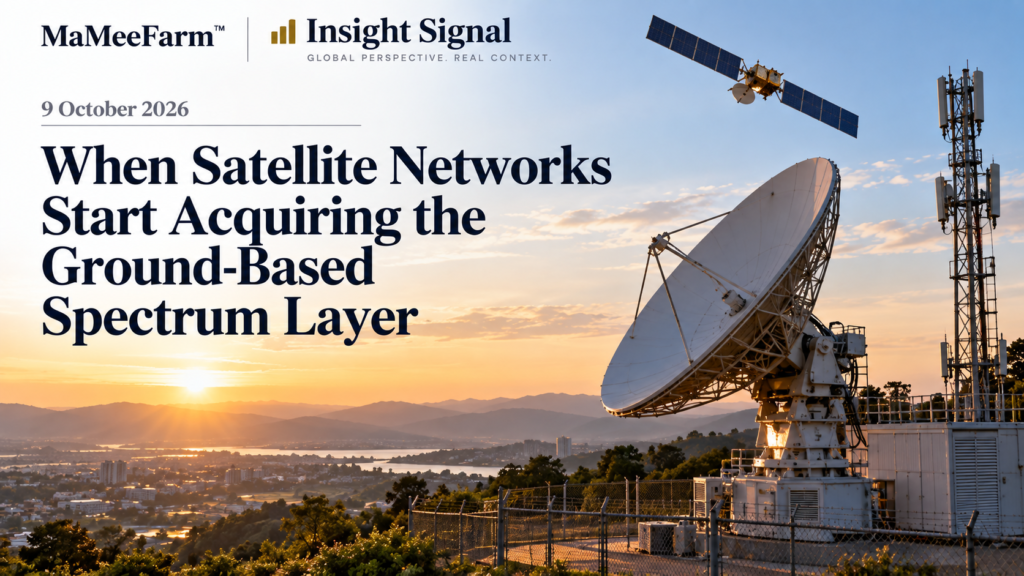
Satellite communications are beginning to move closer to the terrestrial mobile layer.
The emerging model is no longer limited to satellites operating separately from conventional mobile networks.
Satellite operators are increasingly combining orbital infrastructure with mobile-spectrum rights, direct-to-device connectivity, and ground-based deployment.
SpaceX’s expansion into low-band mobile spectrum provides a current example of that shift.
Why This Matters
Spectrum is more than a technical input.
It is a regulated resource that determines where communications services can legally operate and under what conditions.
When a satellite operator begins to control terrestrial spectrum as well as orbital infrastructure, the boundary between satellite service and mobile service becomes less distinct.
The important development is therefore not simply a spectrum transaction.
It is the growing convergence between two communications systems that were historically more separate.
Satellite and Terrestrial Networks Are Converging
Direct-to-device services are changing how satellite connectivity reaches users.
Historically, satellite communications often required specialized terminals or depended heavily on terrestrial mobile partners.
The growing use of ordinary smartphones and mobile-spectrum arrangements reduces part of that separation.
This does not mean satellite networks are replacing terrestrial cellular systems.
It means the two layers are beginning to integrate more closely.
Evidence Boundary
Spectrum acquisition does not by itself create a nationwide mobile network.
Direct-to-device connectivity also does not eliminate the need for regulatory approvals, terrestrial infrastructure, carrier partnerships, or other network dependencies.
Terrestrial mobile systems continue to have important advantages in dense areas and high-capacity environments.
One operator’s strategy also does not establish that the entire telecom industry will follow the same model.
The available evidence supports a narrower observation:
satellite operators are beginning to control more of the terrestrial spectrum and connectivity layers required to reach ordinary mobile users directly.
Insight Signal
The boundary between satellite networks and mobile networks is beginning to weaken.
Satellite operators are starting to compete not only through infrastructure in orbit, but also through access to the spectrum and connectivity layers used on the ground.
That does not mean satellite will replace terrestrial mobile networks.
The more important signal is convergence.
Telecom infrastructure is beginning to look less like separate satellite and terrestrial systems, and more like an increasingly integrated connectivity layer.
Sources
- Reuters. SpaceX low-band spectrum acquisition reporting. 8 October 2026.
- Reuters. U.S. FCC spectrum and direct-to-device reporting. 7 October 2026.
- Federal Communications Commission. SpaceX Gen2 and supplemental coverage authorization materials.
- SpaceX. Starlink Mobile spectrum and satellite-terrestrial architecture disclosures.
MaMeeFarm™
Insight Signal
Telecom / Spectrum / Satellite Infrastructure / Network Convergence
Public under the MaMeeFarm™ Ecosystem
Under the DGCP™ Framework