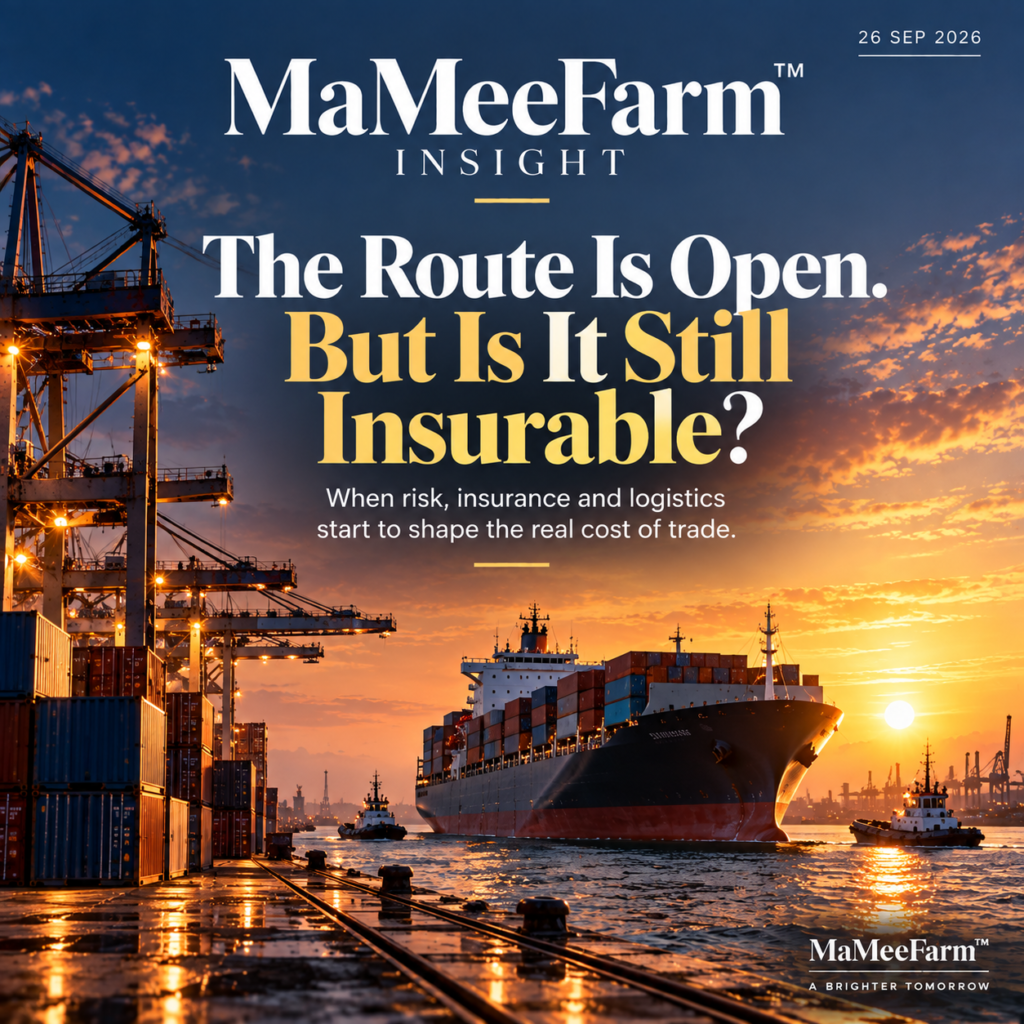
MaMeeFarm™ Insight Signal
Publication Date: 26 September 2026
Region: Global
Primary Topic: Supply Chain
Related Topics: Business · Geopolitics · Resilience · Energy & Resources
Signal Lens: Logistics · Insurance · Trade · Real Economy
The Route Is Open. But Is It Still Insurable?
When risk, insurance and logistics start to shape the real cost of trade.
A shipping route can be open.
The port can be operating.
The vessel can be ready.
The cargo can be waiting.
And yet moving that cargo may still become economically difficult.
Why?
Because physical access is only one part of a functioning trade route.
Someone also has to be willing to carry the risk.
When Risk Gets a Price
Insurance usually sits quietly behind global trade.
When conditions are stable, it rarely becomes the visible part of a shipping story.
But when conflict intensifies, vessels are attacked or particular waters become more dangerous, the financial cost of carrying that risk can move rapidly.
The Strait of Hormuz provides a current example.
In September 2026, an executive at Emirates National Oil Company told Reuters that insurance costs for oil cargoes transiting Hormuz could reach around 6% of cargo value, while war risk premiums could reach as much as 10% in some cases.
Total transit costs could reach roughly US$10 million to US$20 million.
The route still exists.
But the economics of using it have changed.
Insurance Is Part of the Route
This reveals something important about logistics.
A trade route is usually imagined as physical infrastructure.
Ports. Ships. Containers. Canals. Railways. Roads.
But global trade also depends on less visible infrastructure.
Risk has to be assessed.
Potential losses have to be financially absorbable.
Someone has to be willing to underwrite the journey.
This means the commercial availability of a route is not determined only by whether a vessel can physically pass through it.
Another question matters:
At what price is someone willing to carry the risk of the journey?
When the Risk Map Changes
The Black Sea provides another example.
In September, London’s marine insurance market expanded its designated high risk area to cover the entire Black Sea following increased attacks on commercial shipping.
Previously, the designation focused more narrowly on Russian and Ukrainian coastal waters.
The geography did not change.
The sea remained where it was.
Ports remained where they were.
But the insurance market’s assessment of travelling through that geography changed.
Higher risk classifications can require shipowners to notify insurers and can affect the availability and price of war risk cover.
When the financial interpretation of geography changes, the economics of using that geography can change with it.
Insurance Capacity Can Become Trade Capacity
There is another side to the story.
Insurance markets can also create additional capacity to absorb risk.
In June 2026, Lloyd’s announced a new marine war risk consortium for vessels and cargo transiting the Strait of Hormuz.
Led by Chubb with participating Lloyd’s syndicates and specialist market partners, the consortium provides up to US$200 million of capacity for hull and P&I risks and a separate US$200 million of cargo capacity.
Coverage remains subject to underwriting criteria, sanctions screening, policy terms and regulatory requirements.
That qualification matters.
Insurance capacity does not guarantee that every voyage will be insured.
Nor does it guarantee that every shipowner will consider the risk acceptable.
But it demonstrates something structurally important.
Insurance is not merely compensation after something goes wrong.
Its availability can help determine whether commercial activity remains financially possible before the voyage even begins.
A vessel may exist.
Cargo may exist.
Demand may exist.
The route may remain physically navigable.
But commerce also requires someone willing to accept the financial consequences of uncertainty.
The Real Cost of Moving Something
This is why freight economics cannot always be understood simply through fuel, distance and transport capacity.
Risk can become part of the journey.
And once risk receives a price, that price becomes part of the economics of moving goods.
The important distinction is therefore between two questions:
Can the cargo physically move?
and
Can the cargo economically move?
Most of the time, those questions may appear closely aligned.
During periods of disruption, they can separate.
A route may remain technically available while becoming more expensive, less attractive or commercially difficult for particular cargoes and operators.
An Invisible Layer of Global Trade
Modern logistics depends on enormous visible infrastructure.
Ships move across oceans.
Cranes move containers.
Ports connect countries.
Railways and trucks carry goods inland.
But underneath those physical movements sits another system that is much harder to see.
The system that prices uncertainty.
When risk is relatively low, this layer can remain almost invisible.
When risk rises, its importance becomes much easier to see.
Perhaps that is why insurance deserves to be viewed as more than something purchased after deciding how to transport cargo.
In some parts of global trade, it becomes part of the calculation determining whether transportation remains commercially viable at all.
The route can remain open.
The ships can continue moving.
The cargo can still have a buyer.
But another question sits quietly behind the journey:
Who is willing to carry the risk, and at what price?
Because sometimes the important constraint on a trade route is not whether it can be crossed.
It is whether crossing it can still be insured at an economically acceptable cost.
Evidence Boundary
The examples above establish that maritime risk can materially affect insurance pricing, risk classification and available underwriting capacity.
They do not establish that an open route automatically becomes commercially unusable when insurance costs rise.
Actual viability varies by vessel, cargo, operator, insurer, route, policy terms, security conditions and the value of the goods being transported.
The signal is therefore not that insurance has replaced physical infrastructure as the determinant of trade.
It is that physical access alone does not establish commercial accessibility.
Sources
- Reuters, 9 September 2026: Oil vessel transit costs through Hormuz escalated amid conflict, according to an ENOC executive.
- Reuters, 18 September 2026: London’s marine insurers widened the Black Sea high risk zone following increased attacks on commercial shipping.
- Lloyd’s, 19 June 2026: New marine war risk consortium for vessels and cargo transiting the Strait of Hormuz.
P’Toh
MaMeeFarm™ Insight Signal
Global · Supply Chain
Business · Geopolitics · Resilience · Energy & Resources
Logistics · Insurance · Trade · Real Economy
Public under the MaMeeFarm™ Ecosystem
Under the DGCP™ Framework