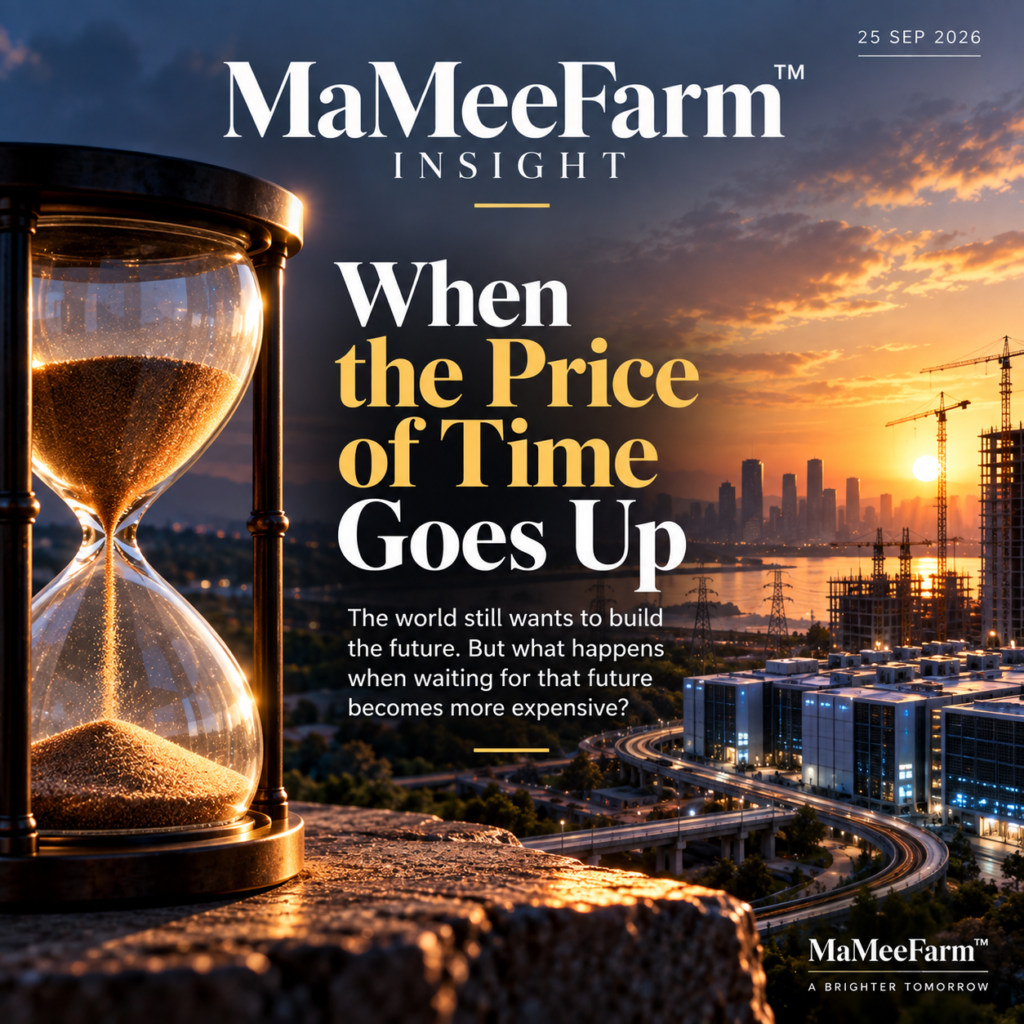
MaMeeFarm™ Insight Signal
Publication Date: 25 September 2026
Region: Global
Primary Topic: Economy
Related Topics: Business · Infrastructure · AI · Energy & Resources
When the Price of Time Goes Up
The world still wants to build the future. But what happens when waiting for that future becomes more expensive?
For years, relatively low financing costs changed the economics of waiting.
A project could require years of construction before producing meaningful returns. A company could invest heavily today in capacity expected to generate value much later.
Waiting always had a cost.
But when financing was relatively inexpensive, that cost was easier to carry.
That environment is changing.
On 24 September 2026, the yield on the 30 year U.S. Treasury climbed to its highest level since 2004. Japan’s benchmark 10 year government bond yield also reached its highest level since 1996.
The moves came amid a broader global bond selloff, with markets weighing elevated energy costs, inflation pressures, resilient economic activity and government borrowing.
But there is another way to look at what is happening.
The price of time is changing.
Money Has a Time Dimension
Interest rates are usually discussed as the price of money.
For long term investment, they are also closely connected to the price of waiting.
A project requiring capital today and generating returns many years from now has to carry that time financially.
When long term financing becomes more expensive, the project does not necessarily become impossible.
But the economics change.
The same factory can still be built.
The same infrastructure can still operate.
The same technology can still create demand.
Yet the value of receiving future returns relative to spending money today has changed.
That distinction matters in a world planning enormous amounts of long term investment.
The Future Requires Capital Before It Produces Returns
Many investments reshaping the global economy share one characteristic.
They require significant spending before the economic return fully appears.
This is visible in infrastructure, manufacturing, energy and increasingly AI.
The physical economy has always operated this way.
Construction happens before production.
Investment happens before revenue.
Capacity exists only after somebody has paid for the time required to create it.
For years, the central question was often whether enough capital was available.
Today another question deserves attention:
How expensive is the time between investment and return?
A Different Constraint
This does not mean the world is running out of money.
Capital continues to move. Companies continue to invest. Governments continue to finance infrastructure. Investors continue to search for growth.
But abundant capital and cheap time are not the same thing.
A project may still attract financing while facing a higher threshold for what investors expect in return.
A business may still expand while becoming more selective about which projects deserve capital first.
And an investment that looked attractive under one financing environment may look different under another.
Nothing physical about the project has necessarily changed.
The price attached to waiting has.
Why This Matters Now
This becomes especially interesting because global investment ambitions are not becoming smaller.
AI infrastructure is expanding.
Energy systems require investment.
Manufacturing capacity is being reconsidered.
Governments are rebuilding or strengthening infrastructure.
All of these ambitions operate not only through capital and physical resources.
They also operate through time.
Some investments generate returns quickly.
Others require years.
When financing conditions change, that difference becomes economically important.
The question may therefore shift from:
Can we finance it?
to:
Can we finance the time it takes?
The Price of the Future
Markets can change expectations in seconds.
Capital can move across borders in minutes.
But factories, power systems, data centers and infrastructure still take time to build.
That difference cannot simply be removed by having more money.
Money can finance time.
It cannot eliminate it.
And when the cost of carrying that time rises, the future itself is not necessarily cancelled.
It becomes more expensive to reach.
Perhaps that is one of the quieter macroeconomic changes worth watching now.
The world still wants to build more.
The capital may still exist.
The demand may still exist.
The plans may still exist.
But between today’s investment and tomorrow’s return sits something every project must eventually pay for:
Time.
Capital can finance the future.
Time determines what that future costs.
Sources
- Reuters, 24 September 2026: U.S. long dated Treasury yields and global bond selloff.
- Market data and reporting, 24 September 2026: Japan 10 year government bond yield at a 30 year high.
P’Toh
MaMeeFarm™ Insight Signal
Macro · Capital · Time · Real Economy
Public under the MaMeeFarm™ Ecosystem
Under the DGCP™ Framework