MaMeeFarm™ Insight Signal
Publication Date: 25 September 2026
Region: Asia
Primary Topic: Supply Chain
Related Topics: Business · Food Systems · Resilience
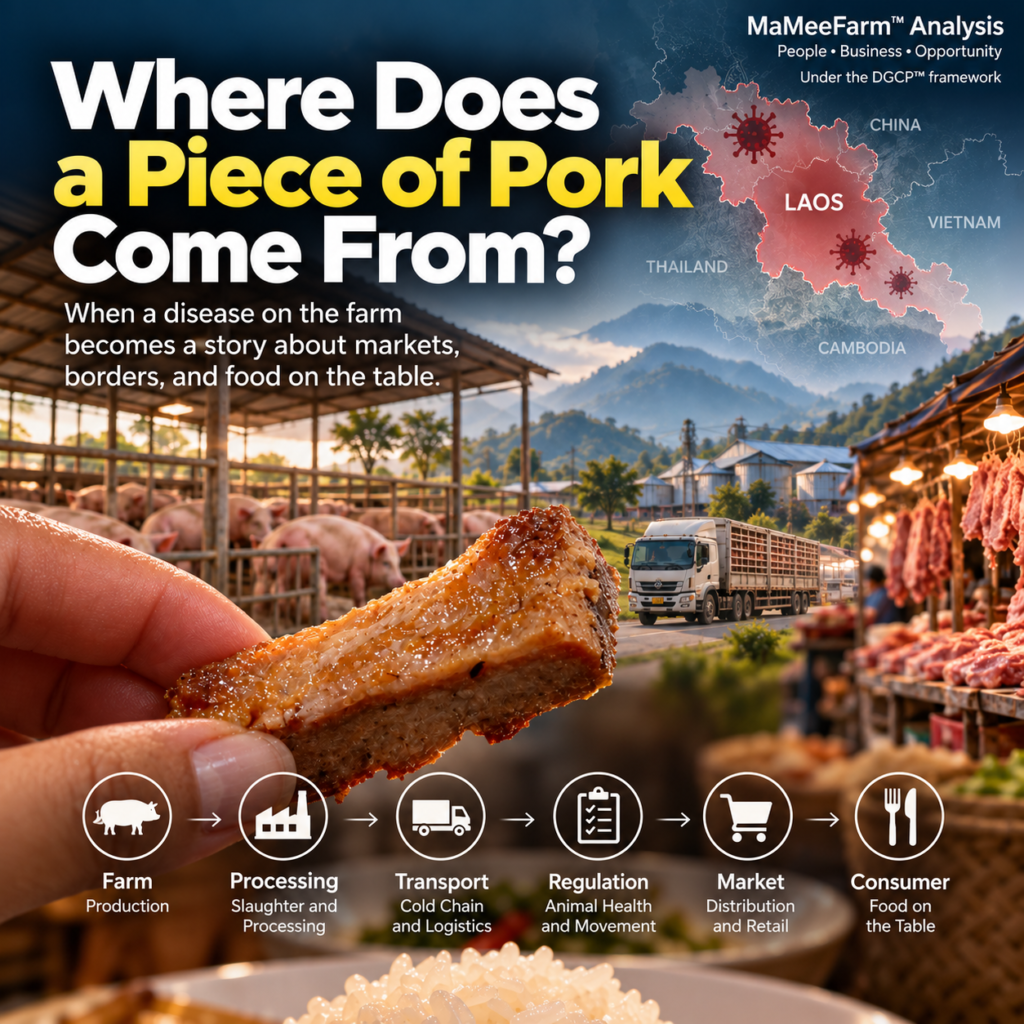
Where Does a Piece of Pork Come From?
When a Disease on the Farm Becomes a Story About Markets, Borders, and Food on the Table
A small observation can reveal a much larger system.
During a meal in Laos, a conversation about pork produced a simple explanation: disease had affected local pigs, so pork had to come from Thailand.
The statement was plausible.
But plausibility is not evidence.
Checking what is currently happening in Laos reveals a more important story.
The outbreak is real
Laos is dealing with African Swine Fever, or ASF.
On 17 September 2026, Lao authorities reported that the current outbreak had affected five provinces, 13 districts and 81 villages, with 11,396 pigs dead or culled. Authorities in Champasak strengthened surveillance, quarantine, movement controls and biosecurity measures in response.
Earlier, Xayaboury District temporarily suspended the slaughter, sale and consumption of pork after ASF was confirmed in samples from pigs. Authorities also tightened controls on the movement and sale of pigs and pork products.
ASF does not pose a risk to human health, but it can be devastating to pig populations. The Food and Agriculture Organization of the United Nations notes that outbreaks can generate substantial economic losses through mortality, culling and trade disruption.
The immediate event is therefore an animal health problem.
Its consequences do not necessarily remain on the farm.
The system extends beyond the pig
Food reaches consumers through a chain.
Farm → Processing → Transport → Regulation → Market → Consumer
Disease can interfere with several points simultaneously.
Animals may die or be culled.
Movement may be restricted.
Slaughter may be temporarily prohibited.
Vehicles and farms may face additional biosecurity requirements.
Markets and restaurants may face restrictions in affected areas.
In Champasak, authorities temporarily suspended movement of live pigs and pork products between districts and provinces. The provincial directive also suspended imports of live pigs and pork products from abroad while strengthening checkpoints and vehicle disinfection.
That detail matters.
A supply disruption does not automatically produce one predictable trade response.
Authorities may restrict domestic movement, restrict imports, strengthen inspections or impose several controls at the same time.
A border does not automatically solve a shortage
Thailand and Laos are geographically connected markets, making cross border sourcing an obvious hypothesis when local supply comes under pressure.
But the observation from the meal cannot establish that this is what happened to the pork on the table.
Nor does the evidence reviewed establish a simple national chain:
ASF → Lao pork unavailable → Thai pork replaces it
What the evidence establishes is narrower.
ASF is affecting pig production in Laos.
Disease control measures are affecting movement and market activity in some locations.
Those interventions can alter how food supply chains operate.
What happens next depends on regulation, available supply, geography, logistics, biosecurity and market responses.
The signal is larger than pork
The deeper insight is not about whether one piece of pork came from Thailand or Laos.
It is about how quickly an agricultural shock can become a system level issue.
Animal health can affect production.
Production disruption can affect logistics.
Disease control can affect movement.
Movement restrictions can affect markets.
Markets can change sourcing behaviour.
And eventually those changes may become visible to an ordinary consumer deciding what to eat.
This is why food security cannot be understood only through production volumes.
A food system must also preserve the ability to process, move, regulate and distribute food safely.
Evidence Boundary
The field observation triggered the investigation.
It did not prove the explanation.
The available evidence confirms an ongoing ASF problem in Laos and documented controls affecting pigs and pork products. It does not, by itself, establish that the current outbreaks have caused Laos nationally to replace domestic pork with imports from Thailand.
That connection would require additional evidence, including current trade volumes, import origin data, local production changes, market prices and sourcing records.
Until then, it remains a hypothesis rather than a finding.
What to Watch
The useful signals from here are changes in domestic pig supply, movement restrictions, pork prices, slaughter activity, cross border trade volumes and the duration and geographic expansion or relaxation of disease control measures.
Together, those indicators would show whether the outbreak remains primarily an animal health event or develops into a broader food supply and trade disruption.
Sometimes an economic signal does not begin with a spreadsheet.
It begins with dinner.
And one question:
Where did this piece of pork come from?
Sources
- Lao News Agency (KPL), “Champasak Strengthens Measures Against African Swine Fever,” 17 September 2026.
- Lao News Agency (KPL), “Xayaboury Detects African Swine Fever, Suspends Pork Sales and Consumption,” 25 August 2026.
- Food and Agriculture Organization of the United Nations (FAO), “African swine fever.”
MaMeeFarm™ Insight Signal
Real World Observation
Asia · Supply Chain · Business · Food Systems · Resilience
Author: P’Toh
Role: System Architect DGCP™
Public under the MaMeeFarm™ Ecosystem
Under the DGCP™ Framework