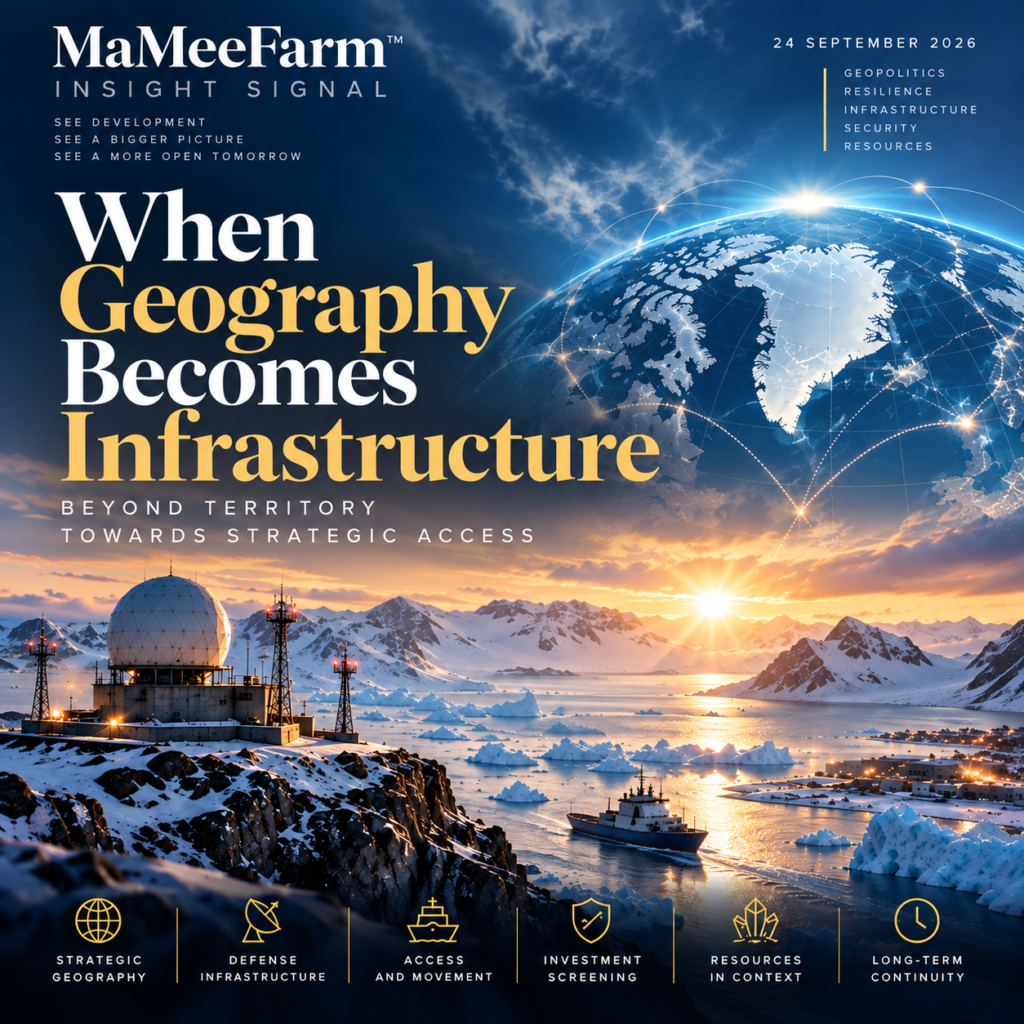
MaMeeFarm™ Insight Signal
24 September 2026
Region: Cross Regional
Topic: Geopolitics
Related: Resilience · Infrastructure · Security · Resources
Greenland has long attracted attention because of its location in the Arctic.
A new security agreement involving the United States, Denmark and Greenland adds another dimension to that geography: the ability to use strategically important territory through long term access, infrastructure and operating arrangements.
Signed on 22 September 2026, the agreement does not transfer Greenland to the United States. It operates within the sovereignty of the Kingdom of Denmark and recognizes Greenland’s right to self determination.
What it changes is the framework surrounding how that geography can be used.
Geography Is More Than Location
Strategic geography is often understood through maps, borders and physical location.
But location alone does not determine how useful a territory can be.
The agreement provides for continued and expanded U.S. defense activities in Greenland, including arrangements concerning Pituffik Space Base and additional Defense Areas.
It also establishes mechanisms through which further Defense Areas may be considered in the future.
The physical geography remains the same.
The arrangements governing its strategic use are changing.
Access Changes What Geography Can Do
The agreement addresses movement by U.S. forces, vessels, aircraft and vehicles between Defense Areas through Greenland by land, air and sea.
These provisions matter because strategic location and strategic accessibility are not necessarily the same thing.
A location may sit near important routes or regions, but its practical significance also depends on whether people, equipment and systems can operate through it.
Greenland therefore illustrates a broader distinction between having strategically important geography and having usable strategic access to it.
Infrastructure Expands the Role of Geography
The agreement also connects Greenland with wider defense infrastructure.
It includes provisions related to the potential establishment of elements supporting the Golden Dome defense system and allows consideration of additional facilities under agreed procedures.
This changes how a remote location can function.
Territory can support communications, surveillance, transportation and other systems extending far beyond the territory itself.
Geography can therefore become part of a larger operating environment rather than simply a location on a map.
Economic Activity Can Also Matter
The agreement is not concerned only with physical military facilities.
It includes provisions relating to security around Defense Areas and investment screening arrangements involving Greenland and Danish authorities.
This reflects a wider reality surrounding strategic infrastructure.
Commercial investment and infrastructure development can become relevant when they occur near sensitive locations or systems.
The agreement’s preamble also acknowledges existing cooperation involving minerals, economic development and business promotion.
It does not, however, transfer ownership of Greenland’s mineral resources to the United States or provide general U.S. mining rights.
That distinction is important.
Strategic access does not automatically mean resource ownership.
Geography Also Has a Time Dimension
The agreement is designed without a fixed end date and operates within the existing defense framework.
It also addresses the possibility that Greenland could exercise its right to self determination in the future.
Under the agreement, if Greenland becomes independent, Denmark and Greenland are to take steps intended to maintain Greenland’s NATO membership and continuation of the relevant rights and obligations established by the agreement.
This places long term continuity alongside physical access and infrastructure.
Strategic geography is therefore not only about where something is located today.
Its importance can also depend on whether access and operating arrangements remain available as political circumstances change.
When Geography Becomes Infrastructure
The Greenland agreement highlights a broader development.
Territory can have strategic importance because of its location.
But location becomes more consequential when it can support movement, infrastructure and long term operations.
This does not make sovereignty less important. The agreement itself continues to recognize sovereignty and Greenland’s right to self determination.
Instead, it shows that the strategic significance of geography can extend beyond ownership alone.
A remote territory connected to transportation, defense infrastructure and durable operating arrangements can become part of a much larger system.
That raises a wider question:
What happens when the strategic value of geography increasingly depends not only on where territory is located, but on whether it can support access, infrastructure and long term operations?
Sometimes infrastructure is something built on geography.
Sometimes geography itself becomes part of the infrastructure.
MaMeeFarm™ Insight Signal
Geopolitics · Infrastructure · Resilience · Resources
Public under the MaMeeFarm™ Ecosystem
Under the DGCP™ Framework