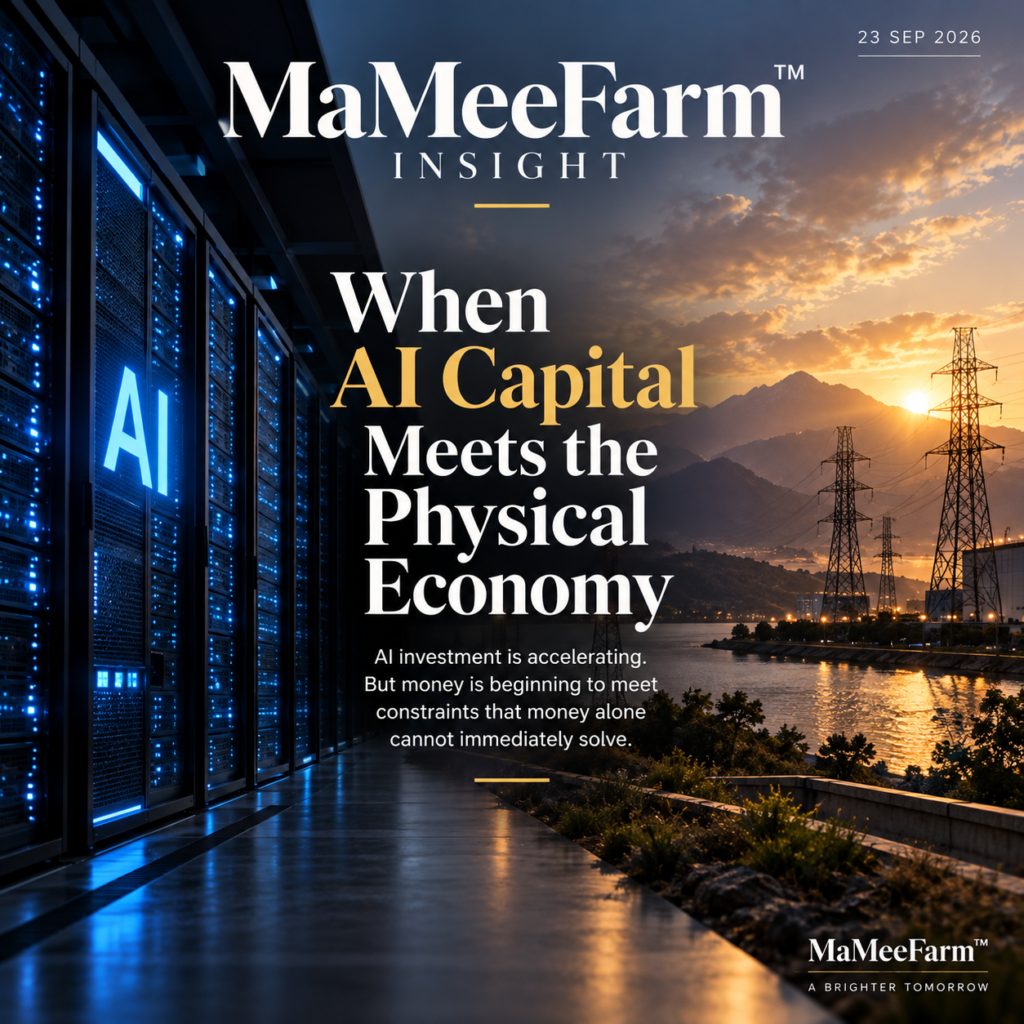
AI investment is accelerating. But capital is increasingly meeting physical constraints that capital alone cannot immediately resolve.
For much of the AI boom, the story has appeared largely digital.
Better models.
More computing power.
Faster chips.
More capable software.
But as AI expands, another part of the system is becoming harder to ignore.
AI may be digital. Its infrastructure is not.
Data centers have to be built somewhere. Computing equipment has to be manufactured and installed. Electricity has to reach the site. Cooling systems have to operate. Networks and supporting infrastructure have to connect.
All of this requires capital.
And increasingly, large amounts of it.
Capital Is Moving Into AI
The scale of financing behind AI infrastructure is becoming more visible in capital markets.
Corporate borrowing associated with AI infrastructure has expanded as technology companies, data center operators, and related businesses finance new capacity.
At the same time, investors are beginning to distinguish more carefully between different forms of AI related debt.
Recent market reporting has pointed to wider spreads on AI related corporate bonds than in the broader investment grade market. That difference does not by itself establish deteriorating credit quality. It also reflects questions about the volume of expected borrowing and the timing and visibility of returns from large infrastructure investments.
Capital is also moving toward companies that supply the physical systems surrounding AI.
Power distribution, cooling, modular infrastructure, construction capacity, and other supporting systems are becoming increasingly visible parts of the AI investment landscape.
The AI capital story is therefore extending beyond software and chips.
It is becoming an infrastructure story as well.
Then Capital Meets the Real World
Capital can move quickly.
Physical systems usually move differently.
A financial commitment can be announced in a day.
A data center cannot be built in a day.
That difference matters because AI infrastructure depends on resources and systems that operate under physical, regulatory, and local constraints.
In Europe, the European Commission is examining energy and water performance requirements for larger data centers as computing capacity continues to expand.
The Commission expects European data center capacity to rise substantially toward 2030, while the sector already represents a measurable share of electricity consumption.
These developments do not show that AI expansion is stopping.
They show that expansion increasingly interacts with electricity systems, water use, land, infrastructure, permitting, and local conditions.
That changes the economic context in which AI capacity is built.
Digital Scale Meets Physical Time
Software can sometimes reach millions of additional users without requiring a new physical facility for each additional user.
Infrastructure behaves differently.
Additional capacity can require equipment, electricity, cooling, land, construction, approvals, and time.
This creates an important difference in speed.
AI demand can accelerate rapidly.
Capital can respond rapidly.
Market valuations can change rapidly.
Physical capacity often adjusts on another timetable.
This does not necessarily create a permanent limit. Technology can improve. Infrastructure can expand. New capacity can be built.
But the transition between financial ambition and physical capacity may become increasingly important to observe.
Having sufficient capital to finance expansion does not mean that every physical resource required for expansion becomes available at the same time.
The Question Is Changing
For several years, one of the central questions surrounding AI has been:
How powerful will the technology become?
Another question is becoming increasingly relevant:
How much physical economy is required to support that technology?
Behind that sits another economic question.
If large amounts of capital are committed to building AI infrastructure, the resulting capacity will eventually need to generate economic value.
The growing attention of bond investors to borrowing volumes and future returns does not establish whether AI investment is too large or too small.
It signals something more fundamental.
The AI economy is becoming large enough for its relationship with capital markets, infrastructure, energy systems, and the broader physical economy to matter.
AI Is Entering the Physical Economy
The AI story began primarily as a technology story.
It then became a major corporate investment story.
Now its expansion is becoming increasingly visible in infrastructure and capital markets.
As digital growth becomes more dependent on large physical systems, technology is no longer the only variable shaping the pace of expansion.
Capital can finance capacity.
Technology can create demand.
Infrastructure can expand.
But these systems do not necessarily move at the same speed.
That leaves a question worth watching:
What happens when an industry capable of scaling digitally becomes increasingly dependent on resources that cannot scale at the same speed?
That may be one of the more important signals emerging from the current phase of AI expansion.
P’Toh
MaMeeFarm™ Insight Signal
AI • Capital • Infrastructure • Real Economy
Public under the MaMeeFarm™ Ecosystem
Under the DGCP™ Framework