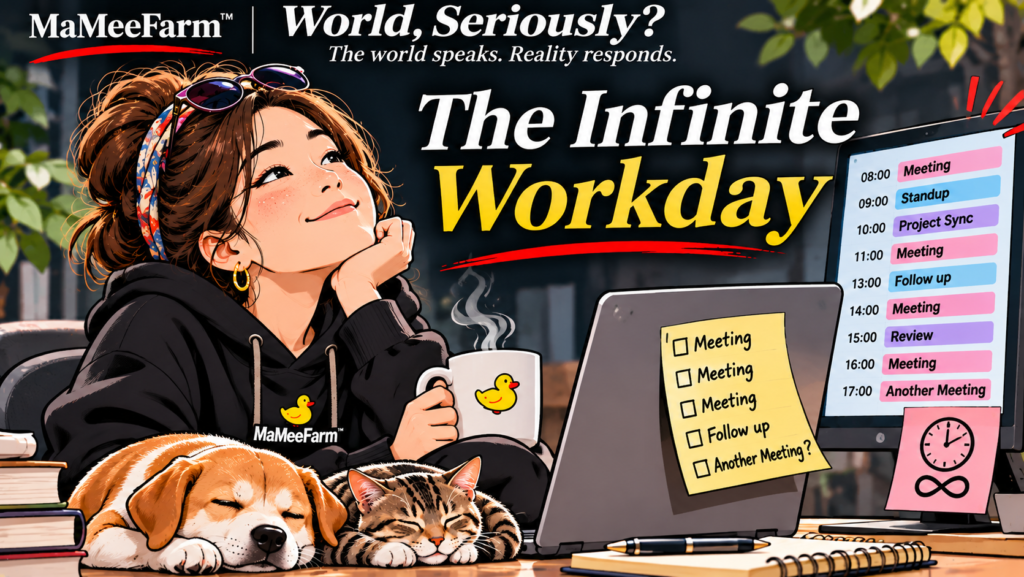
The world speaks. Reality responds.
2 November 2026
Technology was supposed to save us time.
Email replaced letters. Instant messaging made communication faster. Digital calendars made scheduling easier. Collaboration platforms brought entire teams together without requiring everyone to occupy the same room.
And now AI can help draft documents, summarize discussions and organize information.
Wonderful.
So where did all the extra time go?
Apparently, it was invited to a meeting.
Welcome to the infinite workday.
In June 2025, Microsoft published findings from its Work Trend Index examining how digital work was changing.
One finding was particularly interesting.
Among the 20% of Microsoft 365 users receiving the highest volume of meeting invitations, emails and chat messages, the average interval between those incoming signals during an eight-hour workday was approximately two minutes.
Two minutes.
Just enough time to open a document, remember what you were doing and receive another message.
The finding came from aggregated, anonymized Microsoft 365 activity data, not from a measurement of every employee worldwide.
It also measured incoming digital activity, not proof that every notification caused an actual interruption.
Nevertheless, it illustrates how crowded a connected workday can become.
The tools are working.
So are the notifications.
We improved communication. Now everyone communicates.
Modern collaboration tools solve genuine problems.
Teams can coordinate across locations, share documents, respond to urgent issues and keep projects moving.
But making communication easier does not automatically make communication more selective.
A question that once required a scheduled conversation can now become a message.
That message can become a discussion.
The discussion can become a meeting.
The meeting can generate an action list.
The action list can generate another meeting.
Excellent.
We have successfully transformed one question into an entire afternoon.
This is a fictional illustration, not a measured sequence from Microsoft’s research.
But it captures a recognizable organizational dilemma.
Communication is necessary for work.
Communication can also compete with the time required to complete that work.
The calendar is full. Productivity must be excellent.
Microsoft’s 2025 analysis also reported that, among users with the highest meeting volumes, 60% of meetings were unscheduled or ad hoc.
That figure applies to a particular high-meeting-volume group, not all meetings across every organization.
Unscheduled meetings are not necessarily wasteful.
Some resolve urgent problems. Others allow people to make decisions quickly.
The question is whether the resulting coordination helps the work move forward or repeatedly interrupts it.
A full calendar demonstrates that time has been allocated.
It does not, by itself, demonstrate that valuable work has been completed.
Unfortunately, the calendar has no built-in field labeled:
“Did this meeting actually need to happen?”
Perhaps that feature is scheduled for the next update.
A meeting will be arranged to discuss it.
Faster tools. Longer days?
The same Microsoft analysis found that meetings beginning after 8 p.m. had increased by 16% year over year in the activity it examined.
Microsoft associated much of that increase with collaboration across time zones.
That matters.
An evening meeting for one participant may be a normal daytime meeting for someone elsewhere.
Flexible work can also allow people to choose when they concentrate or catch up.
Not every late meeting represents an unhealthy workload.
Still, the findings raise a useful question.
When digital tools make it possible to coordinate across almost any distance and time zone, what determines when the workday ends?
The software can remain available.
Human attention is less unlimited.
A platform does not become tired.
The person answering its notifications might.
AI has arrived to save time. Please attend the introduction meeting.
Artificial intelligence offers another opportunity to reduce repetitive work.
It can help with drafting, summarizing, searching and organizing information.
Those capabilities may create real efficiencies.
But introducing a faster tool does not automatically remove unnecessary processes.
An organization could use AI to summarize a meeting that did not need to happen.
It could generate an action list for a project already burdened with action lists.
It could prepare a beautifully structured update about why everyone is behind schedule.
The output might be excellent.
The underlying coordination problem could remain.
This is not evidence that AI causes longer workdays or more meetings.
Microsoft’s figures do not establish that causal relationship.
The contradiction is simpler.
Making individual tasks faster does not guarantee that the entire work system becomes less demanding.
Sometimes the question is not how quickly a document can be written.
It is why seventeen people need to approve it.
Perhaps efficiency needs a different measurement.
Organizations often measure activity because activity is visible.
Messages can be counted.
Meetings can be scheduled.
Documents can be generated.
Tasks can be assigned.
But the amount of digital activity is not the same thing as the value of completed work.
A team might exchange hundreds of messages to resolve a difficult issue.
Another team might resolve a similar issue with one clear decision.
Without context, the number of messages cannot tell us which team worked better.
The same applies to meetings, documents and AI-generated outputs.
Technology can reduce the effort required for individual activities.
Whether that improvement creates more time for meaningful work depends partly on how the organization uses it.
The tools can make things faster.
They cannot decide that every request deserves everyone’s immediate attention.
At least, not without another policy meeting.
One last conversation
Manager: We need to improve productivity.
Employee: Excellent. Could we have more uninterrupted time?
Manager: Of course. Let’s discuss it.
Employee: When?
Manager: I’ve scheduled a meeting.
Employee: My calendar is full.
Manager: Then we’ll create a working group.
Employee: To do what?
Manager: Find ways to reduce unnecessary meetings.
Employee: How will the group coordinate?
Manager: Weekly meetings.
Employee: …
AI Assistant: I can summarize them.
Reality: Technology promised to save us time. Apparently, our calendars didn’t get the memo. ☕😂
World, Seriously?
The world speaks. Reality responds.
Research reference
Microsoft. (2025, June 17). Breaking down the infinite workday. Microsoft WorkLab, Work Trend Index.
https://www.microsoft.com/en-us/worklab/work-trend-index/breaking-down-infinite-workday
Editorial evidence note
The organizational scenarios and closing dialogue are fictional satire, not documented events.
The Microsoft 365 activity figures reflect defined user groups and measurement periods, not the global workforce as a whole. The underlying analysis used aggregated, anonymized Microsoft 365 activity data through 15 February 2025 and excluded education and European Union tenants.
The two-minute interval describes the average frequency of incoming digital signals for the highest-volume 20% of users. It does not establish that each signal caused an actual interruption.
The 60% ad hoc meeting figure refers to users with particularly high meeting volumes, rather than all Microsoft 365 users. The reported 16% year-over-year increase in meetings beginning after 8 p.m. is an observed activity pattern, not proof of longer working hours for every employee.
These findings do not establish that AI caused increased meetings, interruptions or longer working hours.
License: DGCP | MMFARM-POL-2025