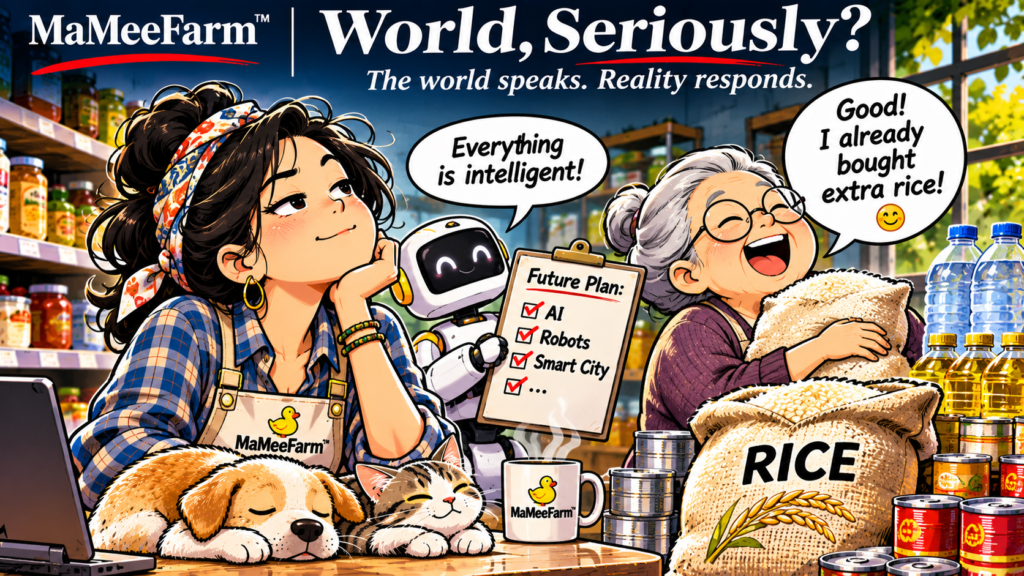
The world speaks. Reality responds.
1 November 2026
The future looks incredible.
Artificial intelligence could manage increasingly complex operations. Robots can deliver packages. Smart cities promise to optimize infrastructure. Algorithms can help predict what people need before they even ask.
Human civilization is developing extraordinarily sophisticated tools.
Meanwhile, someone is buying another bag of rice.
Just in case.
Welcome to the future. Please bring canned food.
The world is investing in smarter systems.
Automated warehouses. Digital payments. Intelligent logistics. Real-time inventory management.
These systems are designed to make operations faster, leaner and more efficient.
And yet, when people worry about disruptions, some begin thinking about remarkably old-fashioned things.
Rice. Drinking water. Canned food. Batteries.
Not because everyone expects civilization to collapse.
Sometimes people simply want enough supplies to get through a few difficult days.
Apparently, a technologically advanced civilization still appreciates a well-stocked cupboard.
The supermarket is not a food factory
Modern supermarkets are impressive.
Thousands of products. Bright lights. Digital checkout systems. Shelves that seem to refill themselves.
But supermarkets do not manufacture food simply because customers expect it to be there.
Food must be grown, processed, transported, stored and delivered.
Each stage depends on people, equipment, energy, infrastructure and functioning commercial relationships.
A temporary disruption somewhere along that chain can affect availability elsewhere.
That does not mean every disruption creates a shortage.
It means a supermarket shelf is the visible end of a much longer system.
And the shelf does not care how advanced your smartphone is.
Everybody wants a backup plan
Consider three hypothetical households.
The first keeps a modest emergency food supply.
The second buys additional groceries because it expects prices to rise.
The third purchases far more than it needs because it fears that other people will empty the shelves.
These actions may look similar at the checkout.
But their motivations and consequences are different.
Emergency preparedness can help households manage temporary disruptions.
Excessive panic buying, particularly when many people do it simultaneously, can place additional pressure on available stock.
The difference matters.
Keeping a reasonable reserve is not the same as trying to acquire the entire supermarket.
Although the shopping trolley may disagree.
The wealthy have bunkers. Everyone else has cupboards.
Imagine two very different emergency arrangements.
One household has access to a sophisticated private shelter.
Another has a shelf in the kitchen.
The underlying question is surprisingly similar.
What happens when the systems we depend on stop working as expected?
Greater financial resources can provide additional storage, equipment and options.
But even an expensive bunker requires supplies, maintenance, energy and decisions about how long those resources will last.
A cupboard has fewer features.
It also has fewer maintenance contracts.
Neither arrangement makes a person independent of the wider world forever.
Food reserves are temporary buffers, not replacements for functioning food systems.
The future still needs farmers
There is something almost poetic about the situation.
A society can develop extraordinary computational capabilities while remaining dependent on soil, water, weather, seeds and agricultural labor.
AI can help forecast demand, improve logistics and support agricultural decisions.
But a prediction about tomorrow’s harvest is not tomorrow’s harvest.
A digital inventory record is not a bag of rice.
And a beautiful dashboard cannot feed anyone if the food is not actually available.
Technology can help manage physical reality.
It cannot make physical reality optional.
One last conversation
Technology: Welcome to the future! Everything is intelligent!
Human: Wonderful. Is the food supply secure?
Technology: We have predictive algorithms!
Human: Excellent. Do we have rice?
Technology: We can predict rice demand!
Human: Do. We. Have. Rice?
Technology: …
Grandmother: I bought two bags yesterday.
Human: Thank you, Grandma.
Technology: Would you like an AI-powered inventory dashboard?
Grandmother: Can it cook?
Technology: …
Grandmother: Then move. You’re blocking the kitchen. 🍚😂
World, Seriously?
The world speaks. Reality responds.
References and evidence
This article is editorial satire grounded in documented principles of emergency preparedness and supply chain management. The three households, bunker comparison and fictional dialogue are illustrative, not documented events.
- Ready.gov, U.S. Department of Homeland Security. Build a Kit. Guidance on maintaining emergency supplies, including non-perishable food, drinking water, batteries and other essentials for temporary disruptions. https://www.ready.gov/kit
- Ready.gov. Food. Guidance on emergency food supplies, storage and preparation during disruptions to normal services. https://www.ready.gov/food
- Product Availability and Stockpiling in Times of Pandemic: Causes of Supply Chain Disruptions and Preventive Measures in Retailing (2022). A research study using supply chain modeling to examine how consumer stockpiling, demand variability and supply uncertainty can affect retail operations. https://pmc.ncbi.nlm.nih.gov/articles/PMC9709757/
The article does not predict a global food shortage or recommend excessive stockpiling. Emergency preparedness and panic buying are treated as distinct behaviors.
License: DGCP | MMFARM-POL-2025