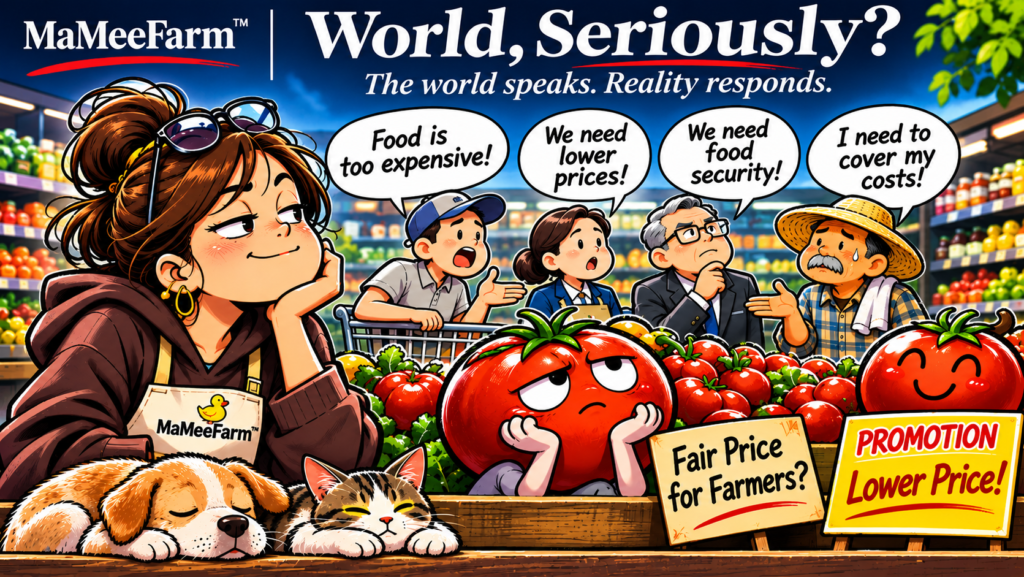
The world speaks. Reality responds.
1 November 2026
Everyone loves affordable food.
Consumers want lower prices. Supermarkets advertise discounts. Governments worry about food inflation.
And somewhere at the beginning of the supply chain, a farmer is expected to make the whole arrangement work.
Preferably without increasing prices.
How convenient.
The cheapest tomato in the room
Imagine two tomatoes sitting on a supermarket shelf.
One costs less than the other.
The customer sees the price tags.
The farmer sees something else.
Seeds. Water. Fertilizer. Labor. Transport. Weather. Equipment. Time.
None of these expenses disappear simply because the supermarket announces a discount.
Yet the conversation about affordable food often begins at the checkout counter.
Not at the farm.
Apparently, tomatoes are supposed to understand economics.
Especially when everyone else is trying to save money.
Everybody supports farmers
Ask people whether farmers deserve a fair income.
Most would probably agree.
Ask whether food should become more expensive.
The conversation may become slightly less enthusiastic.
Consumers face household budgets. Retailers face competition. Food processors face operating costs. Governments face public pressure.
Farmers face all of those pressures, plus the uncertainty of producing something that depends on weather, biology and time.
Every participant has a reasonable concern.
The interesting part is what happens when those concerns meet.
Everyone wants farmers to survive.
Nobody is particularly excited about receiving the bill.
The supermarket has a promotion
A supermarket announces a major discount.
Customers celebrate.
The advertising looks wonderful.
But a lower retail price does not tell us who absorbed the reduction.
Perhaps the retailer accepted a smaller margin.
Perhaps the supplier offered a temporary discount.
Perhaps the product was purchased under an earlier contract.
Perhaps several participants shared the cost.
Without examining the commercial arrangements, the price tag cannot answer the question.
A discount is visible.
Its distribution is not.
And somewhere, a tomato remains silent.
Efficiency will solve everything
There is another familiar suggestion.
Farmers should become more efficient.
Use better equipment. Improve yields. Reduce waste. Adopt technology. Manage resources more carefully.
These improvements can be valuable.
But efficiency does not guarantee that the producer will capture the resulting financial benefits.
If production costs fall while purchasing prices also fall, some benefits may move further along the supply chain.
That does not mean efficiency is pointless.
It means the economic outcome depends on more than production performance.
A farmer can grow more food without necessarily earning more money.
Which is an impressive achievement.
Just not necessarily the one the farmer was hoping for.
Food security sounds excellent
Food security is a serious public concern.
Countries want reliable supplies. Households need affordable meals. Supply chains need resilience.
Agricultural producers are essential to that system.
But producing food and maintaining a financially viable farming business are not identical objectives.
A system can deliver affordable food for consumers while placing financial pressure on some producers.
It can also protect producer incomes through arrangements that increase costs elsewhere.
Neither outcome can be understood from a single price.
The real question is how costs, risks and returns are distributed.
Unfortunately, that question does not fit neatly on a supermarket discount sticker.
One last conversation
Consumer: Food is too expensive!
Supermarket: We need lower prices!
Government: We need food security!
Farmer: I need to cover my costs.
Everyone: Of course! We support farmers!
Farmer: Wonderful. What price will you pay?
Everyone: …
Tomato: 🍅
World, Seriously?
The world speaks. Reality responds.
References and evidence
The tomato comparison and supermarket promotion are illustrative examples, not documented transactions. The article does not assume that retailers, suppliers or farmers always absorb the cost of retail discounts.
- Food and Agriculture Organization of the United Nations (FAO). Prices. Provides information on agricultural prices at different stages of the food supply chain, including producer and consumer prices. https://www.fao.org/prices/en
- Organisation for Economic Co-operation and Development (OECD, 2025). Agricultural Policy Monitoring and Evaluation 2025. Examines agricultural producer support, policy measures, productivity and food security, including the implications for producers and consumers. https://www.oecd.org/en/publications/agricultural-policy-monitoring-and-evaluation-2025_a80ac398-en.html
License: DGCP | MMFARM-POL-2025